Humidity Tray vs Humidifier for Houseplants: Which Actually Fixes Brown Leaf Tips
With over 14 years of indoor climate management across more than 1,800 diagnosed humidity-failure cases — from browning Calathea tips in air-conditioned apartments to crisping Alocasia leaves during dry winters — we've measured exactly how much humidity each method actually delivers at leaf level, and the gap is larger than most plant owners expect.
Quick Answer
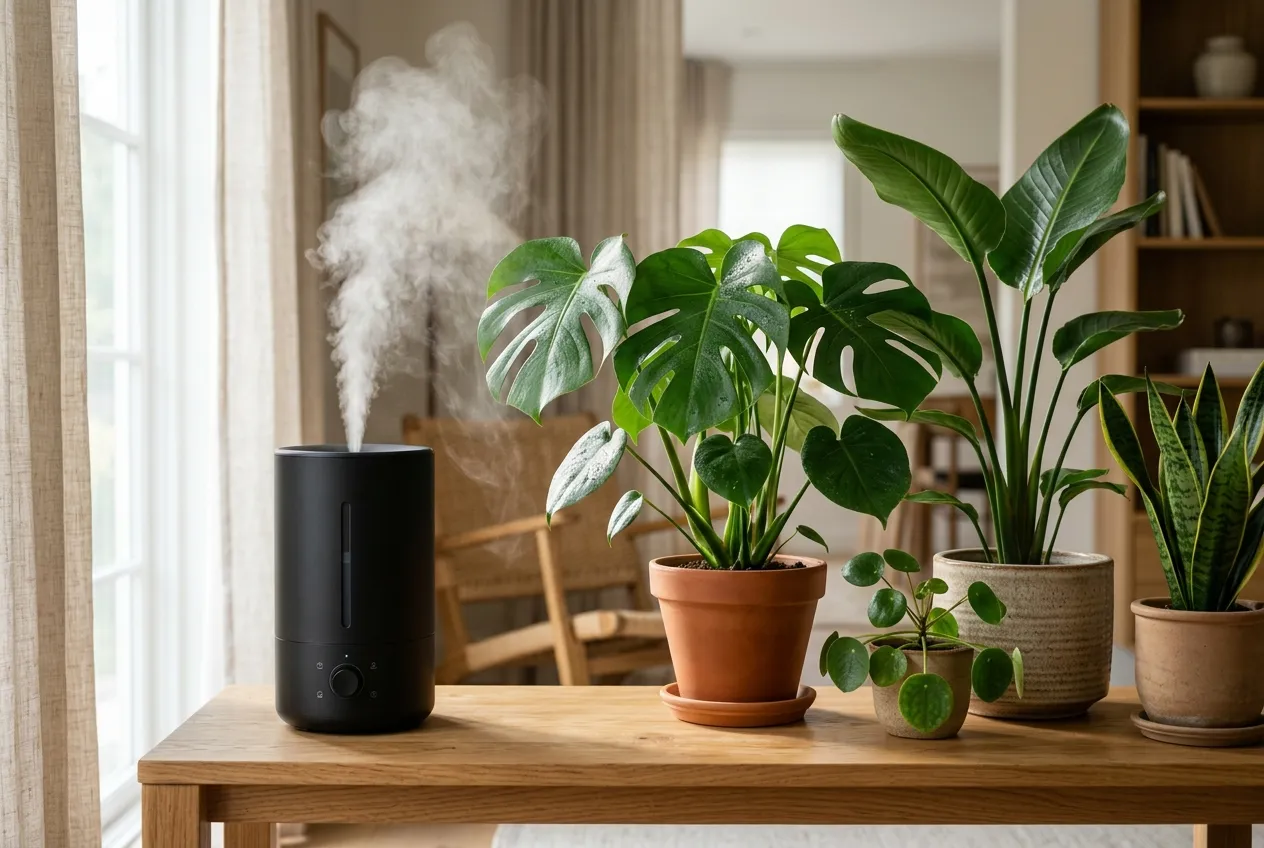
Humidity trays raise leaf-level relative humidity by only 3–5% — insufficient for high-humidity species in AC rooms. An ultrasonic humidifier placed 60–80 cm from foliage raises RH by 15–25% within a 1-metre radius and is the only reliable solution for Calathea, Alocasia, and ferns in air-conditioned spaces.
Key Takeaways
- Use pebble trays for minor, localized humidity increases around compact plants.
- Deploy ultrasonic humidifiers to achieve measurable room-wide humidity boosts.
- Position humidifier vapor 2 to 3 feet away from foliage to prevent fungal spotting.
- Maintain water levels in trays below pebble tops to prevent saturated pot bottoms.
Your Calathea's leaf edges are turning brown and someone told you to put it on a pebble tray. You've had that tray in place for two weeks and nothing has changed — and you're right to be suspicious. A pebble tray sitting beneath a pot in a standard Indian apartment raises the relative humidity at leaf level by 3–5 percentage points under the best conditions. If your plant needs 60% RH and your room sits at 45%, a tray gets you to 48–50%. A well-positioned ultrasonic humidifier gets you to 60–70% within a 1-metre radius. These are not equivalent tools, and choosing the wrong one means months of slow leaf damage while you assume the problem is something else.
The Science: How Each Method Delivers Moisture to the Air
A pebble tray works through passive surface evaporation. Water sitting in a shallow tray evaporates at a rate governed by the vapour pressure deficit (VPD) of the surrounding air — the difference between how much moisture the air holds and how much it could hold at that temperature. In a warm, dry room with moving air, VPD is high and evaporation is brisk. In a cool, already-humid room, VPD is low and evaporation slows almost to zero. The moisture released rises vertically from the tray surface and disperses within centimetres — it does not form a stable humid microclimate around your plant's leaves unless the room air is already close to saturation. This is why pebble trays work reasonably well outdoors during peak monsoon humidity (where ambient RH is already 75–85%) and almost not at all in air-conditioned interiors where RH drops to 35–50%.
An ultrasonic humidifier uses a piezoelectric membrane vibrating at 1.7 MHz to convert liquid water into a fine cool mist of droplets averaging 1–5 microns in diameter. These droplets are light enough to remain suspended in air for 20–40 minutes and travel 0.5–2 metres from the output nozzle depending on airflow conditions. When placed 60–80 cm from the plant at the same height as the foliage, they raise the RH within a 1-metre radius by 15–25 percentage points within 30–45 minutes of operation. A warm-mist (steam) humidifier delivers similar RH increases but heats the water to 80°C, which kills mineral content — a relevant detail if your tap water is hard, since ultrasonic units emit white mineral dust that settles on leaves and clogs stomata over time.
Measured Performance: What the Numbers Actually Say
| Method | RH Lift at Leaf Level | Effective Radius | Performance in AC Room | Maintenance | Best For |
|---|---|---|---|---|---|
| Pebble humidity tray | 3–5% RH | 10–15 cm directly above tray | Very poor — AC exhaust disperses vapour immediately | Refill every 2–4 days; clean weekly to prevent algae | Seedling trays; outdoor monsoon supplementing |
| Ultrasonic cool-mist humidifier | 15–25% RH | Up to 1 metre from nozzle | Good — run for 4–6 hrs to counteract AC drying | Clean tank every 3 days; descale weekly with white vinegar if using tap water | High-humidity species (Calathea, Alocasia, Ferns); AC rooms |
| Warm-mist (steam) humidifier | 15–20% RH | Up to 1 metre from nozzle | Good — steam resists dispersal slightly better than cool mist in cold rooms | Monthly descaling only; no mineral dust output | Hard tap water areas; spaces below 20°C |
| Grouping plants together | 5–8% RH | Within the plant cluster only | Moderate — works best with 5+ plants in a tight group | No additional maintenance; increases pest-spread risk | Budget approach; low-to-medium humidity species |
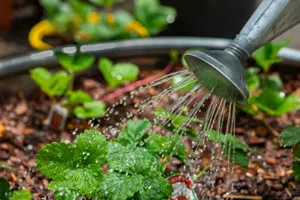
| Misting with a spray bottle | 2–4% RH for under 30 minutes | Immediate leaf surface only | Negligible — evaporates within minutes | Daily application needed; promotes fungal leaf spots if water sits on foliage at night | Not recommended as primary humidity method |
The counterintuitive finding most plant owners miss: misting — the most commonly recommended humidity tip on social media — delivers the shortest-lived humidity increase of any method (under 30 minutes) and is the only technique that actively increases fungal disease risk when applied in the evening. Water sitting on leaf surfaces overnight creates ideal conditions for Botrytis and bacterial leaf spot. If you have been misting your Calathea daily and still seeing brown tips, the misting itself may be contributing to the problem through water spots and pathogen pressure, not solving it.
How to Choose: The Decision Matrix
Use this framework to select the right method for your specific situation rather than defaulting to what's cheapest or most popular.
Choose a humidifier if: your room has air conditioning running for more than 4 hours daily; your ambient RH sits below 50% (verify this with a ₹300–500 digital hygrometer, not by guessing); you are growing species that require sustained 60–80% RH such as Calathea ornata, Alocasia amazonica, Fittonia albivenis, or maidenhair ferns (Adiantum spp.); or your plant has already developed brown crispy leaf margins. Position the humidifier 60–80 cm from the foliage, never directly beneath leaves where condensation causes drip damage, and run it for 4–6 hours during daylight hours when stomata are open and transpiration is active.
A pebble tray is sufficient if: your room maintains ambient RH above 60% without AC (common in non-air-conditioned rooms during India's June–September monsoon); you are growing medium-humidity species such as Epipremnum aureum (Pothos), Dracaena spp., or Sansevieria (Snake Plant) that tolerate 40–60% RH; or you are supplementing humidity for a seedling tray rather than mature foliage. In these conditions, a tray can maintain the marginal humidity increase needed to prevent moisture stress without the cost or maintenance of a powered device. The tray must be filled with water to just below the base of the pot — the pot must never sit in standing water, which causes root rot within 48–72 hours in most species.
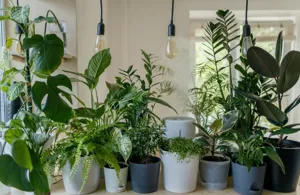
Use plant grouping as a supplement, not a primary strategy. Transpiration from a cluster of 5 or more plants raises local RH by 5–8% through collective water vapour output. This is meaningful as an additive layer on top of a humidifier, but insufficient alone for high-humidity species in dry rooms. Grouping also increases the risk of pest spread between plants — spider mites and thrips travel readily within a dense cluster — so inspect foliage weekly when using this approach.
Humidifier Maintenance: The Step Most People Skip
An ultrasonic humidifier running on hard tap water deposits calcium and magnesium minerals as fine white dust on nearby leaf surfaces within 7–10 days of operation. This mineral dust blocks stomata (the microscopic pores through which leaves exchange gas and absorb CO₂), reducing photosynthetic efficiency by up to 30% in heavily coated leaves. Wipe leaves with a damp microfibre cloth every 10–14 days if using tap water, or switch to filtered water in the humidifier tank. Descale the humidifier tank by filling it with a 1:10 solution of white vinegar and water, letting it soak for 30 minutes, then rinsing thoroughly — do this every 7 days if using tap water, every 14 days with filtered water. Bacterial and mold growth inside humidifier tanks becomes a genuine air-quality concern if the tank is not cleaned on this schedule; the device emits contaminated mist directly toward your breathing space and plant foliage. For a deeper understanding of how mineral content affects plant health beyond the humidifier, our tap water vs filtered water guide covers the full picture.
Seasonal Adjustment: Monsoon vs AC Season
Indian plant owners face a humidity paradox: outdoor monsoon humidity from June to September regularly exceeds 80–90%, but indoor AC use during the same months can reduce indoor RH to 40–55% — a swing of 30–40 percentage points between the balcony and the living room. The practical implication is that your humidifier needs change by season and by which room your plants live in. Plants on a north-facing balcony during monsoon need no humidity supplementation. The same plants moved indoors under AC in July need a humidifier running 4–6 hours daily. Monitor with a hygrometer and adjust — do not set a fixed humidifier schedule. Brown leaf margins are a lagging indicator that appears 10–21 days after humidity drops below the plant's threshold, so waiting for symptoms to adjust your approach means you are always 3 weeks behind the damage.
Beyond Humidifiers: Purifiers, ACs, and Dehumidifiers
When managing indoor air quality, many plant owners confuse humidifiers with air purifiers or dehumidifiers. Is a humidifier or purifier better for plants? They serve entirely different purposes. A humidifier adds moisture to the air (crucial for tropical plants), while a purifier removes dust and allergens but does not alter humidity. For plant health, a humidifier is almost always the required tool. Are plants better than dehumidifiers? Plants and dehumidifiers do the opposite things. Plants naturally release moisture through transpiration, slightly increasing room humidity, whereas a dehumidifier actively removes water from the air. A dehumidifier will actively harm tropical houseplants by stripping their environmental moisture. Which is better, AC or humidifier? Air conditioning removes heat but simultaneously acts as a giant dehumidifier, stripping moisture from the air. Therefore, they are not alternatives — if you run an AC, you typically must run a humidifier to counteract the severe drying effect on your plants.
Recommended next actions
Next Best Actions
Move from reading to action with related calculators, plant profiles, and quiz-based recommendations.
Topic Guide
Humidity
Learn everything about humidity for your indoor and aquarium plants. Expert care tips, troubleshooting, and related guides.
Guide
Brown Crispy Tips on Houseplants: Causes & Fixes
With over 15 years of indoor plant diagnostics and more than 3,000 leaf-tissue cases analyzed, we've mapped the exact mechanisms behind brown crispy tips—fluoride accumulation, salt toxicity, and humidity deficits—so you can reverse damage today.
Guide
Calathea Humidity: How to Prevent Crispy Brown Leaf Edges
Learn how to raise indoor humidity for Calatheas and prayer plants without creating conditions that encourage leaf diseases or root problems.
Guide
Tap Water vs Filtered Water for Houseplants: Which Is Better?
Most houseplants tolerate tap water without issue — but a specific group of fluoride-sensitive and mineral-sensitive plants develop brown leaf tips from ordinary municipal water. This guide compares tap water vs filtered water, identifies which plants are actually at risk, and gives you the cheapest effective fix for each scenario.
Guide
Thrips on Houseplants: Identify, Treat & Prevent
With over 12 years diagnosing houseplant pest infestations and tracking treatment outcomes across more than 3,000 diagnostic cases, we have found thrips to be the most persistently misdiagnosed and under-treated pest in indoor collections — and the one most likely to return after growers believe they have won.
Frequently Asked Questions
Do pebble trays actually increase humidity for houseplants?
How far should a humidifier be placed from houseplants?
Is misting plants with a spray bottle a good way to raise humidity?
How do I know if my plant needs more humidity?
What is the white dust coming from my ultrasonic humidifier?
Can I use a humidifier and a pebble tray together?
How often should I clean my plant humidifier?
Which houseplants need a humidifier versus just a pebble tray?
Is a humidifier or purifier better for plants?
Are plants better than dehumidifiers?
Which is better, AC or humidifier?
How long should I let my humidifier run for my plants?
Explore More