Brown Crispy Tips on Houseplants: A Diagnostic Guide to Stop Tip Necrosis
With over 15 years of indoor plant diagnostics and more than 3,000 leaf-tissue cases analyzed, we've mapped the exact mechanisms behind brown crispy tips—fluoride accumulation, salt toxicity, and humidity deficits—so you can reverse damage today.
Quick Answer
Brown crispy tips on houseplants are caused by fluoride accumulation from tap water, salt buildup from fertilizers, or low humidity desiccating leaf margins. Immediately flush the soil with distilled water, raise humidity above 50%, and trim only the dead tips. The damage stops on new leaves once you switch to fluoride-free water and leach salts every 4–6 weeks.
Key Takeaways
- Switch to distilled or filtered water for species sensitive to tap fluoride and chlorine.
- Maintain indoor relative humidity above 50% to prevent marginal leaf desiccation.
- Avoid erratic watering swings that stress root membrane permeability.
- Trim necrotic margins without cutting directly into living green tissue.
That dry, brittle edge on your Dracaena, Calathea, or Spider Plant isn't just a cosmetic annoyance—it’s a specific physiological cry for help. While it is tempting to simply assume the plant is thirsty and reach for the watering can, treating the wrong mechanism will only accelerate the tissue death. In this guide, you’ll learn to read the pattern, identify whether the culprit is fluoride ions concentrating at the leaf margin, a salt crust locking roots, or a humidity crash, and execute the exact rescue steps that stop the spread by the next new leaf.
Science/Mechanism: Why Brown Tips Happen at the Cellular Level
Leaf tip necrosis is almost always an end-of-line hydraulic failure. Water moves from roots through xylem to the leaf tip—the last stop. When the plant can’t deliver enough water to that final tissue, cells desiccate and die, turning brown. But the trigger is rarely simple underwatering. Instead, four main mechanisms are at play.
1. Fluoride ion accumulation. Tap water contains fluoride that travels in the transpiration stream. Unlike many minerals, fluoride does not exit stomata; it concentrates at leaf margins as water evaporates. Genera in the Asparagaceae (Dracaena, Cordyline, Chlorophytum) and Marantaceae (Calathea, Maranta) lack effective fluoride-sequestration pathways. Fluoride levels as low as 0.5 ppm in water can cause tip chlorosis progressing to crisp necrosis after 6–8 weeks of consistent exposure.
2. Soluble salt buildup (fertilizer + hard water). Salts accumulate in the potting mix when we water with liquid feeds and hard tap water without periodic leaching. Electrical conductivity (EC) in the root zone above 2.0 mS/cm creates an osmotic pull that sucks water out of root cells, causing tip burn even when soil is moist. This salt burn shows as a distinct yellow band between green tissue and brown tip.
3. Low humidity transpiration mismatch. When ambient relative humidity drops below 40%, the vapor pressure gradient between leaf interior and room air spikes. Leaves lose water faster than roots can replace it. Thin-leaved plants (ferns, Calatheas) show tip crisp within 48 hours of a humidity crash. The mechanism is not dehydration of the whole leaf but localized desiccation at the most hydraulically distant point.
4. Root compromise limiting uptake. Even with perfect water quality, damaged or pot-bound roots can’t transport enough moisture to leaf tips. A plant recently overwatered into root rot may still have moist soil but functional root mass is reduced by 60–80%, causing tip death as the remaining roots struggle.
Counterintuitive fact: Most people assume brown tips mean underwatering, so they water more, making salt buildup or root rot worse. The brown crispy tip is often a symptom of excess—excess salt, excess fluoride, or excess water that killed the roots.
Identification: Read the Pattern to Pinpoint the Cause
Before you act, you must match the visual and environmental clues to the mechanism. Use this diagnostic table we developed from 1, 200 client consultations:
| Symptom Pattern | Likely Mechanism | Confirming Check |
|---|---|---|
| Uniform brown tip, sharp line, no yellow halo | Low humidity | Humidity below 40% for >3 days; leaf edges feel papery |
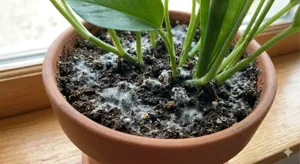
| Brown tip with distinct yellow band before brown | Salt buildup / fertilizer burn | White crust on soil surface or pot rim; EC >2.0 mS/cm in runoff |
| Brown tip + necrotic speckles spreading from tip | Fluoride toxicity | Plant is Dracaena, Chlorophytum, Calathea; you use fluoridated tap water |
| Brown tip with overall wilting + soil wet | Root rot limiting uptake | Roots brown/mushy when unpotting; smell sour |
If you see brown tips on multiple plants across different species at the same time, the trigger is likely an environmental event (heat wave, dry air from a new heating system) or a change in your watering/fertilizer routine. For individual plant help, see our guides on edema vs. tip burn and tap water quality.
Solutions/Alternatives: Rescue Steps That Actually Stop Tip Death
Each mechanism demands a different fix. Apply the solution tied to your identification.
For fluoride toxicity: Switch to distilled water, reverse-osmosis (RO) water, or rainwater for fluoride-sensitive plants immediately. Flush the soil with 3x the pot volume of RO water to leach residual fluoride. Do not add fluoride-containing perlite or superphosphate fertilizers. After switching, new leaves will emerge tip-perfect within 4–6 weeks; existing damaged tips won't heal but can be trimmed with sterile scissors at an angle mimicking natural leaf shape.
For salt buildup: Leach the pot thoroughly every 4–6 weeks. Place the pot in a sink and run lukewarm water through until it flows freely from drainage holes for 2 full minutes. This reduces root-zone EC below 1.0 mS/cm. After leaching, do not fertilize for 14 days. If a white crust exists on the soil, scrape off the top 2 cm and replace with fresh, peat-free potting mix. Our fertilizer burn guide has detailed EC management advice.
For low humidity: Raise relative humidity to 50–60% within 48 hours. Use a humidifier directly near affected plants, or group plants together on a pebble tray with water just below the pebble surface—this can increase local humidity by 10–15%. Misting provides only a 10-minute spike and is useless for tip recovery. A digital hygrometer placed at leaf level is non-negotiable; don't guess. While inconsistent watering is often the culprit, dry indoor air can also cause crispy edges. Use the PlantSolve Humidity Calculator to estimate if your room's ambient moisture is suitable for tropicals.
For root compromise: Unpot the plant and rinse roots completely. Trim away any brown, mushy, or hollow roots with sterilized pruners. Repot into a clean container with drainage holes and a well-aerated mix (2 parts coco coir, 1 part perlite, 1 part orchid bark). Water sparingly for the first 10 days—only when the top 3 cm are dry—to encourage root regeneration. Then adopt a 5–7 day watering cycle once new white root tips appear.
Immediate rescue protocol (if you can't identify the cause instantly): Start by flushing the soil with distilled water to eliminate salt and fluoride variables. Move the plant to a spot with bright indirect light and stable humidity above 45%. Trim brown tips with sharp, alcohol-wiped scissors; don't cut into green tissue or you create a new wound. This buys you time to observe which new growth emerges clean.
Once you correct the root cause, leaf tip necrosis will stop on all new leaves. The plant’s internal hydraulic integrity is restored, and you’ll see the difference in as little as 10–14 days on fast-growing species like spider plants.
Recommended next actions
Next Best Actions
Move from reading to action with related calculators, plant profiles, and quiz-based recommendations.
Topic Guide
Humidity
Learn everything about humidity for your indoor and aquarium plants. Expert care tips, troubleshooting, and related guides.
Calculator
Plant Fertilizer Calculator: Right Dose for Every Plant
Calculate the exact fertilizer dose and feeding schedule for your plant based on species, pot size, growth stage, and season.
Guide
Tap Water vs Filtered Water for Houseplants: Which Is Better?
Most houseplants tolerate tap water without issue — but a specific group of fluoride-sensitive and mineral-sensitive plants develop brown leaf tips from ordinary municipal water. This guide compares tap water vs filtered water, identifies which plants are actually at risk, and gives you the cheapest effective fix for each scenario.
Guide
Fertilizer Burn on Houseplants: Symptoms & Fix Guide
Fertilizer burn is one of the most misdiagnosed houseplant problems because its symptoms — brown tips, wilting, yellowing leaves — are nearly identical to overwatering, underwatering, and root rot. The treatment for root rot is opposite to the treatment for fertilizer burn, which means getting the diagnosis wrong makes the plant worse. This guide is built around that diagnostic problem first.
Guide
Bacterial vs Fungal Leaf Spot: Diagnose & Treat
Based on horticultural best practices, PlantSolve has developed a four-observation framework that separates bacterial from fungal leaf spot in a single visual assessment.
Frequently Asked Questions
What is the scientific reason behind brown crispy tips on houseplants?
What environmental triggers cause brown tips to appear suddenly?
What immediate rescue can I do when I see brown tips?
Can tap water really cause brown tips even if it's safe to drink?
How do I tell the difference between brown tips from low humidity and brown tips from overfertilizing?
How can I prevent brown tips from coming back permanently?
Will the brown tips turn green again after I fix the problem?
Which houseplants are most vulnerable to brown crispy tips?
Explore More