Monstera Deliciosa Care Guide: How to Grow the Swiss Cheese Plant Indoors
After growing and troubleshooting Monstera deliciosa plants across nine years and multiple home environments, we've mapped out exactly what this iconic climbing aroid needs to produce large, dramatically split leaves indoors.
Quick Answer
Monstera Deliciosa Care Guide: Growing the Swiss Cheese Plant Indoors: Monstera deliciosa thrives in bright indirect light, a chunky free-draining aroid mix, and water applied only when the top 3–5 cm of soil has dried out. Provide a moss pole to encourage climbing and dramatically increase fenestration on mature leaves. Keep humidity between 40–70% and feed fortnightly in spring and summer with a balanced liquid fertilizer at half strength.
Key Takeaways
- Provide bright, indirect sunlight to encourage large fenestrated leaves.
- Water when the top 2 to 3 inches of aerated aroid substrate feel dry.
- Install a sturdy moss pole or cedar trellis to support natural climbing habits.
- Repot every 1 to 2 years as roots expand and fill the container.
Why Monstera Deliciosa Remains the World's Most Popular Houseplant
There are very few plants that genuinely look like they belong in an interior design magazine, but Monstera deliciosa earns that reputation every single time. Over nine years of growing and troubleshooting these plants — across apartments with poor winter light, homes with dry central heating, and everything in between — we've learned something that most care guides skip: the quality of your Monstera's leaves is a direct report card on the conditions you're providing. Small, unperforated leaves mean the plant is struggling. Large, deeply fenestrated leaves mean you've got the fundamentals right.
Monstera deliciosa is native to the tropical rainforests of southern Mexico and Central America, where it grows as a hemi-epiphytic climber, anchoring itself to trees and working its way upward toward bright filtered canopy light. Understanding that it is a climber — not a tabletop ornament — changes every care decision you make, from how you water to whether you stake it to which corner of the room you place it in.
Popular Monstera Varieties Worth Knowing
Monstera Deliciosa
The original and most widely grown variety. It produces iconic fenestrated leaves that can reach 60–90 cm (2–3 feet) across under ideal indoor conditions. This is the variety most people picture when they hear "Monstera" and the best starting point for any grower.
Monstera Deliciosa 'Thai Constellation'
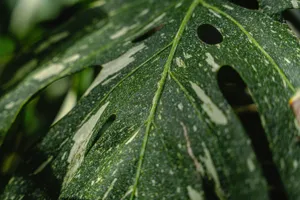
A cultivar prized for its creamy white and pale yellow variegation splashed across deep green leaves. It grows significantly slower than the standard species and commands higher prices. Because the white portions of the leaf contain no chlorophyll, it needs slightly more light to sustain the same growth rate.
Monstera Deliciosa 'Albo Variegata'
Perhaps the most sought-after cultivar, featuring bold white sectors on its leaves. Its variegation is unstable, meaning individual leaves can revert to all-green or go almost entirely white. It requires very bright indirect light and careful watering to avoid rot in the paler sections.
Monstera Adansonii
Often sold as the "Mini Monstera" or "Swiss Cheese Vine," this is a different species but a close relative. It has smaller, more delicate leaves with larger oval perforations. It tolerates humidity fluctuations better than deliciosa and grows faster in standard indoor conditions.
The Fenestration Question: Why Won't My Monstera Split?
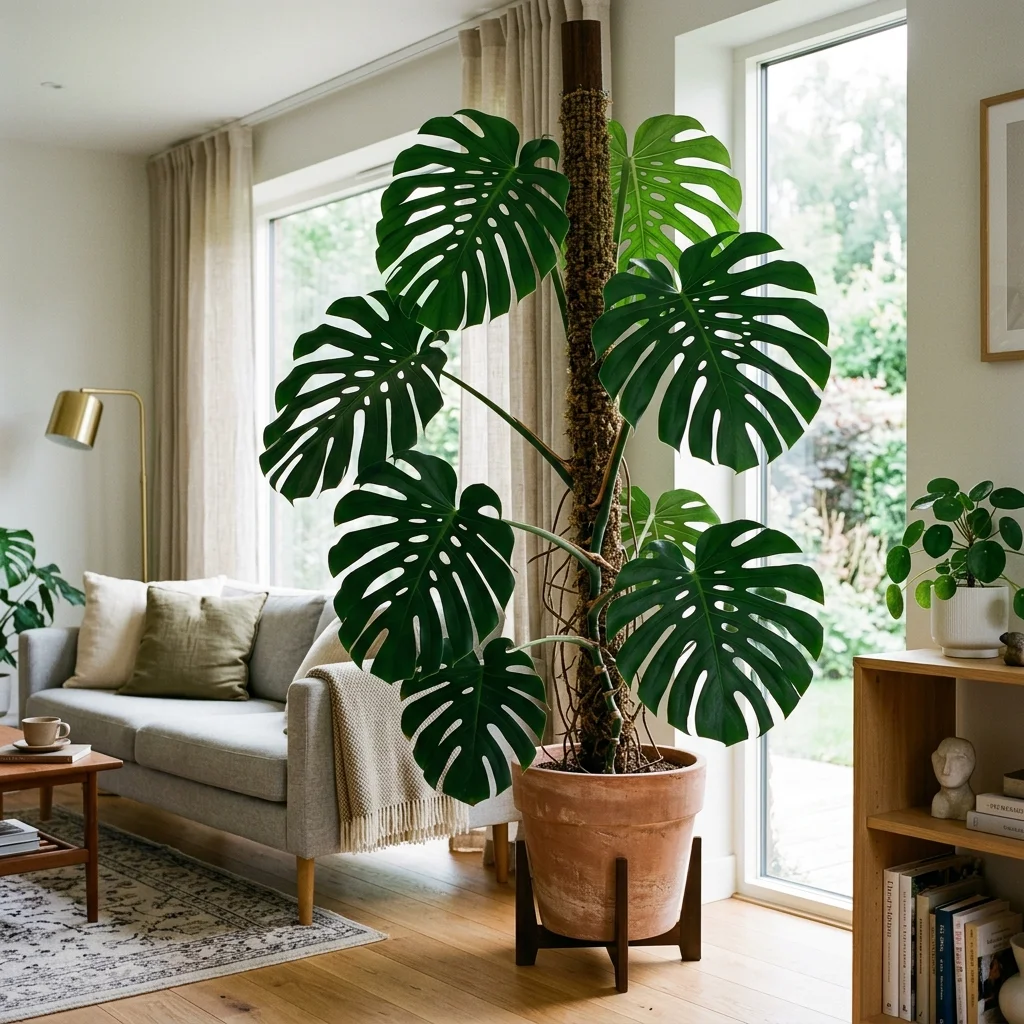
This is the most common question we receive, and the answer almost always comes down to one of three things: the plant is too young, the light is too low, or the plant has no support to climb. Monstera produces plain, heart-shaped juvenile leaves when it is small. Fenestrations — the splits and holes in the leaves — develop naturally as the plant matures and gains access to brighter light. In nature, fenestrations allow wind to pass through large leaves without tearing them, and may also improve light distribution to lower leaves. Indoors, the formula is simple: brighter indirect light plus a moss pole or support structure equals faster maturity and more pronounced leaf splitting.
Essential Care Requirements
Temperature
65–85°F (18–29°C) is the ideal indoor range. Monstera tolerates temperatures down to around 55°F (13°C) for short periods but will stop growing and may begin to show cold damage below that threshold. Keep it away from drafty windows in winter and cold air conditioning vents in summer.
Humidity
40–60% is tolerated without obvious symptoms in most homes. Growth improves noticeably at 60–70%, and at this range the plant pushes out larger leaves more frequently. Unlike Alocasia or Calathea, Monstera handles the average humidity in a centrally heated home reasonably well, making it far more forgiving for most growers.
Light
Bright, indirect light is the sweet spot. An east-facing or bright north-facing window (in the Southern Hemisphere) works well. A west-facing window with a sheer curtain to diffuse afternoon sun is another reliable option. Direct summer sun through unfiltered glass will scorch the leaves within days. Low light conditions will keep the plant alive but significantly slow growth and reduce or eliminate fenestration on new leaves.
Watering
Allow the top 3–5 cm (roughly the top 1–2 inches) of potting mix to dry out between waterings. In summer during active growth, this typically means watering every 7–10 days depending on pot size, humidity, and light levels. In winter, the soil stays wet much longer — watering every 14–21 days is often appropriate. Always water thoroughly until it drains freely from the base, then empty the saucer promptly. Never let the pot sit in standing water.
Soil
A chunky, free-draining aroid mix is essential. A reliable home blend is 40% standard potting mix, 30% perlite, 20% orchid bark, and 10% horticultural charcoal. This structure allows water to drain quickly while retaining just enough moisture around the roots. Avoid dense, peat-heavy mixes that compact over time and hold excess moisture — this is the most direct path to root rot.
Support
Providing a moss pole, coco coir totem, or similar vertical support is one of the highest-impact changes you can make for a Monstera. As the aerial roots grip the support and the plant climbs upward, it begins to produce progressively larger and more fenestrated leaves. Secure early stems loosely with plant ties while the aerial roots establish their grip. This is not optional for growers who want mature, impressive leaf form.
Fertilizing Monstera Deliciosa
During the growing season (March through September in the Northern Hemisphere), feed every 2–4 weeks with a balanced liquid fertilizer (NPK 20-20-20 or similar) diluted to half strength. A fertilizer with a slightly higher nitrogen component supports the large, leafy growth that Monstera produces. Reduce feeding to once every 6–8 weeks from October through February, or stop entirely if the plant is in a low-light location and has essentially paused growth. Do not fertilize a recently repotted plant for at least 6–8 weeks, as fresh potting mix contains nutrients the roots need time to access. Flush the soil with plain water every 2–3 months to prevent fertilizer salt accumulation, which presents as white crusty deposits on the soil surface and causes root tip burn.
Seasonal Care Adjustments
One thing experienced growers understand that beginners often miss is that Monstera care is not a fixed routine — it shifts with the seasons. In spring and summer, increased light and warmth accelerate growth, water is used faster, and the plant benefits from regular feeding and possible repotting. This is also the ideal window for propagation. In autumn and winter, growth slows or pauses entirely, soil stays wet far longer, and the greatest risk shifts to overwatering. Reduce watering frequency, stop or dramatically cut back fertilizing, and resist the urge to repot until spring returns. Treating winter care the same as summer care is one of the most consistent mistakes we see.
Step-by-Step Propagation Guide
- Choose a healthy stem with at least one node (the bump or joint on the stem where a leaf and aerial root emerge). You need a node for propagation to work — a cutting without one will not root.
- Use clean, sharp scissors or pruning shears to cut just below the node. If the cutting includes a leaf, the node, and an aerial root, success rates are significantly higher.
- Allow the cut end to dry and callous for 1–2 hours before placing in water or moist propagation medium.
- Place the cutting in a jar of clean water, ensuring the node is submerged but the leaf is above the waterline. Keep in bright indirect light and change the water every 5–7 days.
- Roots typically emerge within 3–6 weeks. Once roots are 3–5 cm (about 2 inches) long, the cutting is ready to pot into a well-draining aroid mix.
- Keep the newly potted cutting in high humidity and bright indirect light for the first 2–3 weeks while it adjusts from water to soil.
Repotting Guide
Repot every 18–24 months, or when you can see roots emerging from the drainage holes or circling visibly at the soil surface. Spring is the ideal time, as the plant is entering its most active growth phase. Choose a pot only 2–4 cm (1–2 inches) larger in diameter than the current one — oversizing dramatically increases the risk of overwatering because excess soil holds moisture the roots cannot access. Always use fresh potting mix. If your Monstera has a moss pole or support structure, try to maintain it during the transition rather than disturbing the established aerial root grip.
Toxicity Warning
Monstera deliciosa contains insoluble calcium oxalate crystals throughout its stems, leaves, and roots. These crystals are toxic to cats, dogs, and humans if ingested. In pets, ingestion typically causes immediate oral irritation, drooling, pawing at the mouth, vomiting, and difficulty swallowing. The ASPCA lists Monstera deliciosa as toxic to both cats and dogs. Keep this plant out of reach of pets and young children at all times.
Common Problems & Solutions
- Yellow leaves are almost always caused by overwatering or poor drainage. Check that the soil is not consistently wet and that the pot has functional drainage holes. In winter, yellowing often indicates the watering schedule has not been reduced to match the slower drying rate of the soil.
- Brown, crispy leaf edges suggest low humidity or the plant is sitting too close to a heat source such as a radiator or forced-air vent. Move the plant away from the heat source and consider adding a humidifier nearby.
- Brown patches in the middle of the leaf, particularly with a bleached or papery appearance, indicate sunscorch from direct sunlight. Move the plant back from the window or filter the light with a sheer curtain.
- No new leaves or very slow growth in summer usually points to insufficient light or a pot-bound root system. Move to a brighter location and check whether repotting is due.
- New leaves that consistently emerge without fenestrations on a mature plant signal that light levels are too low. Increase brightness and ensure the plant has vertical support to climb.
- Drooping or wilting leaves, when the soil is not bone dry, often indicate root rot. Unpot the plant, inspect the roots, trim any soft black or brown roots with sterile scissors, and repot into fresh dry mix.
- Spider mites and scale insects are the most common pests. Inspect the undersides of leaves regularly. Treat early infestations with neem oil or insecticidal soap applied weekly for 3–4 weeks.
Recommended next actions
Next Best Actions
Move from reading to action with related calculators, plant profiles, and quiz-based recommendations.
Guide
Thai Constellation Monstera Care: Variegation Guide
Having cultivated and propagated over 100 rare Monsteras over the past 7 years, we have developed a proven method for maximizing the growth and stable variegation of the highly sought-after Thai Constellation Monstera.
Topic Guide
Humidity
Learn everything about humidity for your indoor and aquarium plants. Expert care tips, troubleshooting, and related guides.
Topic Guide
Repotting
Learn everything about repotting for your indoor and aquarium plants. Expert care tips, troubleshooting, and related guides.
Frequently Asked Questions
Is Monstera deliciosa toxic to cats and dogs?
Why does my Monstera have no holes or splits in its leaves?
How often should I water my Monstera deliciosa?
What is the best soil mix for Monstera deliciosa?
Does Monstera need a moss pole?
Why are my Monstera's leaves turning yellow?
When should I repot my Monstera?
Can Monstera deliciosa grow in low light?
Explore More