Christmas vs Thanksgiving vs Easter Cactus: Differences, Bloom Times & Care
Most plants sold as Christmas cactus are actually Thanksgiving cactus, and Easter cactus is a third relative with different flowers. This guide compares stem shape, flower shape, bloom timing, and care, and gives a simple routine to trigger flowers plus a troubleshooting table for bud drop and limp segments.
Quick Answer
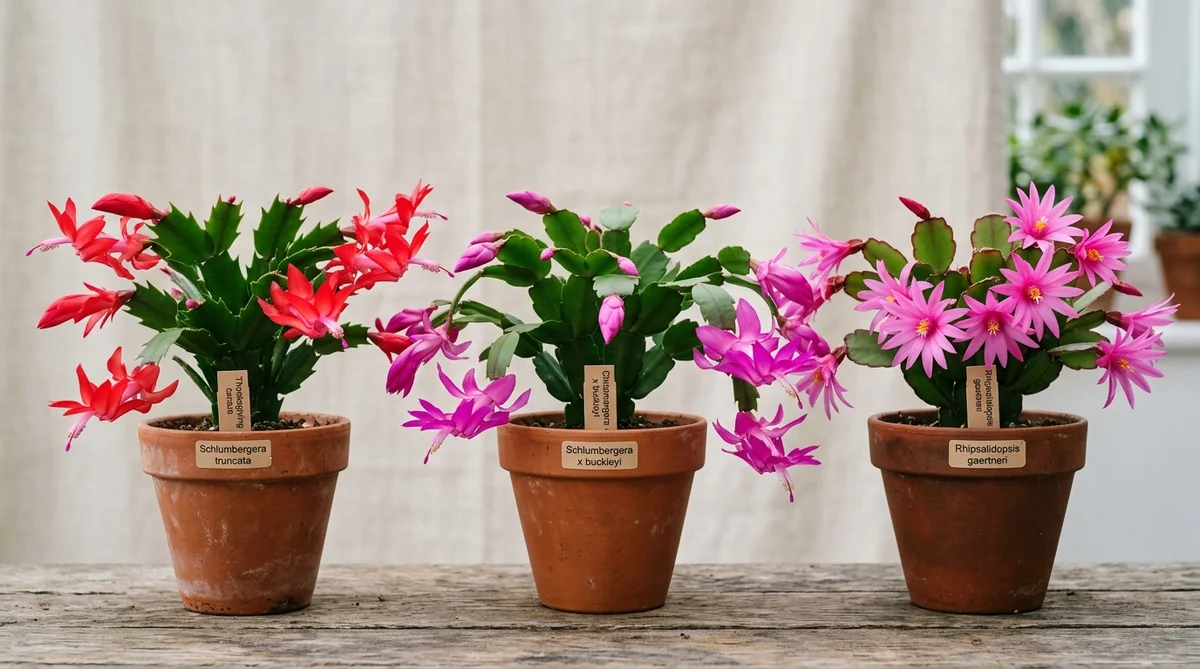
Thanksgiving cactus (Schlumbergera truncata) has pointed, saw-toothed stem edges and usually blooms around November. Christmas cactus (Schlumbergera × buckleyi) has rounded, scalloped edges and usually blooms from December to January. Easter cactus (Hatiora gaertneri) has rounded edges with small bristles, star-shaped flowers, and blooms in spring. Most plants sold as Christmas cactus are actually Thanksgiving cactus. All three are Brazilian forest cacti that prefer bright indirect light, moderate watering, and cool nights to set buds.
Key Takeaways
- Most plants sold as Christmas cactus are Thanksgiving cactus. Check the stem edges: pointed teeth mean Thanksgiving, rounded edges mean Christmas or Easter.
- Easter cactus is a different genus with bristled segment tips and star-shaped flowers that bloom in spring.
- Buds are commonly triggered by about 6 to 8 weeks of cool nights and 12 to 14 hours of uninterrupted darkness, though exact needs vary by cultivar.
- Holiday cacti are humid-forest epiphytes, so treating them like desert cacti with too little water and hot sun is a common mistake.
- Bud drop is usually tied to moving the plant, drafts, temperature swings, or uneven watering. Keep conditions steady once buds appear.
Quick Facts
- Most common mix-up Thanksgiving cactus sold as Christmas cactus
- Fastest ID clue Pointed stem edges (Thanksgiving) vs rounded edges (Christmas, Easter)
- Commonly recommended bud trigger 6 to 8 weeks of cool nights (about 50 to 55°F / 10 to 13°C) with 12 to 14 hours of darkness
What Should I Do?
Your plant has pointed, saw-toothed stem edges
Buds are dropping
You want flowers on a target date
PlantSolve Recommendation
- Conservative dosage designed for container plants
- Based on manufacturer instructions
- Adjusted using horticultural best practices
- Start low and increase only if vigorous growth is observed
Most plants sold as a "Christmas cactus" in stores are actually Thanksgiving cactus, and a third relative, the Easter cactus, is often sold under the same catch-all "holiday cactus" label. All three are forest-dwelling cacti from Brazil rather than desert plants, so they share most care habits. They differ in stem shape, flower shape, and bloom time.
This guide gives you a side-by-side identification table, bloom timing and bloom-trigger conditions, a shared care chart, and a triage table for the problems people report most, such as bud drop and limp segments. Naming is inconsistent between nurseries, botanists, and even extension sources, so treat the tables as reliable clues rather than a guarantee for any single plant.
The Three Holiday Cacti at a Glance
| Feature | Thanksgiving Cactus | Christmas Cactus | Easter Cactus |
|---|---|---|---|
| Botanical name | Schlumbergera truncata | Schlumbergera × buckleyi (older listings may show S. bridgesii) | Hatiora gaertneri (also listed as Schlumbergera gaertneri or Rhipsalidopsis gaertneri, depending on the source) |
| Stem segment edges | Pointed, saw-toothed hooks, typically 2 to 4 per side | Rounded and scalloped, no sharp points | Rounded and smoother, with short bristles at the tips |
| Flower shape | Asymmetrical and tubular, held out or angled upward | More symmetrical, hanging downward | Star-shaped or funnel-shaped, radially symmetrical |
| Pollen color | Yellow | Pink to purplish-brown (sources differ) | Not a reliable clue; use flower shape |
| Typical bloom window (Northern Hemisphere) | Around November | Around December to January | Spring, often around April |
| How common in stores | Very common, usually labeled "Christmas cactus" | Less common; often a passed-down heirloom plant | Most available in spring |
| Bloom pattern | Main bloom in fall or early winter; some plants may flower lightly again later | Main bloom in winter; occasional lighter rebloom | Usually once a year in spring, though this varies |
Quick Identification Checklist
- Start with the stem edges: sharp, claw-like teeth point to Thanksgiving cactus. Rounded edges point to Christmas or Easter cactus.
- Check the tips of new segments: fine bristles suggest Easter cactus.
- Look at the flowers if they are open: hanging and symmetrical suggests Christmas, angled outward or upward suggests Thanksgiving, and a star-shaped funnel suggests Easter.
- Use bloom time only as a clue: a "Christmas cactus" that flowers in November is very likely a Thanksgiving cactus, but temperature and light can shift bloom timing by weeks.
- Confirm with at least two features before deciding, since hybrids and mislabeled plants are common.
Bloom Timing and What Triggers It
Holiday cacti set flower buds in response to longer nights and cooler temperatures, not the calendar. The conditions below are commonly recommended by growers and extension resources. Exact needs vary by cultivar, so use them as a starting point.
| Type | Usual Bloom | Commonly Recommended Bud Trigger | Notes |
|---|---|---|---|
| Thanksgiving cactus | About November | Roughly 6 to 8 weeks of cool nights (about 50 to 55°F / 10 to 13°C) with 12 to 14 hours of uninterrupted darkness | The most widely sold type, so most bloom-forcing advice is written for it |
| Christmas cactus | About December to January | Same routine as above; it typically flowers a few weeks later than Thanksgiving cactus | Often more established and slower growing |
| Easter cactus | Spring | Several weeks of cooler nights in late winter with bright light; details vary by cultivar | Usually blooms once a year |
Southern Hemisphere note: because the trigger is longer, cooler nights, the same cycle typically runs about six months out of phase with the Northern calendar. Count weeks from when you start the routine, not the month.
Bloom-Start Calendar (Northern Hemisphere, Approximate)
| Target Bloom | Start Cool-Night Routine | Notes |
|---|---|---|
| Mid to late November (Thanksgiving display) | Mid-September to early October | Late September to early October is when many growers begin |
| Mid to late December (Christmas display) | Late October to early November | Works best on plants that already have healthy, mature segments |
| April (Easter cactus) | Roughly December to February | Aim for about 6 to 8 weeks of cooler nights before buds are expected |
A simple bloom routine looks like this:
- Give long, uninterrupted nights: 12 to 14 hours of darkness. Stray light from lamps or streetlights can interfere.
- Keep nights cool: about 50 to 55°F (10 to 13°C), away from heater vents and cold glass.
- Keep the mix lightly moist: avoid both bone-dry and soggy conditions during bud set.
- Pause fertilizer during the routine, then resume normal feeding after flowering (see our fertilizer dosing guide).
- Stop moving the plant once buds appear. Return to normal room temperatures of about 60 to 70°F (16 to 21°C) and keep its position and light steady.
Care Comparison: What All Three Need
| Factor | Thanksgiving and Christmas Cactus | Easter Cactus | Helpful Tool |
|---|---|---|---|
| Light | Bright, indirect light; gentle morning sun is usually fine, but hot midday sun can scorch or redden segments | Similar; bright light in late winter supports bud set | Sunlight calculator |
| Watering | Water when the top inch (2.5 cm) of mix feels dry; avoid long dry spells and soggy mix | Similar; many growers ease off slightly during the late-winter rest | Watering calculator |
| Humidity | Moderate humidity preferred (around 50% or higher); average homes are usually tolerated | Similar | Humidity calculator |
| Temperature | Days around 60 to 70°F (16 to 21°C); cooler nights to set buds | Similar, with a cooler rest before spring bloom | Humidity topic hub |
| Feeding | Diluted balanced fertilizer in spring and summer; pause during bud set | Similar | Fertilizer topic hub |
| Potting mix | Airy, fast-draining mix, for example a peat- or coir-based mix with perlite or bark | Same | Potting mix calculator |
| Repotting | Every 2 to 3 years, ideally in spring after flowering; a slightly snug pot is fine | Same | Repotting calculator |
| Longevity | Can live for decades with steady care | Can live for years | Schlumbergera profile |
For plant-specific numbers such as growth rate and pot size, see the growth calculator. General repotting timing is covered in how often to repot your plants.
Holiday Cacti vs. Desert Cacti
The name "cactus" leads many owners to treat these plants like desert species, which is a common cause of problems. Holiday cacti are epiphytes from humid Brazilian forests, so their needs are closer to a tropical houseplant than a barrel cactus.
| Feature | Holiday Cacti | Desert Cacti |
|---|---|---|
| Native habitat | Humid mountain forest, growing on trees and rocks | Arid, exposed desert |
| Light | Bright, indirect or filtered | Full, direct sun |
| Watering | Regular, moderate; avoid long drought | Infrequent, deep watering |
| Humidity | Moderate to high | Low |
| Soil | Airy, organic-rich, fast-draining | Gritty, mineral-heavy |
| Common mistake | Too little water and too much hot sun | Overwatering |
For true desert species, see our cactus profile and how to water succulents and cacti.
Troubleshooting Table
Symptoms overlap, so use this table as a starting point and check the listed items first.
| Symptom | Common Causes | Check First | Read Next |
|---|---|---|---|
| Buds dropping | Sudden temperature changes, drafts, moving the plant, uneven watering, low light | Recent move? Heater vents or cold windows? Steady moisture? | Draft damage and acclimation stress |
| Limp, wrinkled segments | Underwatering, or root rot from overwatering | Feel the mix, then check whether roots are firm or mushy | Root rot rescue and overwatering |
| No flowers | Not enough uninterrupted darkness, warm nights, low light, heavy feeding | Is a lamp on near the plant at night? Night temperature? | Bright indirect light |
| Red or purple segment edges | Strong sun, cold, or general stress | Recent move to a brighter or colder spot? | How much light plants need |
| Yellowing or dropping segments | Overwatering, root issues, shock | Drainage and root condition | Yellowing leaves |
| White cottony spots or sticky residue | Mealybugs | Look in segment joints | Mealybugs |
| Tiny flying insects | Fungus gnats in constantly wet mix | Let the top of the mix dry between waterings | Fungus gnats |
| Spots or scorch after spraying | Chemical injury from oils, soaps, or foliar sprays | Product used and how recently | Spray damage guide |
Pet Safety
- Christmas cactus is generally listed as non-toxic to cats and dogs by common pet-safety references. Chewing any plant can still cause mild stomach upset in some animals.
- Check species-level details in our Schlumbergera pet safety calculator and browse indoor plants safe for cats and dogs.
- If you use neem oil or other sprays on a plant a pet chews, follow the product label and test a small area first (see the neem oil calculator).
Which Holiday Cactus Should You Choose?
| If You Want | Best Fit | Why |
|---|---|---|
| The earliest fall blooms | Thanksgiving cactus | Typically flowers first, around November |
| A classic look with hanging flowers | Christmas cactus | More symmetrical, pendant flowers; usually blooms later |
| Spring color | Easter cactus | Blooms around Easter with star-shaped flowers |
| The easiest plant to find | Thanksgiving cactus | Most widely sold, often labeled "Christmas cactus" |
| Color across several seasons | A mix of all three | Bloom windows differ, so displays overlap less |
Propagating Holiday Cacti
- Twist or cut off a section of 2 to 3 segments from a healthy stem.
- Let the cut end dry for about a day before placing it in a lightly moist, airy mix.
- Keep it in bright, indirect light and avoid soaking the mix while roots form.
- For broader technique, see how to propagate houseplants.
Authority References & Further Reading
Identification and bloom-timing details in this article are informed by extension resources:
- Washington State University Extension: Guidance on telling Thanksgiving, Christmas, and Easter cacti apart.
- University of Arizona Cooperative Extension: Notes on the Truncata and Buckleyi groups and how they differ from Easter cactus.
- UC ANR (University of California Agriculture and Natural Resources): Background on holiday cactus species, flower structure, and bloom timing.
Recommended next actions
Next Best Actions
Move from reading to action with related calculators, plant profiles, and quiz-based recommendations.
Plant Guide
Schlumbergera
The Christmas Cactus is a spectacular jungle epiphyte famous for exploding into bright pink and red blooms in the dead of winter. It requires a strict dark treatment in autumn to trigger its flowers.
Topic Guide
Humidity
Learn everything about humidity for your indoor and aquarium plants. Expert care tips, troubleshooting, and related guides.
Topic Guide
Fertilizer
Learn everything about fertilizer for your indoor and aquarium plants. Expert care tips, troubleshooting, and related guides.
Topic Guide
Overwatering Plants: Symptoms, Diagnosis & Prevention
Learn how to identify, treat, and prevent overwatering in your indoor and aquarium plants. Expert care tips and troubleshooting.
Topic Guide
Bright Indirect Light
Learn everything about bright indirect light for your indoor and aquarium plants. Expert care tips, troubleshooting, and related guides.
Guide
How to Water Succulents and Cacti: Soak and Dry Guide
Learn when and how to water succulents and cacti, how to recognize thirst and overwatering, and how seasonal conditions affect watering frequency.
Frequently Asked Questions
How can I tell a Christmas cactus from a Thanksgiving cactus?
Why is my Christmas cactus blooming in November?
Why is my holiday cactus dropping buds?
How do I get a holiday cactus to bloom again?
Do holiday cacti need the same care as desert cacti?
Are Christmas cacti safe for cats and dogs?
Sources & References
-
Source: extension.wsu.edu
Guidance on distinguishing Thanksgiving, Christmas, and Easter cacti by stem shape and flower features.
-
Source: cales.arizona.edu
Notes on the Truncata and Buckleyi groups and how they differ from Easter cactus.
-
Source: ucanr.edu
Background on holiday cactus species, flower structure, and bloom timing.
Explore More