How to Propagate Houseplants: Cuttings, Water, Soil & More
Learn how to propagate houseplants from stem cuttings using water, soil, moss, or perlite, including where to cut, how to root cuttings, and when to.
Quick Answer
For most stem cuttings, include at least one healthy node because the node contains the buds needed for new shoots and often supports rooting. Cut just below the node, then root the cutting in water, an appropriate propagation medium, or soil depending on the plant. Some plants, including certain succulents and Begonias, can instead be propagated from leaves. Refresh water regularly to keep it clean; roots are ready to transplant once they have several healthy roots, with 2–3 inches (5–7 cm) being a useful beginner guideline for many water-rooted cuttings.
Key Takeaways
- For stem cuttings, include a node—the stem region where leaves and buds emerge and where rooting can occur.
- Refresh water regularly to keep it clean and oxygenated, rather than following a fixed schedule.
- Roots formed in the eventual growing medium may transition more easily after potting, while water-rooted cuttings can require an adjustment period.
- Moderate to high humidity can reduce water loss from leafy cuttings, particularly before roots develop.
- Some plants, including certain succulents and Begonias, can be propagated from leaves, offsets, or division.
Quick Facts
- Where to cut Make a clean cut just below a healthy node; the node should remain attached to the cutting
- Essential cutting part Node—the stem region where leaves and buds emerge and where rooting can occur
- Water maintenance Refresh the water regularly and whenever it becomes cloudy, dirty, or depleted
- Best for water propagation Aroids: Pothos, Philodendron, Monstera
- Best for soil/moss propagation Cuttings that establish well in a moist, airy growing medium
- Ready to plant Once the cutting has a healthy root system; 2–3 inches is a useful beginner guideline for many water-rooted cuttings
What Should I Do?
You're new to propagation and want to see roots develop
Your cutting is from a plant that dislikes transplant shock (e.g., some Ficus, woody plants)
You have a cutting with long, leafless stem and one node
You're propagating in a dry home environment with low humidity
Your cutting is wilting or turning brown at the cut end
You're propagating a succulent or other plant that is prone to rot
The cutting has roots but no new leaves
The cutting has leaves but no roots
The cutting is losing leaves while rooting
Water vs. Soil Propagation: Which Method Is Right for You?
| Method | Best For | Pros | Cons | Risk Level |
|---|---|---|---|---|
| Water propagation | Aroids (Pothos, Philodendron, Monstera), beginners | Visual—you can see roots develop; less chance of drying out | Water roots can be fragile; transplant shock is more common | Low to moderate—watch for rot |
| Direct soil propagation | Plants that root well in soil; plants prone to transplant shock | Roots develop directly in a growing medium and may transition more easily after establishment | Can't see root development without checking; need to keep medium consistently moist | Moderate—overwatering can cause rot |
| Sphagnum moss propagation | High-humidity lovers, semi-woody plants | Excellent aeration; strong, adaptable roots | Moss can be messy; requires careful moisture management | Low to moderate—works well for many species |
| Perlite propagation | Plants prone to rot, very high humidity environments | Excellent drainage and aeration; low risk of rot | No nutrients; must fertilize after transplant | Low—good for rot-prone cuttings |
How Plant Propagation Works
Plant propagation is the process of creating new plants from existing ones. For houseplants, this is most often done through vegetative propagation—using stems, leaves, or other plant parts to grow new individuals. The key to success is understanding where new growth originates and providing the right conditions for rooting.
The Node: What You Need for Stem Cuttings
For most houseplants propagated from stem cuttings, the node is essential because it contains buds capable of producing new shoots and can support the formation of adventitious roots. A node is the area of the stem where leaves, buds, branches, or aerial roots emerge. A leaf-only cutting may produce roots in some species but will not necessarily produce a new plant.
How to cut: Using sterilized shears, make a clean cut just below a healthy node. The exact distance is less important than ensuring the node remains attached to the cutting. A clean cut reduces the risk of infection.
Method 1: Water Propagation (Best for Beginners)
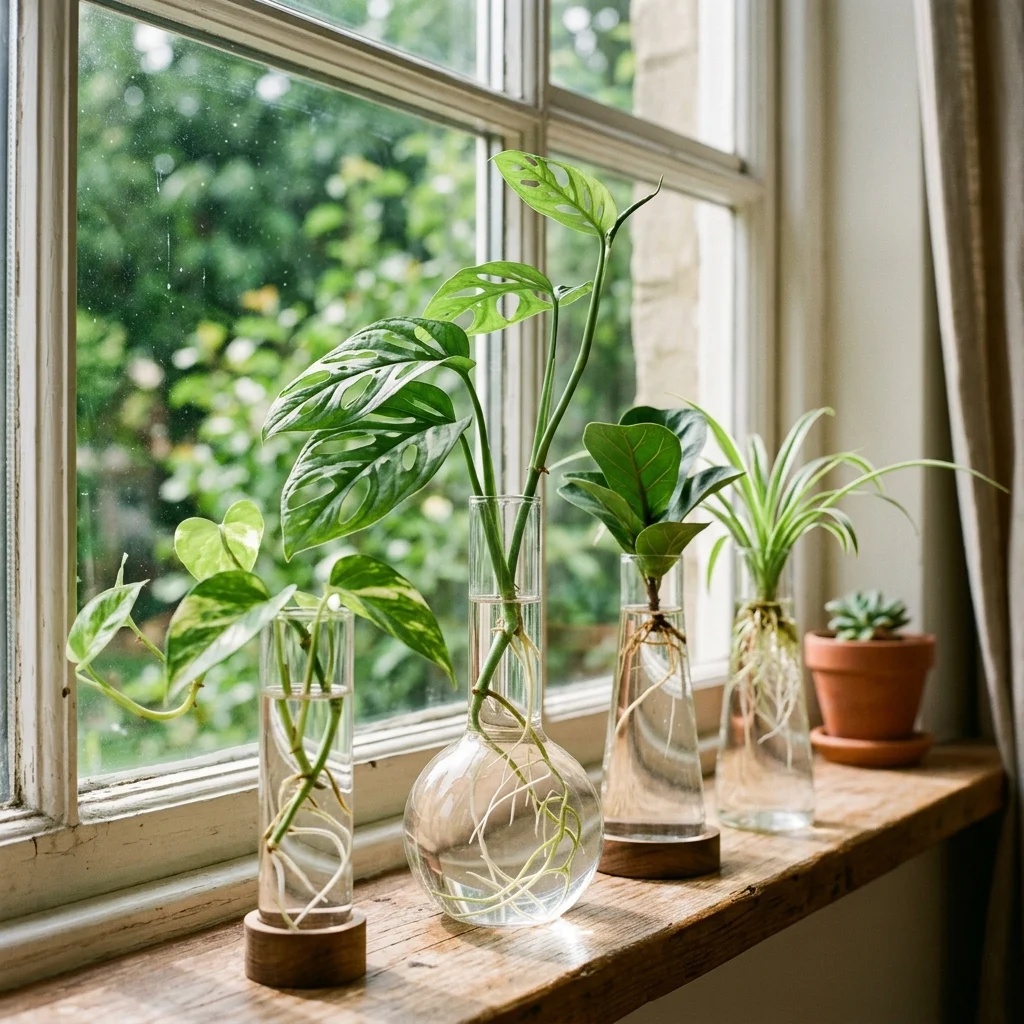
Water propagation is highly visual and incredibly satisfying. It works exceptionally well for aroids like Pothos, Philodendrons, and Monsteras.
- The Cut: Using sterilized shears, make a clean cut just below a healthy node.
- Submerge: Place the cutting in a glass vessel so the node is completely submerged, but the leaf remains above water. Use a clear container so you can monitor root development.
- Maintain: Refresh the water regularly to keep it clean and oxygenated. If the water becomes cloudy, develops an odor, or contains debris, replace it rather than waiting for a fixed interval. Weekly changes are a useful practical routine, but not a strict requirement.
- Potting Up: There is no universal root-length threshold for transplanting. As a practical guideline, many water-rooted cuttings can be moved once they have several healthy roots, often around 2–3 inches (5–7 cm) long. Species and root structure matter more than a single measurement.
Pro tip: Place the cutting in bright, indirect light. Strong direct sunlight can increase leaf temperature and water loss before the cutting has an established root system.
Method 2: Sphagnum Moss / Perlite Propagation
Water roots can be fragile and sometimes struggle to adapt to dense soil (transplant shock). Propagating directly into a coarse medium like damp sphagnum moss or pure perlite can create roots that transition more easily after potting.
- Pack a small cup with damp (not dripping wet) sphagnum moss or perlite.
- Nestle the node directly into the medium.
- Place the cup in a high-humidity environment, such as a clear plastic propagation box or a Ziploc bag.
- Moderate to high humidity can reduce water loss from leafy cuttings, particularly before roots develop.
- Keep the medium consistently moist but not soggy—overwatering can cause rot.
Method 3: Direct Soil Propagation
Some plants root best directly in soil. Use a well-draining potting mix appropriate for the plant and insert the cutting with the node buried below the soil line. Keep the soil consistently moist but not waterlogged. Cover the pot with a clear plastic bag or dome to maintain humidity, but avoid direct sunlight.
Propagating by Division, Offsets, and Leaves
Not all plants propagate well from stem cuttings. Here are other common propagation methods:
- Division: For plants with clumping root systems (Peace Lily, ZZ Plant, Snake Plant), gently separate the root ball into sections, each with roots and leaves, and pot them individually.
- Offsets: Many plants produce offshoots or "pups" around the base (Spider Plant, Aloe). Remove these when they are large enough to have their own roots.
- Leaf cuttings: Some plants (certain Begonias, many succulents) can be propagated from individual leaves. For succulents, allow the cut surface to callus before placing on well-draining soil.
- Runners: Plants like Spider Plant produce plantlets on long stems that can be rooted while still attached or removed and potted.
How to Know When Roots Are Ready
There is no universal root-length threshold for transplanting. As a practical guideline, many water-rooted cuttings can be moved once they have several healthy roots, often around 2–3 inches (5–7 cm) long. Species and root structure matter more than a single measurement. A good rule of thumb is to wait until roots have secondary branching before transplanting.
Transplanting Rooted Cuttings
When you're ready to transplant, use a well-draining potting mix appropriate for the plant. Water thoroughly after transplanting and keep the plant in a warm, bright location with indirect light. The plant may experience a brief period of adjustment—this is normal.
Propagation Troubleshooting
- Cutting has roots but no leaves: Be patient. Root development can precede visible shoot growth, and some species take longer to activate dormant buds.
- Cutting has leaves but no roots: Check that a node is present and the cutting is receiving appropriate warmth and light. Avoid excessive moisture around the stem.
- Cutting is losing leaves while rooting: Some leaf loss can occur while a cutting reallocates resources. Check for excessive water loss, rot, extreme temperatures, or inadequate light.
Common Mistakes to Avoid
- Cutting below the wrong point: Always cut below a node, not just anywhere on the stem.
- Overwatering during soil propagation: Keep the medium moist, not soggy. Roots need oxygen to develop.
- Not changing water: Stagnant water promotes bacterial rot. Refresh water regularly, especially if it becomes cloudy.
- Direct sunlight: Cuttings are vulnerable—bright, indirect light is best.
- Transplanting too early: Wait for healthy root development before moving to soil.
- Using dirty tools: Always sterilize shears before cutting to prevent disease transmission.
- Applying excessive moisture to succulents: Many succulents need the cut surface to callus before planting and prefer drier conditions.
Frequently Asked Questions
What is a node on a plant stem?
Can you propagate a plant without a node?
How long does it take for cuttings to root?
Can you propagate a plant from a single leaf?
Should I use rooting hormone?
Why is my cutting turning black or mushy?
When should I transplant water-rooted cuttings to soil?
Sources & References
-
Source: content.ces.ncsu.edu
Type: extension
-
Source: extension.umn.edu
Type: extension
-
Source: extension.illinois.edu
Type: extension