How to Water Succulents and Cacti
Learn when and how to water succulents and cacti, how to recognize thirst and overwatering, and how seasonal conditions affect watering frequency.
Quick Answer
For most indoor succulents and cacti, water thoroughly when the growing medium has dried sufficiently for that species, then allow excess water to drain completely. Avoid frequent small sips that repeatedly wet only the surface. A fast-draining mix and a pot with drainage holes are important because prolonged saturation can deprive roots of oxygen and contribute to rot. The exact drying time varies with species, pot size, light, temperature, humidity, and season, so use the plant and growing medium rather than a fixed watering calendar as your guide.
Key Takeaways
- Water thoroughly rather than repeatedly giving small amounts that only wet the surface.
- Allow the growing medium to dry appropriately between waterings; the correct degree of drying varies by species and growing conditions.
- Use a fast-draining succulent or cactus mix and a container with drainage holes.
- Never leave the pot standing in water after thorough watering.
- Wrinkled or shriveled leaves can indicate that a succulent needs water, while soft, translucent, or rapidly dropping leaves can indicate excessive moisture.
Quick Facts
- Preferred watering approach Water thoroughly when the growing medium has dried appropriately, then allow excess water to drain
- Container requirement Use a pot with drainage holes so excess water can escape
- Soil requirement Use a fast-draining growing medium appropriate for succulents or cacti
- Common thirst sign Wrinkled, shriveled, or less-firm leaves in species where these signs are reliable
- Common overwatering signs Persistently wet soil, soft or translucent leaves, yellowing, unexplained leaf drop, or a softening stem/base
- Seasonal adjustment Water less frequently when growth slows or the growing medium takes longer to dry
What Should I Do?
The potting mix is dry and the plant shows normal signs of needing water
The soil is still wet several days after watering
The leaves are wrinkled or noticeably less firm and the growing medium is dry
The leaves are soft, translucent, or mushy and the growing medium remains wet
Water runs down the sides of the pot without soaking the growing medium
The plant is receiving much less light or temperatures have dropped
The plant is actively growing in warm, bright conditions
Underwatered vs. Overwatered Succulents and Cacti
| Sign | Possible Underwatering | Possible Overwatering | What to Check |
|---|---|---|---|
| Leaf texture | Wrinkled, shriveled, softer, or less firm than usual | Soft, swollen, translucent, or mushy | Check the growing medium and consider the species' normal leaf texture |
| Leaf color | May become dull or develop dry, crispy areas when stress is prolonged | Yellowing, darkening, or translucent areas may occur | Check moisture, light, temperature, and recent watering history |
| Leaf drop | Older leaves may dry out and drop as the plant conserves resources | Soft or otherwise apparently healthy leaves may detach unexpectedly | Inspect the roots, stem/base, and moisture level rather than relying on leaf drop alone |
| Stem or base | May become shriveled or less plump while remaining firm | May become soft, dark, or mushy if rot develops | A soft or collapsing base is a warning sign requiring immediate investigation |
| Growing medium | Very dry and potentially pulling away from the sides of the container | Remains wet for an unusually long period | Consider soil composition, drainage, pot size, light, and environmental conditions |
How Succulent and Cactus Watering Actually Works
Succulents and cacti are adapted to environments where water availability can be highly variable, but that does not mean every species should be kept completely dry for as long as possible. Healthy roots need both moisture and oxygen. The goal of indoor watering is to provide enough water to hydrate the plant while allowing excess moisture to drain away and the growing medium to dry appropriately before the next watering.
There is no single watering interval that works for every succulent or cactus. Species, pot size, soil composition, drainage, light, temperature, humidity, and season all affect how quickly the growing medium dries.
The Soak-and-Dry Approach
For many container-grown succulents and cacti, a thorough watering followed by an appropriate drying period is more effective than frequent shallow watering.
- Check the growing medium: Determine whether the medium has dried sufficiently for the particular plant. Do not rely on a calendar alone.
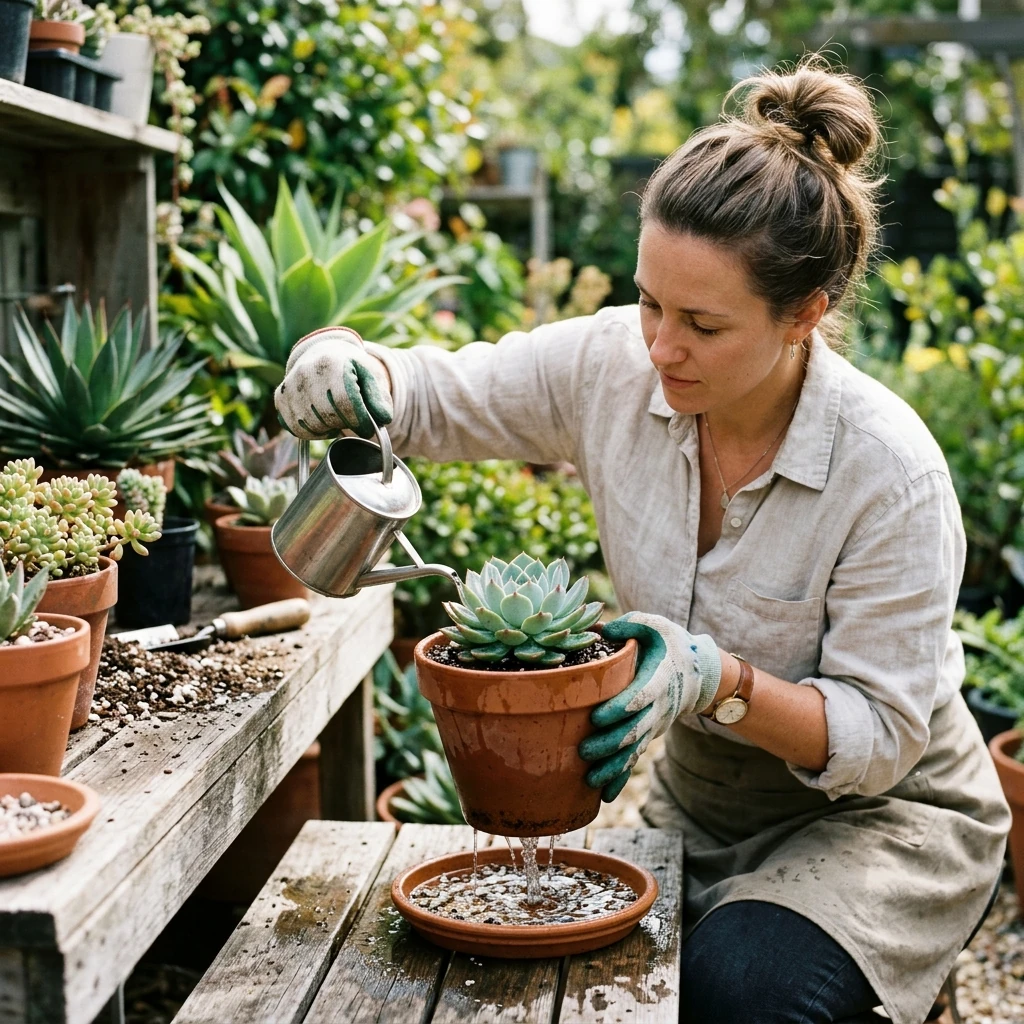
- Water thoroughly: Apply water evenly across the growing medium until excess begins to drain from the bottom of the container.
- Allow complete drainage: Empty the saucer or cachepot so the container does not remain standing in water.
- Wait and observe: Allow the growing medium to dry appropriately before watering again. The interval may range from several days to several weeks or longer depending on conditions and species.
The important principle is not a specific number of days. It is matching watering frequency to how quickly the plant and its growing medium actually use and lose water.
Why Frequent Small Sips Can Be a Problem
Giving a small amount of water every few days can repeatedly moisten only the upper portion of the growing medium while leaving other parts of the root zone inconsistently hydrated. It can also make it difficult to judge when the plant has actually dried sufficiently.
A thorough watering followed by an appropriate drying period gives you a clearer cycle: hydrate the root zone, allow excess water to escape, then wait until the plant and substrate indicate that another watering is needed.
Use the Right Pot and Growing Medium
Watering technique cannot compensate for poor drainage. Use a container with drainage holes and a growing medium formulated for succulents and cacti or otherwise designed to drain readily.
A very dense or moisture-retentive mix can remain wet for too long even when you are watering infrequently. Conversely, an extremely dry or hydrophobic mix may cause water to bypass the root zone rather than soaking evenly.
How to Tell When a Succulent Needs Water
Plant symptoms are useful, but they should be interpreted together with the condition of the growing medium.
- Wrinkled or shriveled leaves: Common in many soft-leaved succulents when they are becoming dehydrated.
- Reduced firmness: Leaves may feel less plump than they normally do.
- Drying lower leaves: Older leaves may naturally dry and fall as part of normal growth, but widespread or rapid drying can indicate stress.
- Very dry growing medium: A dry root zone combined with visible dehydration is a stronger signal than leaf appearance alone.
Not every succulent displays thirst in the same way. Some cacti and highly adapted species can remain firm even after the growing medium has become quite dry, so species-specific knowledge is useful.
How to Recognize Overwatering
Overwatering is often less about giving a single large drink and more about keeping the root zone wet for too long or watering again before the plant has had time to use the available moisture.
- Soft or mushy leaves
- Translucent or unusually swollen leaves
- Yellowing or darkening leaves
- Unexpected leaf drop
- Persistently wet growing medium
- Soft, dark, or collapsing stems or bases
If the stem or base becomes soft and dark, inspect the plant promptly for rot. A healthy watering cycle should allow the root zone to receive moisture without remaining saturated indefinitely.
Bottom Watering: When It Helps
Bottom watering can be useful when a dry potting mix has become hydrophobic and water is running down the sides of the container rather than penetrating the root zone.
Place the drainage container in a shallow amount of water and allow the growing medium to absorb moisture from below. Remove the pot once the medium has become adequately hydrated, then allow it to drain completely.
Bottom watering is not a way to keep the pot permanently wet. The same principle still applies: the growing medium needs periods with adequate air exchange between watering events.
Seasonal Watering Adjustments
Succulents and cacti often use less water when temperatures are cooler, light levels are lower, or growth slows. Some species also experience dormancy during particular seasons. During these periods, the growing medium may remain wet for much longer than it does during active growth.
Rather than automatically watering once a week or once a month, check how quickly the substrate is drying and consider the plant's seasonal growth pattern. A plant that needs water every week in bright summer conditions may need water much less frequently during a cool, low-light winter.
Common Watering Mistakes
- Following a fixed calendar: Watering every Sunday regardless of soil conditions can lead to overwatering when evaporation slows.
- Giving frequent tiny amounts: Repeated shallow watering can create inconsistent moisture patterns.
- Using a pot without drainage: Excess water has nowhere to escape, increasing the risk of prolonged saturation.
- Leaving water in the saucer: Standing water can keep the root zone wetter for longer than intended.
- Ignoring the growing medium: Leaf symptoms alone cannot distinguish every watering problem.
- Using a moisture meter without understanding its limitations: Readings can vary with soil composition and the type of meter, so use them as one source of information rather than an absolute answer.
When to Water: A Simple Routine
- Check the growing medium and the plant's condition.
- Consider recent weather, temperature, light, and seasonal growth.
- If watering is appropriate, soak the growing medium thoroughly.
- Allow all excess water to drain.
- Empty the saucer or outer container.
- Wait until the plant and growing medium indicate that another watering is appropriate.
Bottom Line
The best way to water most indoor succulents and cacti is not to follow a rigid schedule. Provide a thorough watering when the plant actually needs it, use a well-draining growing medium and container, let excess water escape, and allow the root zone to dry appropriately before watering again. Watch both the plant and the substrate, and adjust the interval as light, temperature, season, and growth rate change.
Frequently Asked Questions
How often should I water succulents?
Should succulents be watered from the top or bottom?
How do I know if my succulent needs water?
What does an overwatered succulent look like?
Can succulents be watered every week?
Should I let succulent soil dry completely before watering?
Why is water running straight through my succulent pot?
Do succulents need less water in winter?
Explore More