Mealybugs on Houseplants: How to Identify, Treat, and Stop Them Coming Back
Mealybugs are one of the most persistent houseplant pests — and the reason most treatments fail is that people stop too early. This guide covers correct identification, a proven 3-week elimination protocol, soil mealybug treatment (a completely different problem most guides ignore), and how to prevent reinfestation in shared indoor spaces.
Quick Answer
Mealybugs are white, cottony sap-sucking insects that cluster at leaf joints and stem bases. Treat with 70% isopropyl alcohol to remove adults, followed by neem oil or insecticidal soap spray every 5–7 days for 3 weeks. Isolate the plant immediately and check the soil for root mealybugs if the infestation keeps returning.
Key Takeaways
- Spot-treat white, cottony mealybugs using cotton swabs dipped in 70% isopropyl alcohol.
- Inspect leaf axils, stem joints, and pot rims where mealybugs congregate.
- Spray foliage thoroughly with insecticidal soap or neem oil every 5 to 7 days.
- Isolate infested plants immediately to prevent spread to neighboring pots.
Why Mealybugs Are So Hard to Get Rid Of
You wiped them off with rubbing alcohol two weeks ago. You thought they were gone. Then you spotted fresh white fuzz tucked into a new leaf joint this morning.
This is the mealybug cycle that frustrates nearly every indoor plant owner, and it happens for one reason: a single treatment kills the visible adults but leaves eggs and crawlers hidden in soil, root zones, and the tight folds of new growth. Mealybugs are not difficult to kill — they are difficult to find completely.
This guide explains exactly where to look, how to treat every hiding spot, and why you need to keep treating for three weeks minimum after you think the infestation is gone.
What Mealybugs Look Like: Identification
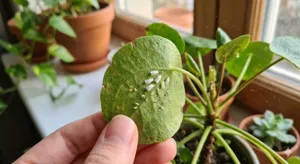
Mealybugs (family Pseudococcidae) are soft-bodied, sap-sucking insects that produce a distinctive white, waxy, cotton-like coating for protection. Adult females are oval, 1–4mm long, and rarely move. Males are tiny winged insects you will almost never see.
You are most likely to find them:
- In the joints where leaves meet stems (leaf axils)
- Along the undersides of leaves, especially near the midrib
- At the base of the plant where stems meet soil
- On new growth, which is softer and easier to pierce
- On roots (root mealybugs — a separate, more serious problem covered below)
The white cottony clusters are the most visible sign. You may also notice sticky honeydew on leaves and surfaces beneath the plant, and secondary black sooty mold growing on that honeydew.
Mealybugs vs Other White Pests
Not all white residue on plants is mealybugs. Here is how to distinguish them:
- Powdery mildew: A flat white coating on leaf surfaces, not clustered at joints. Does not move. Fungal, not insect.
- Woolly aphids: Larger colonies, more blue-grey than white. Usually found in clusters on stems.
- Scale insects: Brown, flat, or domed bumps — no cotton. Found along stems and leaf undersides.
- Mealybugs: Distinctly cottony or fluffy, clustered at joints and growing points, occasionally mobile crawlers visible with close inspection.
Common Symptoms of Mealybug Infestation
- White cotton-like clusters at leaf joints, stem bases, or on roots
- Sticky residue (honeydew) on leaves or the surface below the pot
- Black sooty mold developing on sticky areas
- Yellowing leaves, particularly on new growth
- Leaf drop despite adequate watering and light
- Stunted or distorted new growth
- Wilting that does not respond to watering (sign of root mealybugs)
Why Mealybugs Appear: Root Causes
Mealybugs do not appear spontaneously. They arrive through one of four routes:
1. Infested New Plant
The most common source. Nursery stock and plant swaps frequently carry mealybug eggs or crawlers in the soil or hidden at stem bases. A plant can look completely clean in the shop and develop a visible infestation within 3–6 weeks at home.
2. Contaminated Soil or Pots
Reused potting mix, unwashed second-hand pots, or outdoor soil brought indoors can introduce root mealybugs and eggs directly into your setup.
3. Spreading From Another Plant
Crawlers — the juvenile stage — actively move. In a home with multiple plants grouped together, an infestation on one plant will spread to neighbours within weeks. This is how a single infested nursery purchase can eventually affect an entire collection.
4. Warm, Dry Conditions
Mealybugs thrive when temperatures are consistently above 70°F (21°C) and humidity is low — exactly the conditions found in centrally heated apartments in autumn and winter. Drought-stressed plants are also more susceptible because weakened tissue is easier for mealybugs to pierce.
How to Diagnose Correctly Before Treating
Before reaching for rubbing alcohol, spend five minutes doing a proper inspection. Treatment that misses the root zone or hidden crawlers will fail.
Above-Ground Inspection Checklist
- Check every leaf axil from the top of the plant to the soil line
- Turn leaves over and inspect the midrib and veins on the underside
- Check the base of the stem where it enters the soil
- Look at the inside of any leaf sheaths or rolled leaves
- Check the drainage holes at the bottom of the pot
How to Check for Root Mealybugs
Root mealybugs (most commonly Rhizoecus species) live entirely in the soil and on roots. They look like tiny white specks or powder on the roots and inner pot walls. Suspect root mealybugs when:
- The plant wilts despite moist soil
- Above-ground mealybugs keep returning after repeated treatment
- You see white powdery residue on the inside walls of the pot when you unpot the plant
To confirm: gently unpot the plant and inspect the root ball and inner pot surface with a magnifying glass.
Step-by-Step Mealybug Treatment Protocol
Effective mealybug treatment requires three weeks of repeated applications, not a single wipe-down. Here is the full protocol.
Step 1: Isolate the Plant Immediately
Move the infested plant at least 3 feet away from all other plants. Crawlers move on their own and can transfer on clothing, tools, and air currents. Keep it isolated for the entire treatment period.
Step 2: Remove Visible Mealybugs Manually
Dip a cotton swab or cotton pad in 70% isopropyl rubbing alcohol and press it directly onto each mealybug cluster for 10–15 seconds. The alcohol dissolves their waxy coating and kills on contact. Do not dilute it — 70% is the correct concentration (higher concentrations evaporate before penetrating).
Work methodically from the top of the plant down to the soil line. Do not rush. A single missed cluster contains dozens of eggs.
Step 3: Spray the Entire Plant
After manual removal, spray the whole plant — leaves, stems, and soil surface — with one of the following:
- Neem oil solution: Mix 2 tsp cold-pressed neem oil + 1 tsp dish soap per liter of water. Shake well and spray to full coverage. Neem disrupts the mealybug reproductive cycle and acts as a systemic deterrent when absorbed through roots.
- Insecticidal soap: Ready-to-use formulations (look for potassium salts of fatty acids) are safe for most houseplants and kill mealybugs on contact. Do not use on succulents or plants with waxy coatings.
- 70% isopropyl spray: Effective for small plants. Dilute to 50% with water for plants with delicate foliage. Test on one leaf and wait 24 hours before full application.
Spray in the early morning or evening — never in direct sun, which causes the solution to burn foliage.
Step 4: Treat the Soil Surface
Drench the top 2 inches of soil with the neem oil solution. This targets any mealybugs at the soil surface and stem base, and begins to work systemically. Do not waterlog the root zone — one thorough drench is sufficient per treatment cycle.
Step 5: Repeat Every 5–7 Days for 3 Weeks
Mealybug eggs hatch over a 7–14 day cycle. A single treatment kills adults but not eggs. You must repeat the spray application every 5–7 days for a minimum of three weeks to catch each new generation of crawlers before they mature and lay eggs of their own.
Mark the dates on your calendar. Missing a cycle resets the process.
Step 6: Treat for Root Mealybugs (If Confirmed)
Root mealybugs require a different approach because surface sprays do not reach them:
- Unpot the plant completely and shake all old soil from the roots.
- Rinse the roots under lukewarm running water to remove as many insects as possible.
- Soak the bare root ball in a diluted neem oil solution (1 tsp neem + 0.5 tsp dish soap per liter of water) for 15–20 minutes.
- Repot into completely fresh, sterile potting mix in a clean pot. Wash the old pot with hot soapy water or discard it.
- Water in with a neem oil drench once established.
- Continue weekly soil drenches for 4 weeks after repotting.
Step 7: Declare Victory — Carefully
A plant is considered clear when you find no mealybugs, eggs, or crawlers on two consecutive weekly inspections after completing the 3-week treatment cycle. Keep it in isolation for one additional week before returning it to your collection.
Treating a Multi-Plant Collection
If you have multiple plants grouped together and discover a mealybug infestation, inspect every plant in the group immediately — not just the obviously affected one. Crawlers spread faster than most plant owners expect.
Any plant that shares a shelf, windowsill, or humidity tray with the infested plant should be treated prophylactically with one spray application even if you see no visible signs.
Prevention Strategy
Quarantine All New Plants
This is the single most effective prevention measure. Every new plant — from a nursery, garden centre, friend, or online order — should spend 2–3 weeks in a separate room before joining your collection. Inspect it weekly during quarantine. This alone eliminates the most common entry point.
Monthly Inspections
Build a monthly inspection habit. Check all leaf axils and stem bases on every plant during watering. Early detection when there are 5–10 mealybugs is infinitely easier than treating a full colony of hundreds.
Avoid Overcrowding
Plants touching each other create a direct physical bridge for crawlers. Leave a few inches of space between plants and avoid shared humidity trays where possible.
Preventive Neem Soil Drenches
Apply a neem oil soil drench to your most vulnerable plants (tropicals, succulents, cacti) once every 4–6 weeks during the growing season. This does not prevent aerial infestation but significantly reduces the risk of root mealybugs establishing.
Avoid Over-Fertilizing with Nitrogen
High-nitrogen fertilizers produce soft, lush growth that is the preferred feeding ground for mealybugs. Keep fertilizer at recommended rates and avoid nitrogen-heavy formulas on plants already showing signs of stress.
Common Treatment Mistakes
- Treating once and stopping. The most common reason infestations return. Eggs survive the first treatment. You must repeat every 5–7 days for 3 weeks.
- Missing hidden locations. Mealybugs in tight leaf sheaths, drainage holes, and at the soil line survive every above-ground treatment. Follow the full inspection checklist before each application.
- Not isolating the plant. Treating an infested plant while it remains touching its neighbours allows re-infestation before treatment is complete.
- Using alcohol at too high a concentration. Pure 99% isopropyl alcohol evaporates before penetrating the waxy coating. 70% is the correct concentration for contact kill.
- Spraying in direct sun. Both neem and soap solutions cause leaf burn when applied in bright light. Always treat in low light conditions.
- Ignoring the soil. Treating only the above-ground parts of the plant while root mealybugs continue feeding below means the infestation never fully clears.
- Reusing contaminated pots without cleaning. Mealybug eggs survive in old soil and on unwashed pot surfaces for weeks.
Key Takeaways
- Mealybugs are identified by white cottony clusters at leaf joints, stem bases, and on roots.
- They arrive on new plants, in contaminated soil, or spread from existing infestations.
- Effective treatment requires 70% isopropyl alcohol for manual removal, followed by neem oil or insecticidal soap sprays repeated every 5–7 days for 3 weeks.
- Root mealybugs require unpotting, root washing, and a complete soil replacement — surface sprays do not reach them.
- Quarantining all new plants for 2–3 weeks before joining your collection is the single most effective prevention measure.
- Isolate any infested plant immediately and inspect all nearby plants prophylactically.
Fertilizer Guidelines
During the active growing season (spring and summer), feed your plant every 4 weeks with a balanced liquid fertilizer diluted to half strength. Reduce feeding to once every 8 weeks during the winter dormancy period. Flush the soil every few months to prevent mineral salt buildup.
Propagation Steps
- Identify a healthy stem or section of the plant.
- Using sterilized shears, make a clean cut below a node.
- Place the cutting in water or a well-draining propagation mix.
- Keep in high humidity and bright indirect light until roots form (usually 3-4 weeks).
Repotting Guide
Repot every 12 to 18 months in the early spring before the active growing season begins. Only go up one pot size (1-2 inches larger in diameter). Always use fresh, well-draining soil to ensure the roots receive adequate oxygen and to prevent root rot.
Toxicity Warning
It is important to note that many common houseplants contain calcium oxalate crystals or other compounds that are toxic to cats, dogs, and humans if ingested. Always keep this plant out of reach of pets and children to avoid symptoms like mouth irritation or vomiting.
Common Problems and Solutions
- Yellow leaves generally indicate overwatering or poor soil drainage. Ensure your pot has drainage holes and allow the top inch of soil to dry out between waterings.
- Brown, crispy leaf edges are typically a sign of low ambient humidity. Use a humidifier to raise the moisture levels in the room to at least 60%.
- Drooping foliage can be caused by severe underwatering or root rot. Check the soil moisture immediately to determine which extreme is the cause.
- Pest infestations (like spider mites or fungus gnats) thrive in stressed plants. Treat early with neem oil and ensure proper airflow around the foliage.
Temperature
Maintain temperatures between 65–80°F (18–27°C). Avoid placing the plant near cold drafts or AC vents.
Humidity
Aim for a humidity level of 50-70%. If your home is dry, especially in winter, consider running a humidifier nearby.
Light
Provide bright, indirect sunlight. Direct harsh rays will scorch the leaves, while too little light will stunt growth.
Watering
Water thoroughly when the top two inches of soil feel dry. Ensure excess water drains completely from the pot.
Recommended next actions
Next Best Actions
Move from reading to action with related calculators, plant profiles, and quiz-based recommendations.
Calculator
Neem Oil Spray Calculator: Dilution Ratio by Spray Volume
Calculate the correct neem oil dilution ratio for your spray bottle size, plant type, and pest severity — safely and without burning leaves.
Guide
Scale Insects on Houseplants: ID & Treatment
Scale insects are the most misidentified houseplant pest — most owners spend weeks treating the wrong thing because those flat brown bumps look like part of the plant. After working through infestations across Monstera, Ficus, Pothos, Orchid, and Citrus collections, here is the exact identification and treatment framework that actually works.
Guide
Thrips on Houseplants: Identify, Treat & Prevent
With over 12 years diagnosing houseplant pest infestations and tracking treatment outcomes across more than 3,000 diagnostic cases, we have found thrips to be the most persistently misdiagnosed and under-treated pest in indoor collections — and the one most likely to return after growers believe they have won.
Guide
Monstera Deliciosa Care: Watering, Light & Growth Tips
After growing and troubleshooting Monstera deliciosa plants across nine years and multiple home environments, we've mapped out exactly what this iconic climbing aroid needs to produce large, dramatically split leaves indoors.
Frequently Asked Questions
Are mealybugs harmful to humans or pets?
Can I save a heavily infested plant, or should I throw it away?
How do I get rid of mealybugs with rubbing alcohol?
Does neem oil really work on mealybugs?
Why do mealybugs keep coming back after treatment?
Can mealybugs live in potting soil?
How do I stop mealybugs spreading to my other plants?
What plants are most vulnerable to mealybugs indoors?
Explore More