Topic Guide
Nutrient Burn
Nutrient burn occurs when fertilizer is applied at concentrations higher than a plant can metabolize, or when salts accumulate in growing medium over time, raising the soil solution's osmotic potential above that inside root cells. This reversal pulls water out of the roots rather than allowing normal absorption to occur. The resulting cellular dehydration is most pronounced in root tips and leaf margins, the tissues farthest from the plant's central vascular supply and therefore least buffered against this ionic stress, producing the characteristic crispy, damaged tissue growers recognize as burn.
From the Grower's Bench
Real-world experience
"More fertilizer does not mean more growth. I learned this the hard way when I burned the tips off an entire tray of Philodendron cuttings by mixing the fertilizer too strong. I now dilute all liquid fertilizers to half-strength—plants in containers can’t flush out excess salts like outdoor plants can."
Quick Answer
Nutrient burn, also called fertilizer or salt burn, results from excess soluble mineral salts in the root zone raising the soil's osmotic potential above that of root cells. This reverses the normal water flow, pulling moisture out of roots rather than into them, causing dehydration at root tips and leaf margins. Flushing soil with plain water removes excess salts and helps recovery.
- Flush soil thoroughly with plain water to remove excess salts. This is essential for optimal plant health and consistent growth.
- Reduce fertilizer concentration or frequency going forward. This is essential for optimal plant health and consistent growth.
- Watch for damage concentrated at root tips and leaf margins first. This is essential for optimal plant health and consistent growth.
- Test EC levels to confirm salt concentration before reapplying feed. This is essential for optimal plant health and consistent growth.
- Understand this as an osmotic reversal, not simple nutrient overload. This is essential for optimal plant health and consistent growth.
What Is Nutrient Burn?
Nutrient burn, sometimes called fertiliser burn or salt burn, is a physiological disorder caused by an excess of soluble mineral salts in the root zone. When fertiliser is applied at concentrations higher than a plant can metabolise, or when salts accumulate in the growing medium over time, the osmotic potential of the soil solution rises above that of the root cells. This reverses the normal osmotic gradient — rather than water and dissolved minerals moving passively from soil into root tissue, water is drawn out of the roots and into the surrounding medium. The result is cellular dehydration in root tips and leaf margins, the tissues farthest from the plant's central vascular supply and therefore the least buffered against ionic stress.
The mechanism of damage operates at the level of root cell membranes. Under normal conditions, the concentration of ions inside root epidermal and cortical cells is higher than in the surrounding soil solution, and water moves inward via osmosis to maintain turgor pressure. An oversaturated fertiliser solution disrupts this equilibrium. Ion channels in the plasma membrane become overwhelmed by competing cations such as ammonium, potassium, and calcium, leading to secondary nutrient imbalances even when overall fertility is high. Elevated ammonium in particular acidifies the rhizosphere and inhibits calcium and magnesium uptake, compounding the visible damage. Meanwhile, excess sodium and chloride ions — common constituents of low-quality fertilisers — are directly cytotoxic to leaf cells when they accumulate in the apoplast.
Container-grown plants are disproportionately vulnerable because fertiliser ions have nowhere to go. In open ground, surplus salts leach downward beyond the root zone with rainfall. In a pot, every application deposits salts that either accumulate on the medium surface as a visible white crust or build up in the root zone with each subsequent irrigation. Plants in fast-draining mixes such as those containing perlite or coarse sand may paradoxically show nutrient burn more quickly than those in moisture-retentive mixes, because lower water volume means higher ionic concentration per unit of soil solution at any given fertiliser rate. Understanding this dynamic is essential for diagnosing whether a burn episode stems from over-application, salt accumulation, or an underlying drainage problem that is concentrating ions around the roots.
Signs and Symptoms
- Brown, crispy leaf tip scorch: The most characteristic presentation of nutrient burn begins at the very tips of leaves — particularly on long-leaved species — as a sharp brown discoloration that is dry and papery to the touch. Unlike the soft, water-soaked browning of bacterial blight or the mushy collapse of cold damage, nutrient burn tips are desiccated from the outset. The browning progresses inward along the leaf margins in a symmetrical pattern, advancing more quickly in warm, low-humidity conditions.
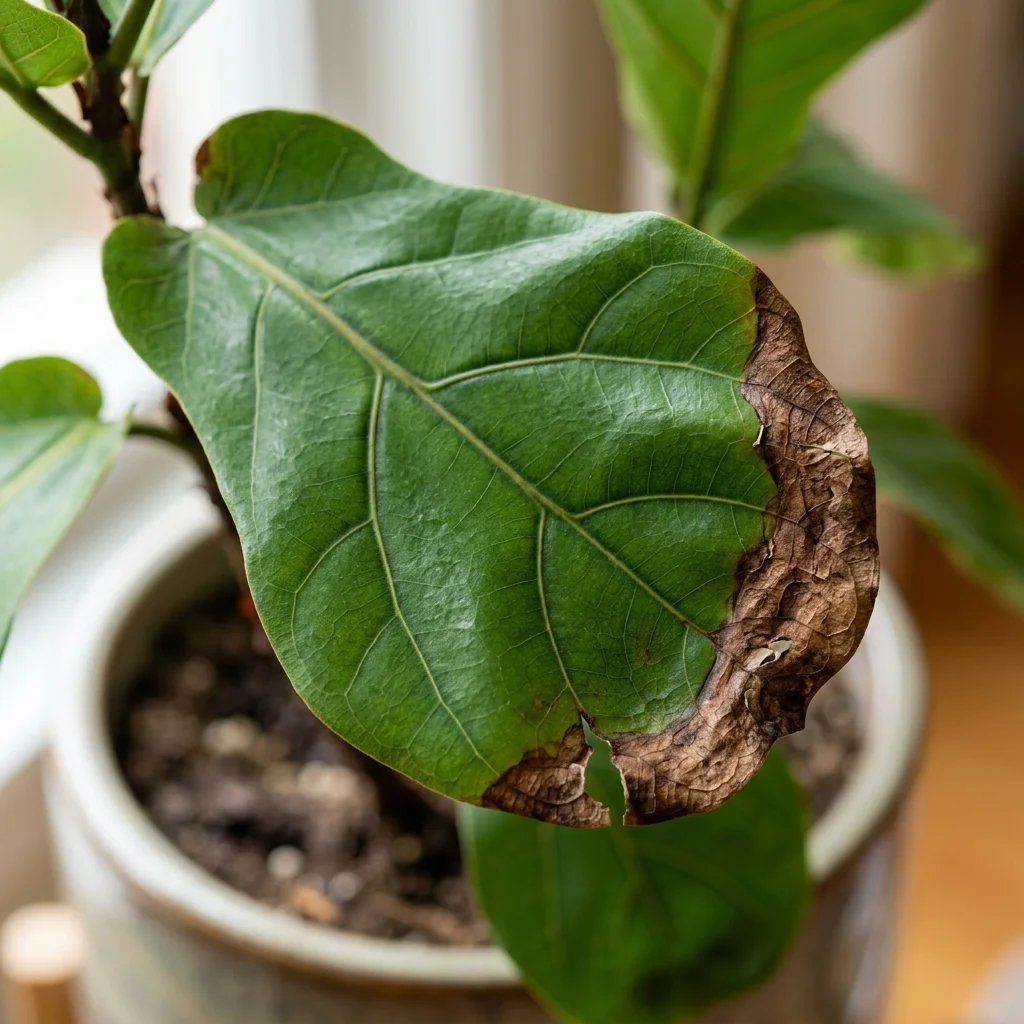
- Marginal leaf scorch on broad-leaved plants: On plants with wide, flat leaves such as pothos or peace lilies, the browning appears first along the outer leaf margins rather than just the tip, tracing a crisp line between healthy green tissue and dead tissue. As burn advances, the necrotic margin widens, eventually consuming a significant portion of the leaf blade. The boundary between dead and living tissue is usually well-defined, distinguishing this from the gradual fade of chlorosis.
- Downward leaf curl at the margins: Before visible browning occurs, leaf edges may begin to curl or cup downward as epidermal cells on the upper surface lose turgor pressure. This early turgidity loss is especially pronounced in younger, more metabolically active leaves. The curl is the plant's attempt to reduce transpiration surface area in response to the osmotic water stress occurring at root level.
- Dark green or unnaturally lush foliage prior to burn: In the days before tip burn appears, over-fertilised plants often display abnormally deep, almost blue-green foliage caused by excess nitrogen forcing rapid chlorophyll synthesis and cell expansion. This lush appearance is deceptive — the same nitrogen overload is simultaneously elevating salt concentrations and setting the stage for osmotic injury. Recognising this pre-symptom phase allows corrective action before tissue death occurs.
- White salt crust on soil surface or pot rim: A visible accumulation of white or off-white mineral deposits on the potting medium surface, around drainage holes, or on the exterior of terracotta pots is a reliable indicator of salt build-up. These deposits are largely calcium, magnesium, and potassium salts that have precipitated as irrigation water evaporated. While the crust itself does not directly burn foliage, its presence confirms that ion concentration in the root zone is elevated.
- Wilting despite moist soil: A plant exhibiting drooping, wilted stems and leaves in a pot that is clearly not dry is displaying a classic osmotic wilting response. The growing medium contains adequate water, but the elevated ionic concentration in the soil solution means the water is osmotically unavailable to root cells. This presentation is frequently misdiagnosed as underwatering, leading to further fertiliser applications that worsen the condition.
- Root tip browning and stunted root development: When roots are examined during repotting or flushing, the delicate white root tips appear brown and blunted rather than white and actively elongating. Severe salt accumulation kills root hairs and the root cap meristem outright, reducing the plant's absorptive surface area and creating a feedback loop in which impaired roots absorb even less water, amplifying the apparent symptoms of drought.
Step-by-Step: How to Treat Nutrient Burn
- Stop all fertiliser applications immediately. As soon as nutrient burn is identified, cease feeding entirely. Adding more fertiliser in an attempt to correct a perceived imbalance is the most common and damaging error. Allow at least three to four weeks after flushing before resuming any feeding programme, giving the plant time to metabolise residual ions and recover root function.
- Flush the growing medium thoroughly with plain, pH-adjusted water. Using water adjusted to pH 6.0–6.5, slowly pour a volume equal to three to four times the pot capacity through the growing medium. This volume is necessary to displace the concentrated salt solution held in the medium and push it out through the drainage holes. Apply the water gradually over 15–20 minutes rather than all at once, allowing it to percolate through and carry ions with it rather than channelling around compacted areas.
- Collect and check the runoff. The water draining from the pot during flushing will initially be darker or have a noticeably different colour than what you are applying — this visible difference reflects dissolved salts and organic compounds being leached out. Continue flushing until the runoff runs clear and, if you have an EC (electrical conductivity) meter, until the runoff EC drops below 1.0 mS/cm, which indicates the salt load has been substantially reduced.
- Trim visibly burned tissue with clean, sharp scissors. Once flushing is complete, remove leaf tips and margins where necrosis has already occurred. Dead tissue will not recover, and leaving it attached increases the risk of secondary fungal infection establishing in the desiccated cells. Sterilise cutting tools with 70% isopropyl alcohol between cuts to avoid transmitting pathogens.
- Move the plant to a lower-light position during recovery. Placing the recovering plant in bright indirect light rather than direct sun reduces the transpirational demand on a root system that is not yet fully functional. High irradiance accelerates water loss through stomata at a rate the compromised roots cannot compensate for, prolonging stress. Maintain ambient temperatures in the range of 18–24°C if possible, as cooler conditions reduce metabolic demand and allow root tissue to repair more efficiently.
- Resume fertilising at half strength after three to four weeks. When new healthy growth is visible and roots appear white and active, reintroduce feeding at 50% of the manufacturer's recommended dilution rate. Use a balanced, complete fertiliser rather than a nitrogen-heavy formula, and observe the plant closely over the following two weeks before incrementally returning to full-strength applications. Liquid fertilisers at reduced concentration are preferable to slow-release granules during this phase because they allow immediate removal by flushing if symptoms recur.
- Implement a preventive flushing schedule going forward. To prevent future salt accumulation, flush container plants with plain water every six to eight weeks during the active growing season. This simple practice resets the ionic balance in the root zone without interrupting the feeding programme significantly, as a single flush removes excess accumulated salts while still leaving the medium with adequate baseline fertility for continued growth.
Best Practices and Pro Tips
Start at quarter strength: When introducing a new fertiliser product or beginning feeding after repotting, start at 25% of the label rate for the first two applications. This allows you to observe how the specific plant responds to that formulation before committing to higher concentrations, and avoids the rapid salt build-up that follows even a single over-application in small containers.
Use an EC meter routinely: Electrical conductivity meters, which cost very little and measure the total dissolved ion load in the soil solution, take the guesswork out of fertiliser management. A reading of 1.5–2.5 mS/cm in the root zone is appropriate for most actively growing houseplants; readings above 3.5 mS/cm are a reliable predictor of imminent burn symptoms, even before leaf damage appears.
Water volume affects concentration: Applying fertiliser solution to a dry medium concentrates salts dramatically in the limited water volume absorbed by thirsty roots. Always pre-moisten the growing medium with plain water before applying liquid fertiliser, ensuring the existing moisture provides a dilution buffer and promoting even distribution through the root zone rather than localised concentration.
Match feeding rate to growth rate: Plants in active growth under good light conditions utilise nutrients efficiently, and higher feed rates are appropriate. The same fertiliser rate applied to a plant in low light, during winter dormancy, or recovering from stress results in salt accumulation because metabolic uptake is far slower than supply. Halve your feeding frequency — not just concentration — during winter or periods of reduced light.
Terracotta reduces accumulation risk: Porous terracotta pots allow excess salts to migrate through the wall and precipitate on the exterior surface, effectively removing them from the root zone. Plants prone to over-fertilisation damage, particularly those in bright, warm positions that receive frequent liquid feeds, benefit from being grown in terracotta rather than glazed ceramic or plastic, where all accumulated salts remain in the medium.
Quick Reference Table
| Factor | Recommended Range | Why It Matters |
|---|---|---|
| Soil solution EC (electrical conductivity) | 1.5–2.5 mS/cm for most houseplants | EC directly measures total dissolved salt load; values above 3.5 mS/cm reliably precede osmotic root stress and leaf burn |
| Flush volume per treatment | 3–4× pot capacity of pH 6.0–6.5 water | Insufficient flushing displaces only a fraction of accumulated salts; this volume ensures the concentrated root-zone solution is fully replaced |
| Recovery feeding concentration | 50% of label rate for first 2–3 applications post-flush | Reintroducing full-strength fertiliser before root function is restored repeats the injury; reduced concentration allows uptake to match supply |
| Preventive flush interval | Every 6–8 weeks during active growing season | Regular flushing prevents incremental salt accumulation that otherwise reaches damaging concentrations without visible warning |
| Post-burn light level | Bright indirect light; avoid direct sun during recovery | Reduced irradiance lowers transpirational demand, allowing impaired roots to maintain adequate tissue hydration while they regenerate |
Plants Most Susceptible to Nutrient Burn
Pothos (Epipremnum aureum) is one of the houseplants most frequently presented with nutrient burn, largely because its reputation for tolerating neglect encourages overcorrection — growers who have previously underfed it tend to apply fertiliser generously once they commit to feeding, pushing salt concentrations past the threshold the roots can handle. The long, trailing leaves develop the characteristic tip and margin scorch quickly and symmetrically, making this an easy species on which to recognise the condition.
Peace lilies (Spathiphyllum wallisii) are particularly sensitive because their preference for consistently moist, organic-rich media means they are often grown in moisture-retentive mixes that hold salt ions close to the roots for extended periods rather than allowing them to leach freely. Brown leaf tip scorch is so common in peace lilies that it is frequently attributed incorrectly to low humidity when the actual cause is fertiliser salt accumulation.
Spider plants (Chlorophytum comosum) show fluoride and salt sensitivity that is more pronounced than in most common houseplants. Even at standard fertiliser concentrations, the leaf tips of spider plants may brown if the water supply contains elevated dissolved solids or if minor salt accumulation occurs. This species is an early warning indicator — tip scorch in spider plants often reveals a salt management issue before it becomes apparent in more tolerant companion plants.
Tomatoes (Solanum lycopersicum) are a classic case of nutrient burn in the vegetable garden, particularly under container growing or hydroponic conditions where growers push feeding schedules heavily to maximise yield. Excess nitrogen at early growth stages produces the characteristic deep green, brittle foliage with curled leaf margins before terminal leaflets begin to claw downward and brown. Fruiting further concentrates demand on the root system, leaving less buffering capacity for salt management errors.
Ferns, particularly the Boston fern (Nephrolepis exaltata), have exceptionally fine, densely branched root systems with enormous surface area relative to plant size. While this architecture makes them efficient at nutrient uptake, it also means they are exposed to a larger volume of soil solution than coarser-rooted plants, increasing the risk of ion overload. Salt accumulation causes rapid frond tip browning that progresses inward along each pinna, creating a scorched, untidy appearance that is difficult to reverse cosmetically.
Calatheas (Calathea spp., syn. Goeppertia spp.) are among the most salt-sensitive foliage plants in cultivation. Their large, patterned leaves develop brown margins and tips at fertiliser concentrations that would be tolerated without complaint by many other tropical houseplants. The combination of their sensitivity to both salt and fluoride, their preference for soft or filtered water, and their popularity as a decorative plant makes nutrient burn an extremely common problem in this genus.
Understanding how fertiliser application rate and timing interact is fundamental to preventing these problems, which we explore thoroughly in our Fertilizer guide. The overlap between nutrient burn symptoms and other forms of tip browning — including those caused by low humidity or fluoride toxicity — is a diagnostic challenge we address in detail in our Brown Tips guide. And since salt accumulation is closely tied to drainage quality and watering frequency, the principles covered in our Overwatering guide are directly relevant to managing the root-zone conditions that make nutrient burn worse.
Common Mistakes to Avoid
Applying fertiliser to dry growing medium: This is one of the most reliable ways to cause acute nutrient burn. When a plant is watered with fertiliser solution after the medium has dried out significantly, the small volume of water available in the root zone concentrates the dissolved salts to a multiple of the intended application rate. Roots actively seeking moisture absorb this concentrated solution rapidly, and osmotic damage follows within 24–48 hours. Always ensure the medium is pre-moistened before applying any liquid feed.
Doubling up with slow-release and liquid fertilisers: Many growers apply slow-release granules at potting time and then add liquid fertiliser on a regular schedule without accounting for the ongoing release from the granules. The cumulative ion load frequently exceeds safe thresholds. A single application of a 6-month slow-release granule at the label rate typically provides adequate nutrition on its own; if supplemental liquid feeding is desired, reduce the rate to no more than 25% of the standard recommendation and monitor EC if possible.
Ignoring the conductivity of tap water: In regions with hard water — total dissolved solids above 300 mg/L — the background ionic load in the irrigation water itself constitutes a meaningful salt input before a single drop of fertiliser is added. Growers using hard tap water who apply fertiliser at full label rates may reach damaging EC levels in the root zone within just a few weeks. Testing your tap water EC and factoring it into your fertiliser calculation, or switching to rainwater or reverse osmosis water, prevents this compounding effect.
Flushing with too little water: When a grower responds to burn symptoms by flushing with one pot-volume of water, they displace only a fraction of the concentrated soil solution. Studies on leaching efficiency in container media show that three pot volumes removes approximately 80–90% of soluble salts; one pot volume removes far less and simply redistributes the salt load within the medium without substantially reducing it. Commit to a thorough flush of at least three times the pot volume to achieve a genuine reset.
Resuming full-strength feeding too quickly after recovery: After flushing and a recovery period, the impulse to return to a full feeding programme is understandable, but root tissue takes two to four weeks to regenerate functional root hairs and restore normal absorptive capacity. Applying full-strength fertiliser to roots that are still recovering from osmotic damage repeats the injury cycle. Maintain 50% concentration for a minimum of three to four feeding cycles before cautiously returning to standard rates, using new healthy leaf growth as the primary indicator of full recovery.
Frequently Asked Questions
Can plants fully recover from nutrient burn?
Yes, plants can fully recover if you catch the burn early. Leaf tissue that has already turned brown is permanently dead, but the plant itself can survive. Flush the soil thoroughly with water and the plant will push out healthy new growth.
How do I know if brown leaf tips are from nutrient burn or something else?
Nutrient burn creates dry, crispy brown tips with a very sharp line between the dead brown tissue and the healthy green tissue. If the brown spots are mushy, it is likely root rot. If the tips are brown but the soil has no white crust, it might just be low humidity.
What fertiliser concentration is safe for sensitive houseplants?
A safe rule for sensitive plants like Calatheas or Ferns is to use a liquid fertilizer at 25% of the recommended strength. These plants are easily burned by salt buildup. Always apply fertilizer to damp soil, never to bone-dry soil.
Should I repot a plant that has suffered severe nutrient burn?
Repotting can help if the soil is heavily crusted with salts, but it also adds stress to a plant that is already struggling. It is usually safer to flush the existing soil with a large volume of water first. Wait 2 to 3 weeks for the plant to stabilize before repotting it into fresh soil.
My plant looks healthy but I can see white crust on the soil — should I act?
Yes, you should act immediately. The white crust is a buildup of fertilizer salts that will eventually burn the roots. Scrape off the top layer of crusted soil, replace it with fresh potting mix, and flush the pot thoroughly with water.
Related Plant Guides
No specific plant guides found matching this topic.
Recommended next actions
Continue Exploring
Dive deeper into related plant care tools and profiles.
Calculator
Plant Fertilizer Calculator: Right Dose for Every Plant
Calculate the exact fertilizer dose and feeding schedule for your plant based on species, pot size, growth stage, and season.
Guide
Fertilizer Burn on Houseplants: Symptoms & Fix Guide
Fertilizer burn is one of the most misdiagnosed houseplant problems because its symptoms — brown tips, wilting, yellowing leaves — are nearly identical to overwatering, underwatering, and root rot. The treatment for root rot is opposite to the treatment for fertilizer burn, which means getting the diagnosis wrong makes the plant worse. This guide is built around that diagnostic problem first.
Guide
How to Dose Fertilizer for Plants: Calculator & Mixing Guide
Stop guessing how much fertilizer your plants need. Use our calculator, dilution formula, mixing charts, and expert troubleshooting to feed safely without burning roots. Estimated reading time: 10 minutes.
Guide
Calathea Orbifolia Care: Tips for Big Striped Leaves
After cultivating over 50 Calatheas and maintaining high-humidity greenhouse environments for 5 years, we have mastered the art of keeping Calathea Orbifolia thriving indoors without brown edges.
Calculator
Aquarium Fertilizer Calculator: Macro & Micro Doses
Calculate exact macro and micro fertilizer doses for your planted aquarium based on tank volume, plant density, CO2 system, and dosing strategy.
Plant Guide
Bougainvillea Care
A complete Bougainvillea care guide covering watering, sunlight, pruning, fertilizers, propagation, flowering cycles, and troubleshooting for healthy vibrant blooms.