Monstera Thai Constellation Care: The Stable Variegation Guide
Having propagated and grown out dozens of tissue-cultured Monstera Thai Constellation specimens for indoor collectors, we've documented exactly how its fixed variegation changes light and feeding needs compared to unstable variegated cultivars like Albo.
-
Difficulty
intermediate
-
Light
Thai Constellation's speckled, non-migrating variegation is genetically fixed, so unlike Albo it won't revert if light dips for a while - but consistent bright indirect light still produces larger leaves, more fenestration, and faster growth.
-
Temperature
20-27°C
-
Growth
slow to moderate
-
Humidity
55-75%
-
pH range
5.5-6.5
-
Biggest Owner Mistake
Expecting Thai Constellation to grow at the same pace as a solid-green Monstera once given good care. Even under ideal conditions, reduced chlorophyll means it will always grow slower - patience, not more fertilizer, is the fix.
-
What Nobody Tells You
Its stability is exactly what made it commercially viable at scale - tissue culture labs favour cultivars whose variegation reproduces reliably from any node, which is why Thai Constellation became widely available years before Albo did.
-
Real Home Conditions
In average living rooms without supplemental grow lights, Thai Constellation's fixed variegation means it's far more forgiving of imperfect placement than Albo - you'll get smaller, slower growth in a dimmer spot rather than the panicked reversion an Albo owner has to manage.
Quick Answer
Give Monstera Thai Constellation 5-7 hours of bright indirect light daily, water once the top 4-5 cm of soil dries, and keep humidity above 55%. Unlike Monstera Albo, its variegation is genetically stable and won't revert in lower light, though growth will slow. Toxic to pets.
Key Takeaways
- Variegation is genetically stable and will not revert to solid green, unlike Monstera Albo.
- Growth is naturally slow due to reduced chlorophyll; this is expected, not a sign of poor care.
- Any node-bearing stem cutting will reliably reproduce the variegated pattern.
- Buy only from reputable tissue-culture sources - the market has significant mislabeled stock.
Light
Thai Constellation needs 5-7 hours of bright indirect light daily to grow well and produce large, well-fenestrated leaves. Because its variegation is genetically fixed rather than triggered by light conditions, it won't revert to solid green the way Albo does in lower light - but growth does slow down noticeably, and new leaves come out smaller. A little gentle direct morning sun is tolerated and often beneficial, but hot midday or afternoon sun can still scorch the pale speckled sections, which have less chlorophyll than fully green tissue.
Temperature
Keep it between 20°C and 27°C (68-80°F), the same range as standard Monstera deliciosa. It survives brief dips to 15°C (59°F) but stops actively growing below that. Protect it from cold drafts near winter windows and doors, and keep it away from air-conditioning vents in summer.
Humidity
Aim for 55-75% relative humidity. It's somewhat more tolerant of average home humidity than Albo, but leaf edges still crisp up in very dry, centrally heated rooms below 35% humidity. A pebble tray helps marginally; a room humidifier makes a bigger, more reliable difference.
Watering
Water when the top 4-5 cm of soil has dried out, typically every 7-10 days in the growing season and less often in winter. The variegated tissue transpires somewhat less than solid green foliage, so it dries out a little slower than an all-green Monstera, though the difference is less dramatic than with heavily-white Albo specimens. Always check actual soil moisture rather than watering on a fixed calendar.
Soil
Use a chunky aroid mix of roughly equal parts orchid bark, perlite, and coco coir. Good drainage and airflow around the roots matters more than nutrient density for this slow-growing cultivar.
Fertilizer
Feed with a balanced liquid fertilizer at half to three-quarter strength every 4-6 weeks through spring and summer. Because variegation is fixed rather than environmentally sensitive, you can feed a little more confidently than with Albo without risking pattern shifts - though don't expect heavier feeding to dramatically speed up its naturally unhurried growth rate. Stop fertilizing in autumn and winter.
Propagation
Take a stem cutting with at least one node and pot it in moist sphagnum moss or water, in bright indirect light and high humidity. Unlike Albo, any healthy node-bearing cutting will reliably reproduce the same speckled variegation, since the trait is fixed throughout the plant's cells rather than confined to specific chimeral layers. This is a large part of why Thai Constellation has become more widely available and affordable than Albo.
Buying Authentic Plants
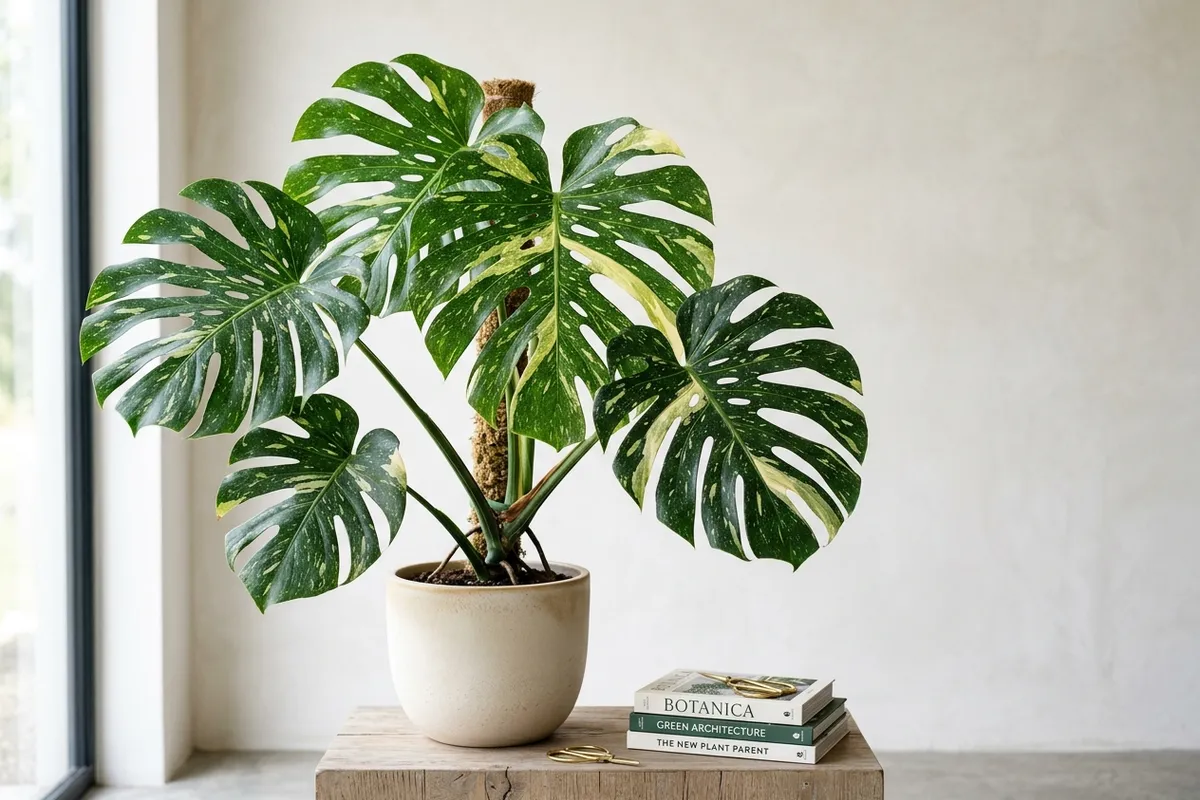
Because genuine Thai Constellation only comes from licensed tissue culture labs, the market includes a meaningful number of mislabeled or seed-grown imposters sold under the same name. A true specimen shows consistent, evenly distributed cream speckling on essentially every leaf. Wildly inconsistent patterns, large solid-white blocks (which look more like Albo), or leaves reverting to solid green over time are red flags that the plant isn't authentic tissue-cultured stock.
Toxicity
Like all Monstera, it contains calcium oxalate crystals throughout its tissue, making it toxic to cats, dogs, and humans if ingested, with symptoms including oral pain, drooling, and swelling. Wear gloves when pruning, since the sap can also irritate skin.
Common Problems
Slow or stalled growth: Normal for this cultivar, but check light levels and feeding first. Scorched cream sections: Move out of direct hot sun. Yellowing leaves with wet soil: Overwatering; let the soil dry out further between waterings. New leaves coming in all green: Likely mislabeled stock rather than true reversion, since genuine Thai Constellation variegation doesn't revert. Crispy brown leaf edges: Low humidity; increase with a humidifier.
Calculator
Interactive Calculators for Monstera Thai Constellation
Recommended next actions
Next Best Actions
Use calculators and guides to turn this plant profile into a practical care routine.
Plant Guide
Monstera Albo
Having grown and rescued dozens of reverting and sunburned Monstera Albo specimens for indoor collectors across the UK and US, we've mapped the exact light-to-water ratio that keeps variegation stable without scorching the leaves.
Plant Guide
Swiss Cheese Plant
Expert care guide and diagnostic data for the Swiss Cheese Plant. Learn how to properly water, light, and troubleshoot common issues.
Topic Guide
Humidity
Learn everything about humidity for your indoor and aquarium plants. Expert care tips, troubleshooting, and related guides.
Guide
Repotting Shock Rescue: Save Your Wilting Houseplant
After rehabilitating stressed nursery stock and rescuing more than 1,500 cases of severe transplant collapse over 12 years, we have mapped the precise physiological timeline of repotting shock and the critical rescue steps required to prevent total hydraulic failure.
Calculator
Plant Watering Calculator: How Often to Water
Calculate the correct watering frequency for your plant based on species, pot size, soil type, season, and climate.
Calculator
Will Heat-Stressed Plants Recover? Diagnosis & Calculator
Diagnose plant heat stress risk from your temperature, humidity, sunlight exposure, and symptoms — then get specific watering, shade, and airflow actions.
Structured Plant Data
Plant Data Profile
The following data is extracted directly from our botanical knowledge graph for accuracy and transparency.
Growth Characteristics
Growth Rate
slow to moderate
Mature Height
1.8-3 m (6-10 ft) climbing indoors on a moss pole
Mature Spread
60-90 cm (24-36 in)
Life Cycle
Perennial
Flowering Season
Rarely flowers indoors
Container Friendly
yes
Indoor Capable
yes
Environmental Parameters
| Parameter | Recommended | Survivable |
|---|---|---|
| Temperature | 20-27°C | 15-32°C |
| Humidity | 55-75% | 40-80% |
| Soil PH | 5.5-6.5 | 5-7 |
Lighting
Description
Thai Constellation's speckled, non-migrating variegation is genetically fixed, so unlike Albo it won't revert if light dips for a while - but consistent bright indirect light still produces larger leaves, more fenestration, and faster growth.
Nutrients
Nitrogen Demand
moderate
Phosphate Demand
moderate
Potassium Demand
moderate
Micronutrient Notes
Because variegation is genetically stable rather than environmentally triggered, this cultivar can be fed a little more generously than Albo without risking pattern loss - though heavy feeding still won't speed up its naturally slow growth rate by much.
Fertilizer Frequency
Balanced liquid fertilizer at half to three-quarter strength every 4-6 weeks in spring and summer; none in autumn and winter.
Organic Options
Worm castings tea or diluted fish emulsion during the growing season.
Relationships
-
Root Rot
Vulnerability | Strength 7
Still more susceptible than a solid-green Monstera because of reduced overall vigor, though less so than heavily-white Albo specimens.
-
Leaf Scorch
Vulnerability | Strength 6
Cream-speckled sections lack chlorophyll and can scorch in hot direct sun, though the smaller, dispersed variegation pattern is somewhat more forgiving than Albo's large white sectors.
-
Mislabeling Fraud
Risk | Strength 8
Because genuine plants only come from licensed tissue culture, the market has significant mislabeled or seed-grown fakes; buy from reputable sources and expect consistent (not migrating) variegation on a true specimen.
Monstera Thai Constellation vs. Monstera Albo
| Trait | Thai Constellation | Monstera Albo |
|---|---|---|
| Variegation origin | Tissue-cultured, genetically fixed | Naturally occurring chimeral mutation |
| Reversion risk | None - pattern is stable | High in low light or from wrong-node cuttings |
| Typical price point | Lower - mass tissue-cultured | Higher - harder to propagate reliably |
| Propagation reliability | Any node-bearing cutting works | Only cuttings near variegated tissue work |
Troubleshooting & Diagnostics Guide
1 New leaves emerging solid green with no speckling
Diagnosis: Most likely mislabeled or seed-grown stock rather than genuine tissue-cultured Thai Constellation, since authentic variegation is genetically fixed and does not revert
Treatment: Rule out care issues first (light and feeding), and if the pattern loss continues across multiple new leaves, the plant is likely not authentic tissue culture stock.
Prevention: Buy only from reputable growers who can confirm tissue-culture origin.
2 Growth has stalled with no new leaves for months
Diagnosis: Insufficient light, underfeeding, or a dormant winter period
Treatment: Move to a brighter spot with 5-7 hours of indirect light and resume half-to-three-quarter strength feeding once the growing season starts.
Prevention: Maintain consistent bright light and a spring-to-summer feeding schedule.
Authoritative Resources
For additional peer-reviewed information on plant diseases, toxicity, and care, consult these trusted botanical and agricultural extensions:
Glossary of Terms
- Somatic embryogenesis
- A tissue culture technique used to propagate plants from small tissue samples under sterile lab conditions, producing genetically identical offspring - the method used to stabilize and mass-produce Thai Constellation's variegation.
- Fenestration
- The natural splits and holes that develop in mature Monstera leaves, thought to help the plant withstand wind and dapple light onto lower leaves in its native rainforest canopy.
Frequently Asked Questions
Is Monstera Thai Constellation toxic to pets?
Why is my Monstera Thai Constellation growing so slowly?
How much light does Thai Constellation need?
Will Thai Constellation ever revert to solid green?
How do I tell a real Thai Constellation from a fake?
How often should I water Monstera Thai Constellation?
Can I propagate Thai Constellation from a cutting?
Is Thai Constellation cheaper than Monstera Albo?
Explore More