Monstera Albo Care: How to Stop Reversion and Keep Variegation Stable
Having grown and rescued dozens of reverting and sunburned Monstera Albo specimens for indoor collectors across the UK and US, we've mapped the exact light-to-water ratio that keeps variegation stable without scorching the leaves.
-
Difficulty
advanced
-
Light
The single most important variable for Monstera Albo. Too little bright light and new growth reverts to solid green; too much direct sun and the white sections, which have no protective chlorophyll, scorch within hours.
-
Temperature
20-27°C
-
Growth
slow to moderate
-
Humidity
60-80%
-
pH range
5.5-6.5
-
Biggest Owner Mistake
Watering an Albo on the same schedule as a solid-green Monstera. Because white tissue transpires far less, this is the single fastest route to root rot in variegated aroids - always check soil moisture directly rather than following a fixed calendar.
-
What Nobody Tells You
Variegation isn't fixed for life - it's a running negotiation between the plant's genetics and its environment. A heavily white plant that isn't getting enough light will quietly shift new growth greener, node by node, long before you notice any single dramatic reversion.
-
Real Home Conditions
In most Western homes, the limiting factor isn't overall light quantity but light consistency - a plant that gets bright light for a few hours a day near a window but spends the rest of the day in dim ambient light behaves like a low-light plant for variegation purposes, even if the room looks bright to the eye.
Quick Answer
Give Monstera Albo more bright indirect light than a standard Monstera (6-8 hours daily), water only once the top 5 cm of soil is dry, and keep humidity above 60%. Avoid direct sun, which scorches the white sections, and avoid low light, which causes reversion to solid green. Toxic to pets.
Key Takeaways
- Needs more bright indirect light than a standard Monstera to prevent reversion to solid green.
- Water less frequently than a solid-green Monstera - white tissue transpires less and holds moisture longer.
- Never place in direct sun; chlorophyll-free white sections scorch quickly.
- Only propagate from stems with variegation near the node to preserve the pattern.
Light
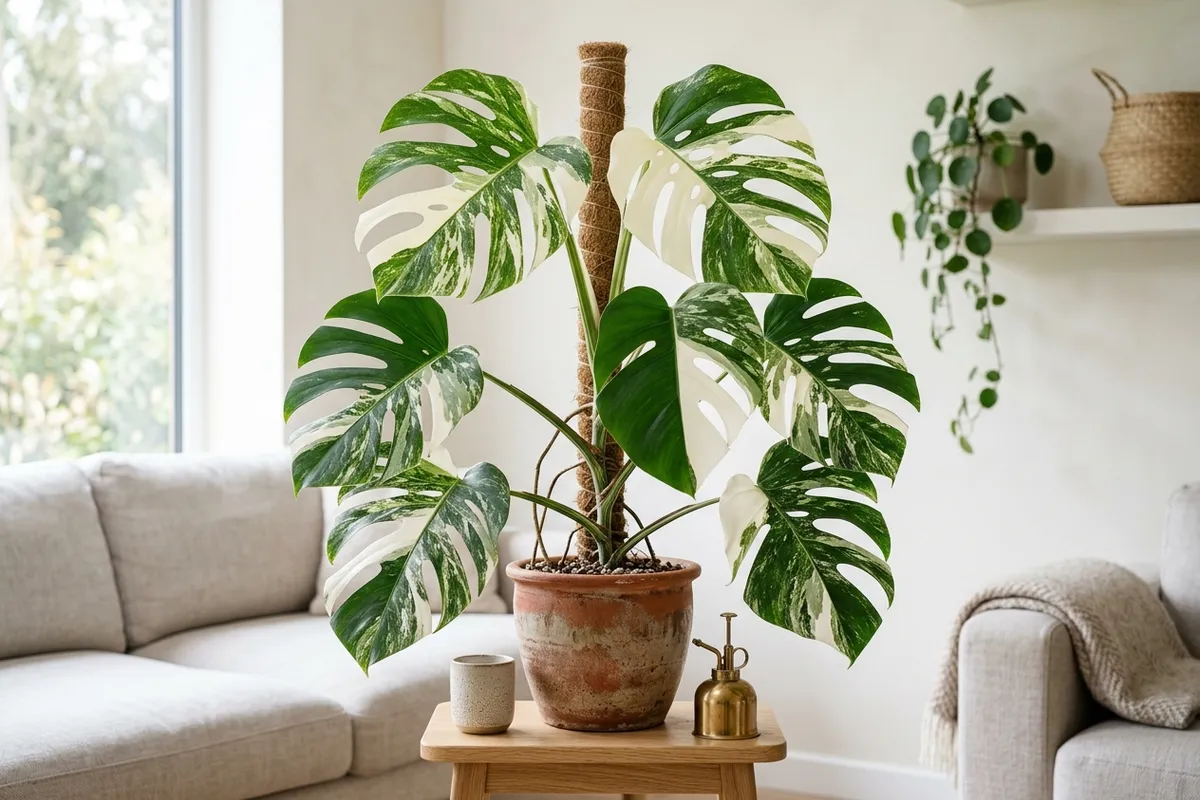
Albo needs more bright indirect light than a typical Monstera, not less. In deep shade, the plant prioritises chlorophyll-producing green growth for survival, which is why low light is the number one cause of reversion. Aim for 6-8 hours of bright indirect light daily, and don't be afraid to let it catch an hour or two of gentle early morning sun through an east-facing window. What it cannot tolerate is direct midday or afternoon sun: the white sections have no chlorophyll to absorb and dissipate that UV energy, so they scorch to a papery, translucent brown within hours in a hot direct beam, while nearby green tissue on the same leaf stays unharmed. If your only bright window faces south or west, keep the plant 1-2 metres back from the glass or filter the light with a sheer curtain.
Temperature
Keep Albo between 20°C and 27°C (68-80°F). It tolerates a dip to 15°C (59°F) but growth stalls below that, and variegated tissue is generally more cold-sensitive than solid green tissue because it has less stored energy reserve to draw on during stress. Avoid cold drafts from windows and doors in winter, and keep the plant away from air-conditioning vents in summer.
Humidity
Aim for 60-80% relative humidity. Variegated leaves are more prone to crispy, uneven edges in dry air because the white sections lose moisture without being able to replace lost turgor pressure as efficiently as green tissue. A room humidifier running through the heating season makes a visible difference to leaf quality within a few weeks.
Watering
This is where most Albo owners go wrong. Because white tissue has no chlorophyll, it does far less transpiration than green tissue, so a heavily variegated plant uses noticeably less water than a solid green Monstera of the same size. Watering on the same schedule as your other aroids is the single most common way to trigger root rot. Let the top 5 cm of soil dry out fully before watering again, and always check the pot's actual weight or use a moisture meter rather than watering on a fixed calendar.
Soil
Use a chunky, fast-draining aroid mix: roughly equal parts orchid bark, perlite, and coco coir. This mimics the loose leaf litter and epiphytic conditions Monstera roots evolved in, and the large air pockets are essential insurance against the slower water uptake of variegated growth.
Fertilizer
Feed lightly. A balanced liquid fertilizer at half strength every 6-8 weeks through spring and summer is enough. Heavy nitrogen feeding pushes the plant toward vigorous green growth at the direct expense of variegation, since chlorophyll production is the plant's default survival response to abundant resources. Stop feeding entirely in autumn and winter.
Propagation
Take stem cuttings with at least one node and, ideally, some aerial root growth, cutting just below the node. Root in water or damp sphagnum moss in bright, indirect light and high humidity. Crucially, only take cuttings from stems showing stable variegation patterns close to the node you're cutting - a node from an all-green section will almost always grow back green, since chimeral variegation is tied to specific cell layers that must be present at the growing point.
Toxicity
All parts contain calcium oxalate crystals and are toxic to cats, dogs, and humans if ingested, causing oral pain, drooling, and swelling. The sap can also irritate skin, so wear gloves when pruning or propagating.
Common Problems
Reverting to solid green: Insufficient light. Move to a brighter spot and prune reverted growth back to a variegated node. Brown, crispy white sections: Sunburn from direct light; move the plant back from the window. Yellowing green leaves with wet soil: Overwatering; variegated plants need longer to dry out between waterings than growers expect. Stunted growth with mostly white leaves: The plant is starved for chlorophyll; prune the least-green leaves to redirect energy. Small, weak new leaves: Usually low light combined with light feeding; both need to increase together.
Calculator
Interactive Calculators for Monstera Albo
Recommended next actions
Next Best Actions
Use calculators and guides to turn this plant profile into a practical care routine.
Plant Guide
Monstera Thai Constellation
Having propagated and grown out dozens of tissue-cultured Monstera Thai Constellation specimens for indoor collectors, we've documented exactly how its fixed variegation changes light and feeding needs compared to unstable variegated cultivars like Albo.
Plant Guide
Swiss Cheese Plant
Expert care guide and diagnostic data for the Swiss Cheese Plant. Learn how to properly water, light, and troubleshoot common issues.
Topic Guide
Humidity
Learn everything about humidity for your indoor and aquarium plants. Expert care tips, troubleshooting, and related guides.
Guide
Repotting Shock Rescue: Save Your Wilting Houseplant
After rehabilitating stressed nursery stock and rescuing more than 1,500 cases of severe transplant collapse over 12 years, we have mapped the precise physiological timeline of repotting shock and the critical rescue steps required to prevent total hydraulic failure.
Calculator
Plant Watering Calculator: How Often to Water
Calculate the correct watering frequency for your plant based on species, pot size, soil type, season, and climate.
Calculator
Will Heat-Stressed Plants Recover? Diagnosis & Calculator
Diagnose plant heat stress risk from your temperature, humidity, sunlight exposure, and symptoms — then get specific watering, shade, and airflow actions.
Structured Plant Data
Plant Data Profile
The following data is extracted directly from our botanical knowledge graph for accuracy and transparency.
Growth Characteristics
Growth Rate
slow to moderate
Mature Height
2-3 m (6.5-10 ft) climbing indoors on a moss pole
Mature Spread
60-90 cm (24-36 in)
Life Cycle
Perennial
Flowering Season
Rarely flowers indoors
Container Friendly
yes
Indoor Capable
yes
Environmental Parameters
| Parameter | Recommended | Survivable |
|---|---|---|
| Temperature | 20-27°C | 15-32°C |
| Humidity | 60-80% | 40-80% |
| Soil PH | 5.5-6.5 | 5-7 |
Lighting
Description
The single most important variable for Monstera Albo. Too little bright light and new growth reverts to solid green; too much direct sun and the white sections, which have no protective chlorophyll, scorch within hours.
Nutrients
Nitrogen Demand
moderate
Phosphate Demand
moderate
Potassium Demand
moderate
Micronutrient Notes
Because white tissue can't photosynthesize, over-fertilizing pushes the plant to produce more green (chlorophyll-bearing) growth at the expense of variegation. Feed lighter than a standard green Monstera.
Fertilizer Frequency
Half-strength balanced liquid fertilizer every 6-8 weeks in spring and summer; none in autumn and winter.
Organic Options
Diluted worm castings tea or seaweed extract, applied sparingly.
Relationships
-
Root Rot
Vulnerability | Strength 8
Variegated tissue reduces overall water uptake, so soil stays wet longer than growers expect if watered on the same schedule as a solid-green Monstera.
-
Leaf Scorch
Vulnerability | Strength 8
White sections have no chlorophyll to buffer UV exposure and burn to a crisp, translucent brown far faster than green leaf tissue in the same light.
-
Spider Mites
Vulnerability | Strength 6
Low humidity and dry indoor air invite spider mites, which are harder to spot on pale variegated sections.
Monstera Albo vs. Other Variegated Monstera Cultivars
| Variety | Variegation Stability | Light Needs |
|---|---|---|
| Monstera Albo Borsigiana | Unstable chimeral mutation; can revert or intensify unpredictably | High - 6-8 hrs bright indirect |
| Monstera Thai Constellation | Stable, genetically fixed via tissue culture | Moderate-high - 5-7 hrs bright indirect |
| Monstera deliciosa (standard) | Not variegated; solid green | Moderate - 3-5 hrs bright indirect |
Troubleshooting & Diagnostics Guide
1 New leaves emerging fully green with no white sections
Diagnosis: Reversion caused by insufficient bright light or the cutting having originated from a non-variegated cell layer
Treatment: Increase light to 6-8 hours of bright indirect exposure daily and prune the reverted stem back to the last node that showed variegation.
Prevention: Maintain consistently bright light year-round and only propagate from stems with variegation close to the node.
2 White leaf sections turning brown, crispy, and translucent
Diagnosis: UV scorch, since chlorophyll-free tissue has no natural sun protection
Treatment: Move the plant out of direct sun immediately and trim severely scorched tissue to prevent fungal entry points.
Prevention: Position 1-2 m back from south- or west-facing windows or filter light with a sheer curtain.
Authoritative Resources
For additional peer-reviewed information on plant diseases, toxicity, and care, consult these trusted botanical and agricultural extensions:
Glossary of Terms
- Chimeral variegation
- A type of variegation where different layers of plant cells have different genetic makeup, resulting in an unstable pattern that can shift, spread, or revert depending on which cell layer dominates new growth.
- Reversion
- When a variegated plant produces new growth that has lost its variegation and returned to the solid green form, usually triggered by low light or propagation from a non-variegated growing point.
Frequently Asked Questions
Is Monstera Albo safe to keep around pets?
Why is my Monstera Albo losing its variegation?
How much light does Monstera Albo actually need?
How often should I water Monstera Albo?
Why are the white parts of my leaves turning brown and crispy?
Should I cut off all-white leaves?
Why is my Monstera Albo growing so slowly?
What's the difference between Monstera Albo and Thai Constellation?
Explore More