How to Care for Pothos (Epipremnum aureum): A Complete Guide
A complete guide to Pothos care, covering lighting, watering, and propagation.
Quick Answer
Pothos (Epipremnum aureum) is a tropical vine from the Araceae family that thrives in bright, indirect light with temperatures between 65–85°F (18–29°C). Water only when the top 2–3 inches of soil are completely dry, then soak thoroughly until water drains from the bottom. Use a well-draining potting mix, fertilize monthly at half strength during spring and summer, and prune above leaf nodes to maintain a bushy shape. Keep away from pets and children—all parts contain calcium oxalate crystals.
Key Takeaways
- Provide bright, indirect sunlight, though low ambient light is well tolerated.
- Allow the top 2 to 3 inches of substrate to dry completely before watering.
- Prune trailing vines above nodes regularly to stimulate fuller, bushier growth.
- Propagate stem cuttings easily in water or aerated potting mix.
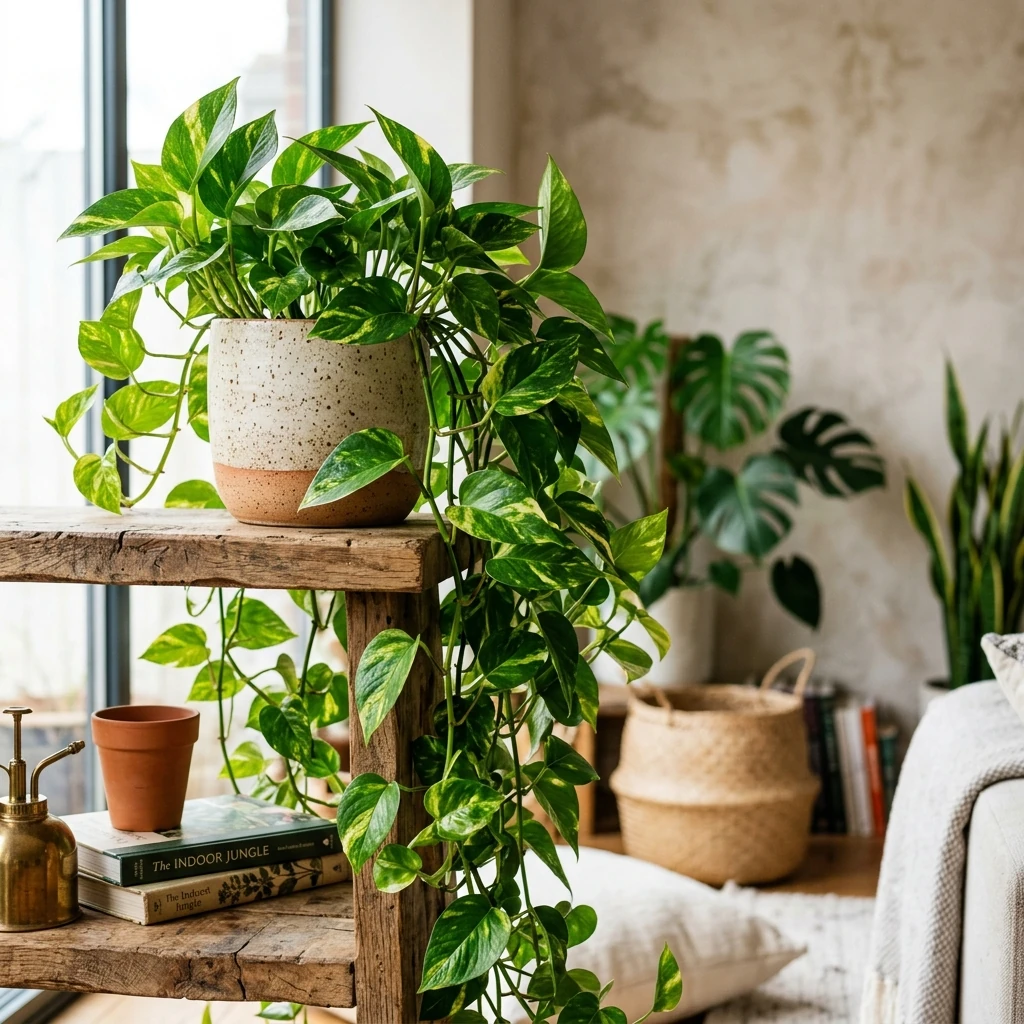
Epipremnum aureum—commonly called Pothos, Devil's Ivy, or Golden Pothos—is a tropical evergreen vine in the Araceae family (arum family). Native to the Solomon Islands and surrounding regions of Southeast Asia, this plant has earned its reputation as the ultimate beginner houseplant. In its natural habitat, it climbs tree trunks using adhesive aerial roots, reaching lengths of 65 feet or more. Indoors, it typically grows 6–10 feet as a trailing or climbing specimen.
What makes Pothos so popular is not just its forgiving nature, but its remarkable adaptability. It tolerates low light, inconsistent watering, and average household humidity better than almost any other houseplant. However, there is a significant gap between a Pothos that merely survives and one that thrives with large, glossy leaves and vigorous vine growth. This guide bridges that gap with botanically sound, practical advice.
Botanical Overview
Pothos belongs to the genus Epipremnum, which contains about 15 species. The plant was previously classified under several names including Pothos aureus, Scindapsus aureus, and Raphidophora aurea, but Epipremnum aureum is now the accepted botanical name. It is hardy in USDA zones 10–12, meaning it cannot tolerate frost and must be grown indoors or as a seasonal annual in temperate climates.
The leaves are heart-shaped, glossy, and waxy with a "knee" in the petiole where it grasps the stem. Juvenile leaves are entire (smooth-edged) and measure a few inches long. When given a support to climb and adequate light, mature plants can produce much larger leaves—up to 3 feet long in ideal tropical conditions—with splits along the midrib. Pothos rarely flowers indoors because only the mature phase produces inflorescences, and houseplants typically remain in the juvenile phase.
Light Requirements
Yes, Pothos can survive in low light. It will tolerate fluorescent office lighting and north-facing windows. But survival is not the same as thriving. For faster growth, larger leaves, and richer coloration, provide bright, indirect light.
An east-facing window is ideal—it delivers gentle morning sun without the harsh afternoon intensity. A spot 3–5 feet from a south or west window also works well. Direct midday sun will scorch the leaves, causing bleached or brown patches. If you notice pale, washed-out foliage, move the plant slightly away from the light source.
Variegated varieties like Marble Queen, Snow Queen, and Neon Pothos need more light than the standard Golden Pothos. In dim conditions, variegated plants will revert to solid green as the plant prioritizes chlorophyll production over pigment variation. If your variegated Pothos is losing its pattern, it is asking for brighter light.
| Light Condition | Growth Rate | Leaf Size | Variegation |
|---|---|---|---|
| Bright, indirect | Fast (12–18 inches/month) | Large | Strong |
| Moderate indirect | Moderate | Medium | Fair |
| Low light | Slow | Small | Fades to green |
| Direct sun | Stunted | Scorched | Bleached |
Watering: The Saturation-Aeration Cycle
The number one cause of Pothos death is overwatering. Pothos roots are adapted to the well-drained forest floors and tree bark of tropical environments. They need oxygen around the root zone and will suffocate in constantly soggy soil. Root rot (Phytophthora and Pythium species) sets in quickly when drainage is poor or watering is too frequent.
Instead of watering on a fixed schedule, use the Saturation-Aeration Cycle:
- Check the soil. Insert your finger 2–3 inches into the potting mix. If it feels dry at that depth, it is time to water. In winter, you can let the top half of the soil dry out.
- Saturate thoroughly. Water slowly and evenly until roughly 20% of the water volume drains from the bottom hole. This deep watering flushes accumulated fertilizer salts and pulls fresh oxygen into the root zone.
- Drain completely. Never let the pot sit in standing water. Empty the saucer after 15 minutes.
- Aerate. Wait until the soil dries again before the next watering. The plant will tell you—leaves may droop slightly when thirsty, but they perk back up within hours of watering.
Warning: Yellow leaves that feel soft and mushy usually signal overwatering and potential root rot. Yellow leaves that are crispy and dry indicate underwatering. Learn to distinguish between the two.
| Season | Watering Frequency | Soil Dryness Target |
|---|---|---|
| Spring/Summer | Every 7–10 days | Top 2 inches dry |
| Fall | Every 10–14 days | Top 3 inches dry |
| Winter | Every 14–21 days | Top half dry |
Humidity and Temperature
Pothos is native to humid tropical forests where humidity often exceeds 70%. Indoors, it tolerates average household humidity (30–50%) remarkably well, which is part of why it is such a reliable houseplant. That said, higher humidity promotes larger leaves, faster growth, and lusher vines.
If your home is particularly dry—common in winter with forced-air heating—consider these options:
- Place the pot on a pebble tray filled with water (keep the pot base above the water line).
- Group plants together to create a localized humid microclimate.
- Use a room humidifier, especially near variegated varieties.
- Mist the leaves occasionally, though this provides only temporary humidity relief.
Temperature is straightforward: Pothos prefers the same range most humans do. Ideal daytime temperatures are 70–85°F (21–29°C), with nights around 60–70°F (15–21°C). It will tolerate brief dips to 55°F (13°C), but prolonged exposure below 50°F (10°C) causes cell damage and leaf drop. Keep plants away from cold drafts, air conditioning vents, and heating radiators.
Soil and Potting
Pothos needs a well-draining, airy potting mix. Standard all-purpose potting soil works, but it should be amended to improve drainage. A good mix contains:
- 60% high-quality peat-based or coco coir potting mix
- 20% perlite or pumice (for aeration)
- 20% orchid bark or coarse sand (for drainage structure)
The pH should be neutral to slightly acidic, around 6.0–6.5. Heavy, compacted soils that retain water for days will suffocate roots and invite rot.
Repotting: Pothos benefits from fresh soil every 1–2 years. Signs it is time to repot include roots emerging from drainage holes, water running straight through the pot without absorbing, or stunted growth despite proper care. Choose a pot only one size larger—Pothos actually prefers being slightly root-bound. Spring is the best time to repot, as the plant enters its active growth phase.
When repotting, gently loosen the root ball and trim any soft, brown, or mushy roots with sterilized scissors. Fill the new container with fresh mix, position the plant at the same depth, and water lightly. Avoid heavy watering immediately after repotting; the disturbed roots are more susceptible to rot.
Fertilizer
Pothos is not a heavy feeder, but regular fertilization during the growing season makes a visible difference in vine length and leaf size. Use a balanced, water-soluble houseplant fertilizer (such as 20-20-20 or 10-10-10) at half the manufacturer's recommended strength.
| Season | Frequency | Strength |
|---|---|---|
| Spring/Summer | Every 4 weeks | Half strength |
| Fall | Every 6–8 weeks | Half strength |
| Winter | None | — |
Over-fertilizing causes salt buildup in the soil, which burns leaf tips and edges. If you see brown, crispy margins on otherwise healthy leaves, flush the soil with plain water several times to leach excess salts. Always apply fertilizer to moist soil, never to dry roots.
Some growers supplement with diluted liquid seaweed or fish emulsion for micronutrients. These are fine additions but not necessary for basic health. Avoid unverified home remedies like coffee grounds or banana peels in the pot—they decompose unpredictably and can alter soil chemistry in ways that harm roots.
Pruning and Training
Left unpruned, Pothos produces one or two dominant vines that grow leggy and sparse. To create a full, bushy plant, prune regularly.
Always cut just above a leaf node—the point where a leaf attaches to the stem. Use clean, sharp scissors or pruning shears sterilized with rubbing alcohol. New growth emerges from the node just below your cut, branching the vine and creating a denser canopy. You can remove up to one-third of the vine length without stressing the plant.
If you prefer a climbing specimen rather than a trailing one, provide a support:
- Moss pole: Wrap the vine around a damp sphagnum moss pole. Aerial roots will attach naturally, and the plant will produce larger leaves as it matures.
- Trellis or stake: A simple bamboo stake or small trellis works for lighter vines. Secure loosely with soft plant ties.
- Wall mounts: Small adhesive hooks can guide vines along a wall, though this requires more maintenance.
Remove yellow or dead leaves as they appear. This is normal—older leaves senesce as the plant directs energy to new growth. However, widespread yellowing is a sign of a care problem, not simple aging.
Propagation
Pothos is one of the easiest houseplants to propagate. Stem cuttings root readily in water, soil, or sphagnum moss. The key is including at least one node—the small bump on the stem where leaves and aerial roots emerge. Roots will only grow from nodes, not from bare stem.
Water propagation (most popular):
- Cut a 4–6 inch section of stem, making sure it has 2–3 nodes and at least 2 leaves.
- Remove the bottom leaf to expose the node.
- Place the cutting in a jar of clean water, submerging the node but keeping the leaves above the surface.
- Change the water every 3–5 days to prevent bacterial growth.
- Roots typically appear in 2–4 weeks. Once they reach 2–3 inches long, transplant into soil.
Soil propagation:
- Prepare a small pot with moist, well-draining potting mix.
- Insert the cutting so the node is buried about 1 inch deep.
- Keep the soil lightly moist and cover with a clear plastic bag to maintain humidity.
- Roots form in 3–6 weeks. Gently tug the cutting after 4 weeks—resistance means roots have established.
Sphagnum moss propagation:
- Wrap damp sphagnum moss around the node and secure with plastic wrap or a zip tie.
- Keep the moss consistently damp.
- Roots emerge in 2–3 weeks. Cut below the rooted section and pot up.
Spring and summer are the best seasons for propagation, as the plant's metabolic activity is highest. Cuttings taken in winter root more slowly and have a lower success rate.
Common Pests
Pothos is relatively pest-resistant, but it is not immune. The most common invaders are:
| Pest | Signs | Treatment |
|---|---|---|
| Spider mites | Fine webbing, stippled yellow leaves | Shower leaves with water; apply insecticidal soap or neem oil |
| Mealybugs | White cottony masses in leaf axils | Dab with rubbing alcohol; use systemic insecticide for heavy infestations |
| Scale insects | Brown, waxy bumps on stems and leaves | Scrape off manually; treat with horticultural oil |
| Fungus gnats | Small black flies around soil surface | Let soil dry between waterings; use sticky traps or beneficial nematodes |
Prevention is the best strategy. Inspect new plants before bringing them home, and isolate any plant showing signs of infestation. Overwatering and poor air circulation increase pest susceptibility, so proper watering goes a long way toward keeping pests away.
Common Problems and Diagnoses
Yellow leaves (soft and mushy): Overwatering and root rot. Check roots—healthy roots are white and firm; rotting roots are brown, black, or mushy. Trim damaged roots, repot in fresh dry mix, and reduce watering frequency.
Yellow leaves (dry and crispy): Underwatering or low humidity. Increase watering slightly and check that the pot is not too small for the root system.
Brown leaf tips: Low humidity, fertilizer salt buildup, or fluoride/chlorine in tap water. Switch to distilled or rainwater if your municipal water is heavily treated. Flush salts from soil by running water through the pot for several minutes.
Leggy growth with small leaves: Insufficient light. Move to a brighter location. The plant is stretching toward the light source (etiolation).
Loss of variegation: Too little light. Variegated varieties need brighter conditions to maintain their color patterns. Move closer to a window.
Wilting despite moist soil: Root rot or root-bound pot. Check roots immediately. If the pot is full of circling roots, it is time to repot.
Toxicity and Safety
All parts of Pothos are toxic to humans and pets. The plant contains insoluble calcium oxalate crystals—sharp, needle-like structures that irritate skin, mouth, and digestive tissues on contact.
In pets (cats and dogs), ingestion causes oral irritation, excessive drooling, vomiting, and difficulty swallowing. The toxicity is generally mild to moderate and rarely life-threatening, but it is painful and distressing. Keep Pothos out of reach of curious pets and small children. If ingestion occurs, rinse the mouth with water and contact a veterinarian or poison control center.
When pruning or repotting, wear gloves if you have sensitive skin. The sap can cause mild dermatitis in some individuals. Wash hands thoroughly after handling.
Popular Varieties
Pothos comes in several cultivated varieties, each with distinct foliage:
- Golden Pothos (Epipremnum aureum 'Golden'): The classic. Heart-shaped green leaves splashed with yellow variegation. Most tolerant of low light.
- Marble Queen: Heavily variegated with white and cream. Needs brighter light to maintain its pattern. Grows more slowly than Golden.
- Snow Queen: Even more white than Marble Queen. Nearly white leaves with green speckles. High light requirement.
- Neon Pothos: Solid chartreuse to lime-green leaves without variegation. The bright color fades in low light.
- Jade Pothos: Deep, solid green leaves. No variegation, so it tolerates lower light better than variegated types.
- Manjula: Broad, wavy leaves with swirls of green, white, and silver. A patented cultivar with a compact growth habit.
- Cebu Blue (Epipremnum pinnatum 'Cebu Blue'): Silvery-blue elongated leaves. Technically a different species but sold as Pothos. Develops fenestrations (splits) when mature.
Air Purification
NASA's Clean Air Study identified Pothos as one of the most effective plants for removing indoor air pollutants, including formaldehyde, xylene, and benzene. While a single houseplant cannot replace proper ventilation, a collection of Pothos and other leafy plants contributes measurably to indoor air quality. The large leaf surface area and vigorous growth rate make it particularly efficient at gas exchange.
Seasonal Care Calendar
| Season | Light | Water | Fertilizer | Tasks |
|---|---|---|---|---|
| Spring | Increase light gradually | Resume regular watering | Begin monthly feeding | Repot if needed; start propagation |
| Summer | Bright, indirect | Water when top 2" dry | Monthly at half strength | Prune for bushiness; watch for pests |
| Fall | Monitor as days shorten | Reduce frequency | Every 6–8 weeks | Move away from cold drafts |
| Winter | Brightest available spot | Water when top half dry | None | Dust leaves; check for pests |
Summary
Pothos earns its title as the ultimate beginner plant not because it is unkillable, but because it forgives mistakes while rewarding good care. Give it bright, indirect light; water only when the soil is dry; provide well-draining soil and occasional fertilizer; and prune to shape. Do that, and you will have a lush, trailing vine that improves your air, fills your space with green, and propagates endlessly for you to share with friends. The difference between a Pothos that survives and one that thrives comes down to one simple principle: respect its tropical roots, and it will reward you for years.
Frequently Asked Questions
My Pothos leaves are turning yellow. Is it overwatering or underwatering?
I propagated my Pothos in water and the roots look great, but every time I transfer it to soil, the plant dies. What am I doing wrong?
My variegated Pothos is turning solid green. Can I get the variegation back?
How do I know if my Pothos has root rot, and can I save it?
Why are my Pothos leaves curling under and drooping?
Can I put my Pothos in direct sunlight?
My Pothos has long bare stems with leaves only at the ends. How do I make it bushy?
Should I change the water when propagating Pothos in water?
Will a Pothos climb a moss pole, and do I need one?
The tips of my Pothos leaves are turning brown and crispy. Is this from fertilizer or humidity?
Do different Pothos varieties need different care?
How do I get rid of pests on my Pothos?
My Pothos looks wilted even though the soil is moist. What is happening?
Is it true that Pothos are toxic to pets and kids?
How often should I fertilize my Pothos, and can I burn it with too much?
Explore More