NPK Ratios Explained
NPK ratios, the three numbers printed on every fertilizer label such as 20-20-20 or 10-30-20, indicate the percentage by weight of nitrogen, phosphorus, and potassium contained in the product. Reading these numbers correctly is the foundation of choosing the right fertilizer for a given plant and growth stage. A balanced ratio suits general maintenance, while a higher middle number benefits flowering or fruiting plants, and a higher first number suits leafy vegetative growth. Understanding this system helps growers move beyond generic feeding toward more targeted, effective fertilization.
Quick Answer
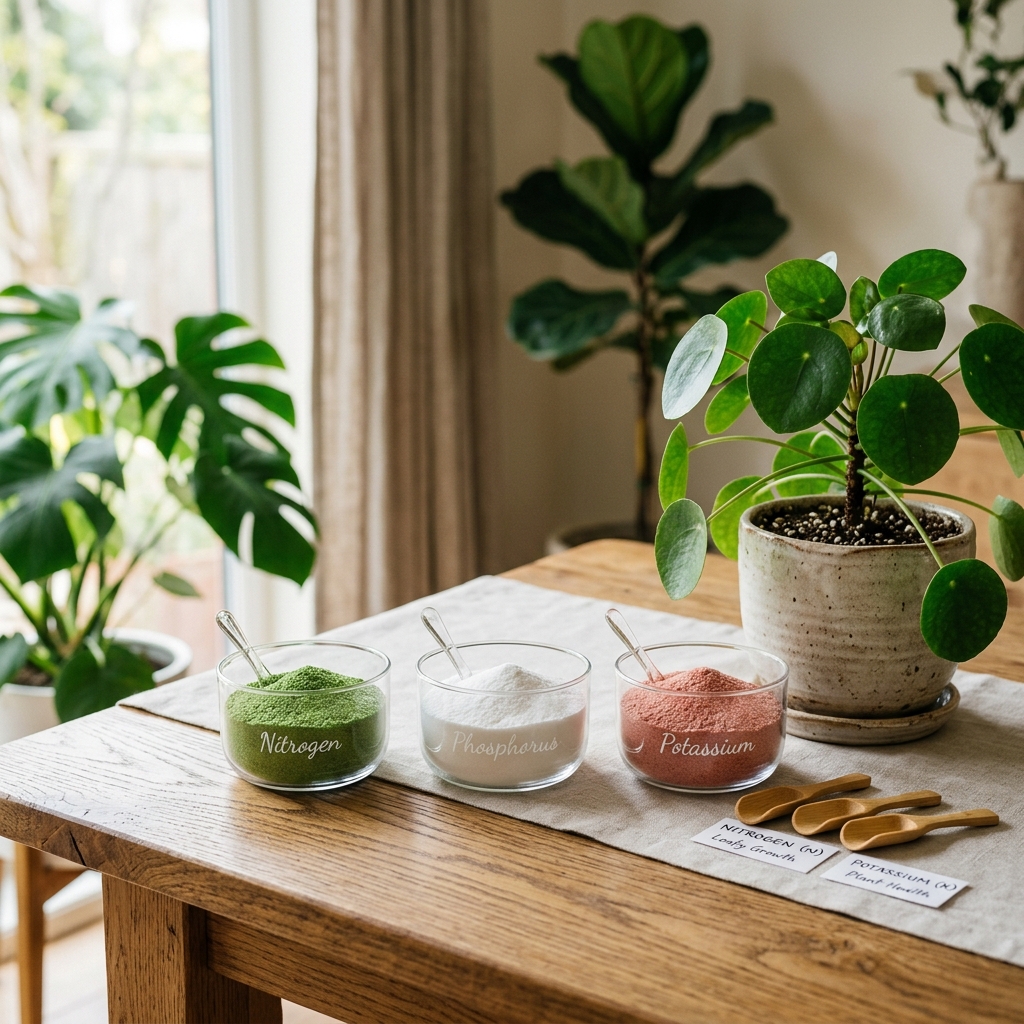
NPK ratios on fertilizer labels show the percentage by weight of nitrogen, phosphorus, and potassium in that order. A higher first number favors leafy growth, a higher second number favors roots and flowering, and the third supports overall plant health. Matching the ratio to a plant's growth stage improves results significantly.
Key Takeaways
- First number (nitrogen) drives leafy, vegetative growth.
- Second number (phosphorus) supports roots, flowering, and fruiting.
- Third number (potassium) supports overall plant health and stress resistance.
- Choose higher-nitrogen ratios during active leaf growth phases.
- Switch to higher-phosphorus ratios before and during flowering.
Symptoms
- Excessive foliage with no flowers or fruit: Too much nitrogen relative to phosphorus suppresses reproductive growth; common with high-N lawn fertilizers on flowering plants.
- Poor or delayed flowering: Insufficient phosphorus during the bloom phase prevents bud formation and reduces flower count.
- Weak, spindly, or lodging stems: Potassium deficiency reduces structural integrity and carbohydrate transport, leading to floppy or brittle stems.
- Leaf scorch or marginal burn: Excess potassium or nitrogen can cause salt accumulation at leaf edges, especially in sensitive species.
- Yellowing older leaves with stunted overall growth: Nitrogen deficiency causes chlorosis and reduced growth rate; the plant cannibalizes nitrogen from older tissue.
- Small, underdeveloped fruit: Inadequate phosphorus and potassium during fruiting limits cell division, sugar transport, and final fruit size.
- Dark green, soft, succulent growth prone to pests: Nitrogen toxicity produces lush but weak tissue that attracts aphids and fungal pathogens.
Common Causes
- Using the wrong fertilizer formula for the plant type: Applying a high-nitrogen lawn or turf fertilizer to flowering houseplants or vegetables distorts growth priorities.
- Fertilizing at the incorrect growth stage: Using a vegetative high-N formula during flowering, or a bloom booster on a seedling, mismatches nutrient supply with demand.
- Overfeeding nitrogen: Excess nitrogen is the most common imbalance; it causes rapid but weak growth and antagonizes potassium and phosphorus uptake.
- Ignoring soil test results or baseline fertility: Fertilizing blindly without knowing existing soil NPK levels leads to over-application of nutrients already present.
- Relying on generic one-size-fits-all fertilizer recommendations: Different species have vastly different NPK needs; what works for tomatoes may burn orchids or starve succulents.
- Using lawn or outdoor garden fertilizer indoors: These products are formulated for high-volume soil and rapid growth; they are far too concentrated for container houseplants.
Prevention
- Always read the fertilizer label and understand what the three NPK numbers mean before purchasing.
- Match the NPK ratio to the specific plant species and its current growth stage.
- Reduce or eliminate fertilizing during dormancy (fall and winter for most houseplants).
- Measure fertilizer precisely using a scale or calibrated scoop; never estimate.
- Start at half the manufacturer's recommended strength and increase gradually based on plant response.
- Test soil NPK annually if growing in ground; container growers should monitor runoff EC and PPM.
Best Practices
- Match the fertilizer NPK ratio to the plant type: high-N for foliage, high-P for blooms, high-K for fruiting.
- Always follow label dilution rates; fertilizer labels are calibrated for specific application volumes.
- Dilute commercial fertilizers to half strength for most houseplants to prevent salt buildup and burn.
- Feed only during active growth periods; withhold fertilizer during dormancy.
- Monitor EC and PPM of your nutrient solution to verify you are delivering the intended concentration.
- Water thoroughly before fertilizing to prevent root burn from concentrated salts on dry roots.
- Rotate between balanced and stage-specific formulas rather than switching erratically.
What Are NPK Ratios?
NPK stands for the three primary macronutrients every plant needs in the greatest quantities: Nitrogen (N), Phosphorus (P), and Potassium (K). The three numbers displayed prominently on every fertilizer package—such as 20-20-20 or 24-8-16—represent the percentage by weight of each nutrient contained in the product.
For example, a 10-pound bag of 24-8-16 fertilizer contains 2.4 pounds of nitrogen, 0.8 pounds of phosphorus (expressed as P₂O₅), and 1.6 pounds of potassium (expressed as K₂O). The remaining weight is filler material, carrier compounds, and any included micronutrients.
How to Read Fertilizer Numbers
Understanding the three numbers is straightforward once you know what each nutrient does:
- First Number — Nitrogen (N): Drives leafy, vegetative growth. It is the building block of chlorophyll and amino acids. High first numbers (24, 30) produce lush green foliage.
- Second Number — Phosphorus (P): Fuels root development, flowering, fruiting, and energy transfer within the plant. High middle numbers (30, 40) are found in bloom boosters.
- Third Number — Potassium (K): Strengthens cell walls, regulates water and nutrient transport, and improves disease resistance. Important for stem integrity and fruit quality.
These percentages are not interchangeable ratios in the mathematical sense—they are independent weight percentages. A 24-8-16 fertilizer is not "three times stronger" than an 8-8-8; it simply contains more total nutrients per unit weight.
Decoding a Fertilizer Label: 24-8-16 Example
Let's break down a real label step by step:
• 24% Nitrogen (N) — In a 1 lb (454g) package: ~109g nitrogen
• 8% Phosphorus (P₂O₅) — ~36g phosphorus pentoxide
• 16% Potassium (K₂O) — ~73g potassium oxide
• 52% Other — Carriers, fillers, binders, and micronutrients
This is approximately a 3-1-2 ratio (24÷8=3, 16÷8=2), which closely mirrors the natural NPK composition of healthy plant leaves. That is why 3-1-2 formulas are considered biologically optimal for foliage plants.
Choosing the Right NPK Ratio by Plant Type
| Plant Category | Best NPK Ratio | Why |
|---|---|---|
| Foliage Houseplants (Monstera, Pothos, Philodendron) | 3-1-2 or 24-8-16 | Mirrors leaf composition; prioritizes nitrogen for lush growth |
| Flowering Houseplants (African Violet, Orchid, Begonia) | 10-30-20 or 15-30-15 | High phosphorus triggers and sustains blooming |
| Succulents & Cacti | 2-7-7 or 5-10-10 | Low nitrogen prevents etiolation; moderate P and K support structure |
| Leafy Vegetables (Lettuce, Spinach, Kale) | 10-10-10 or 30-10-10 | High nitrogen maximizes leaf production |
| Fruiting Plants (Tomato, Pepper, Strawberry) | 5-10-10 or 3-4-6 | Shift from N to P and K during flowering and fruiting |
| Lawns & Turf | 30-0-10 or 28-0-3 | Maximum nitrogen for blade growth; minimal P and K |
| Seedlings & Cuttings | 2-1-2 or 5-10-5 (diluted) | Gentle, balanced nutrition that won't burn delicate roots |
NPK Needs by Growth Stage
Plants shift their nutrient demands as they mature. Matching the NPK ratio to the growth stage is one of the most effective ways to optimize growth:
| Growth Stage | Primary Need | NPK Strategy |
|---|---|---|
| Seedling / Cutting | Root establishment, gentle growth | Low, balanced or slightly phosphorus-heavy; always dilute to ¼–½ strength |
| Vegetative / Foliage | Leaf and stem expansion | Higher nitrogen (first number); 3-1-2 or 30-10-10 ideal |
| Flowering / Budding | Bud initiation and development | Shift to higher phosphorus; 10-30-20 or 15-30-15 |
| Fruiting / Ripening | Fruit size, sugar content, shelf life | Higher potassium and phosphorus; 5-10-10 or 3-4-6 |
| Dormancy / Rest | Minimal metabolic activity | Stop fertilizing entirely, or use ¼ strength balanced if absolutely necessary |
Balanced vs. Specialized Fertilizers
Balanced fertilizers (10-10-10, 20-20-20) provide equal percentages of all three macronutrients. They are excellent general-purpose choices for maintenance feeding and plants without extreme specialization. Most houseplants do well with balanced formulas during active growth.
Specialized fertilizers (24-8-16, 10-30-20, 2-7-7) skew the ratio toward a specific nutrient to match a plant's physiology or growth stage. A foliage plant fed with bloom booster will grow leaves slowly. A flowering plant fed with high-nitrogen turf food may never bloom.
NPK and the Fertilizer Calculator Workflow
NPK understanding powers the complete fertilization journey:
- Identify your plant's needs — Is it a foliage plant, a bloomer, or a fruiter? What growth stage is it in?
- Select a fertilizer with the appropriate NPK ratio — Use the reference tables above to match ratio to plant.
- Calculate the precise dose — Use a fertilizer calculator to determine grams or milliliters needed for your container size and target PPM.
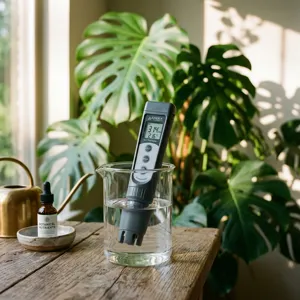
- Mix and measure — Dissolve the fertilizer in water and verify the final PPM with a TDS meter.
- Measure pH — Ensure the solution is in the optimal pH range (usually 6.0–6.5 for soil, 5.5–6.2 for hydroponics).
- Feed and observe — Apply to plants and monitor new growth over the following 2–3 weeks.
- Adjust — If growth is too slow, slightly increase concentration. If leaf tips burn, dilute and reduce.
Skipping the NPK selection step is like using the wrong fuel grade in an engine. The plant may survive, but it will not perform optimally.
Why More Nitrogen Is Not Always Better
Excess nitrogen is the most common fertilizer mistake. While nitrogen drives visible growth, too much causes:
- Soft, succulent tissue that is prone to pests and fungal infection
- Suppressed flowering and fruiting because the plant remains in vegetative mode
- Nutrient antagonism — excess N interferes with potassium and phosphorus uptake
- Environmental runoff — unabsorbed nitrogen leaches into groundwater
The goal is balanced, proportional growth—not maximum speed at any cost.
Common NPK Label Formats Around the World
Different regions express fertilizer analysis differently:
- North America: N-P-K as N-P₂O₅-K₂O (the standard three-number system)
- Europe: Often expressed as N-P-K elemental percentages or as N-P₂O₅-K₂O with additional nutrient declarations
- Hydroponic nutrients: May list elemental ppm of each nutrient rather than NPK percentages
When comparing products, ensure you are comparing the same measurement system. A European 15-15-15 may differ slightly from an American 15-15-15 depending on how phosphorus and potassium are reported.
Frequently Asked Questions
What does NPK stand for?
NPK stands for Nitrogen (N), Phosphorus (P), and Potassium (K). These are the three primary macronutrients required by plants in the largest quantities. The three numbers on a fertilizer label represent the percentage by weight of each nutrient in the product.
What is the best NPK ratio for houseplants?
Most houseplants thrive with a balanced or slightly nitrogen-heavy ratio during active growth, such as 10-10-10, 20-20-20, or 24-8-16. Foliage plants like Pothos and Monstera prefer 3-1-2 or 24-8-16. Flowering houseplants like African Violets and Orchids benefit from higher phosphorus, such as 10-30-10 or 15-30-15, during bloom.
Is 20-20-20 fertilizer good for plants?
Yes, 20-20-20 is an excellent general-purpose balanced fertilizer for most plants during active growth. It provides equal percentages of nitrogen, phosphorus, and potassium. However, it is not ideal for all stages: seedlings need weaker solutions, flowering plants need more phosphorus, and dormant plants need no fertilizer at all.
What does 24-8-16 mean on a fertilizer label?
24-8-16 means the fertilizer contains 24% Nitrogen, 8% Phosphorus, and 16% Potassium by weight. In a 1-pound (454g) package, that equals approximately 109g nitrogen, 36g phosphorus, and 73g potassium. This ratio is approximately 3-1-2, making it ideal for leafy, vegetative growth.
Which nutrient promotes flowers?
Phosphorus (P) is the primary nutrient responsible for root development, bud formation, and flowering. Fertilizers marketed as 'bloom boosters' have elevated middle numbers, such as 10-30-20 or 15-30-15, to supply extra phosphorus during the reproductive phase.
Which nutrient promotes leaves?
Nitrogen (N) is the key driver of leafy, vegetative growth. It is a core component of chlorophyll and amino acids. High-nitrogen fertilizers (e.g., 24-8-16 or 30-0-0) produce lush, green foliage but can suppress flowering if overused.
Can the wrong NPK ratio burn plants?
Yes. While any over-fertilization can cause salt burn, the wrong ratio creates specific stresses: excess nitrogen causes soft, weak tissue and nutrient antagonism; excess phosphorus locks up iron and zinc; excess potassium antagonizes magnesium and calcium. Always match the ratio to the plant and growth stage.
What is the best NPK for tomatoes?
Tomatoes need different ratios by stage: seedlings and early vegetative growth do well with 10-10-10 or 20-20-20. Once flowering begins, switch to a higher-phosphorus and potassium formula like 5-10-10 or 3-4-6 to support fruit set and development. Some growers use calcium-rich supplements alongside bloom formulas to prevent blossom end rot.
What is the best NPK for Monstera and Pothos?
Both Monstera and Pothos are foliage-heavy tropical plants that prefer nitrogen-rich ratios. A 3-1-2 ratio (such as 24-8-16) or a balanced 20-20-20 at half strength works excellently. Avoid high-phosphorus bloom formulas unless you are trying to encourage flowering, which is rare indoors.
What do the fertilizer numbers mean?
The three numbers on any fertilizer package represent the N-P-K analysis: the percentage by weight of Nitrogen, Phosphorus (as P₂O₅), and Potassium (as K₂O) contained in the product. A 10-10-10 fertilizer is 10% nitrogen, 10% phosphate, and 10% potash. The remaining 70% is filler, carrier, or micronutrients.
Explore More
Related Articles

Related Plant Guides
No specific plant guides found matching this topic.
Recommended next actions
Continue Exploring
Dive deeper into related plant care tools and profiles.
Topic Guide
NPK Explained for Plant Care
Understand what NPK means, how nitrogen, phosphorus and potassium affect plant growth and how to choose the right balance.
Topic Guide
Fertilizer
Learn everything about fertilizer for your indoor and aquarium plants. Expert care tips, troubleshooting, and related guides.
Topic Guide
Plant Macronutrients Explained
Understand plant macronutrients including nitrogen, phosphorus and potassium functions and how to spot deficiency symptoms early.
Topic Guide
Slow Release Fertilizer: How It Works, Best Types & When to Use
Learn what slow-release fertilizer is, how polymer-coated and organic formulations work, how long they last, application tips, and when to choose.
Topic Guide
Granular Fertilizer for Plants
Learn how granular fertilizer provides slow-release nutrients to your plants. Discover the best application methods, when to use it, and how to avoid root.
Topic Guide
Liquid Fertilizer: Benefits, How to Use, Dosage, Pros & Cons
Learn what liquid fertilizer is, how to mix and apply it correctly, when to use it, advantages over granular fertilizer, dosage recommendations per liter.