Slow Release Fertilizer: How It Works, Best Types & When to Use
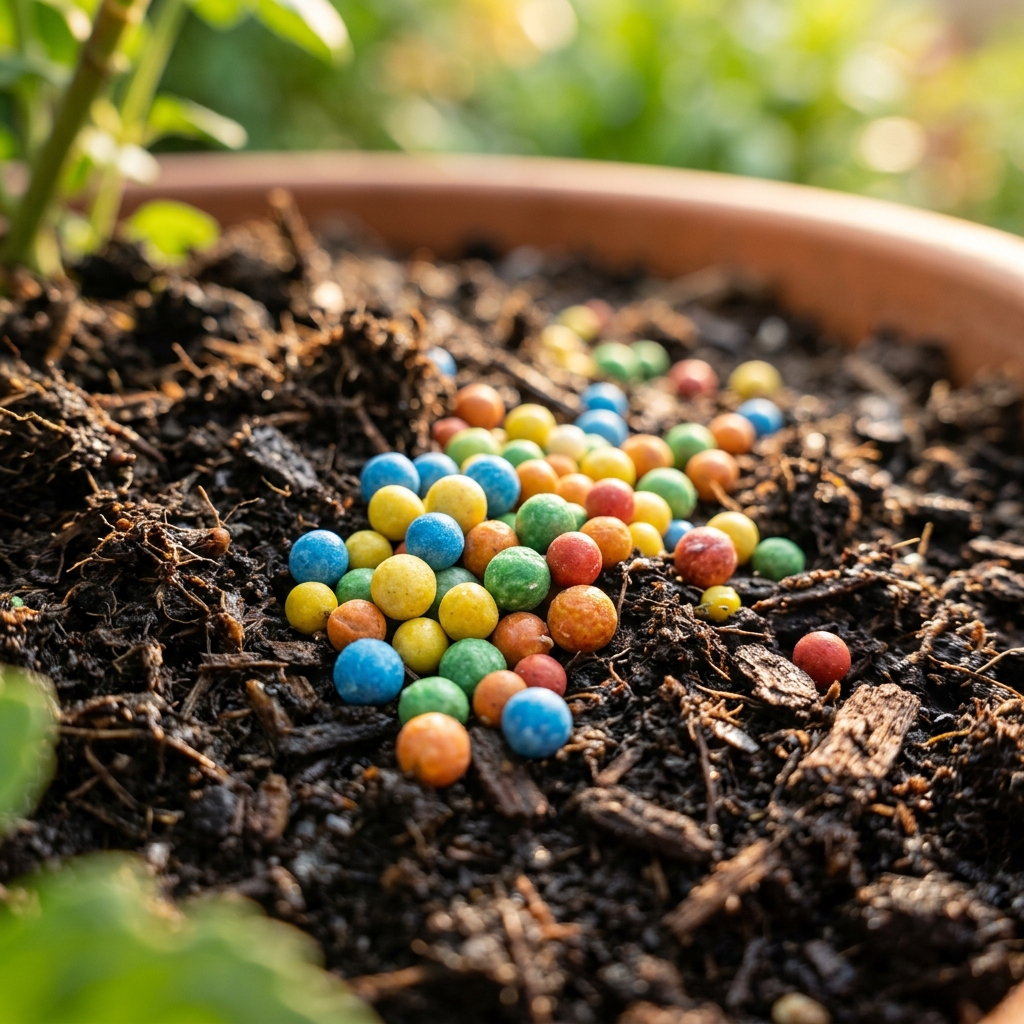
Slow-release fertilizer is a granular or coated fertilizer that releases nutrients gradually over several weeks or months through moisture, temperature, or microbial activity. It provides consistent feeding, reduces fertilizer burn, minimizes nutrient leaching, and is ideal for container plants, landscapes, trees, shrubs, and low-maintenance gardens that don't get feeding attention every week. This approach helps maintain optimal conditions and prevents common issues that can affect your plant's overall health and longevity over time.
Quick Answer
Slow-release fertilizer is a granular or coated fertilizer that releases nutrients gradually over several weeks or months through moisture, temperature, or microbial activity. It provides consistent feeding, reduces fertilizer burn, minimizes nutrient leaching, and is ideal for container plants, landscapes, trees, shrubs, and low-maintenance gardens.
Key Takeaways
- Feeds plants for 2–12 months depending on formulation and environmental conditions.
- Reduces the risk of fertilizer burn compared to liquid or quick-release fertilizers.
- Ideal for busy gardeners, container plants, landscapes, and commercial operations.
- Most synthetic products release nutrients through temperature-driven osmosis (polymer-coated) or moisture penetration (sulfur-coated).
- Organic slow-release fertilizers rely on microbial decomposition and build soil health.
Symptoms
- Yellowing older leaves: Indicates nitrogen depletion from the slow-release product. The plant reallocates mobile nitrogen from old leaves to new growth when overall nitrogen availability drops.
- Stunted or slow growth: General reduction in vigor suggests the slow-release fertilizer has been exhausted or soil temperature is too low for adequate release. Common in early spring with polymer-coated products in cold soils.
- Poor flowering or fruit set: Phosphorus or potassium depletion from an exhausted slow-release supply reduces reproductive performance. May also indicate the initial NPK ratio was too nitrogen-heavy.
- Leaf tip burn: Rare with slow-release but can occur from over-application or placing granules in direct contact with roots. Salt accumulation exceeds the plant's tolerance.
Common Causes
- Product exhaustion: Slow-release granules remain physically present long after nutrients are depleted. Gardeners often assume visible granules mean active feeding, leading to unintended starvation.
- Cold soil temperatures: Polymer-coated and microbial-release products are temperature-dependent. In soils below 50°F (10°C), release is negligible and plants may show deficiency despite fertilizer presence.
- Over-application: Applying more than the label rate causes salt buildup, root damage, and potential nutrient antagonisms. More is not better with slow-release fertilizers.
- Incorrect product choice: Using a 12-month polymer-coated product on fast-growing annual vegetables may starve mid-season crops, while a 30-day organic product is insufficient for trees and shrubs.
- Dry soil conditions: Moisture is required to activate most release mechanisms. Prolonged drought stops nutrient release entirely, even when granules are present in the soil.
Prevention
- Match product duration to crop cycle: Select a slow-release product with a longevity that covers your plant's active growing period. Use 3-month formulations for annuals, 6–9 month for perennials and shrubs.
- Incorporate into soil rather than surface broadcasting: Mixing granules into the root zone ensures consistent moisture contact and prevents granule displacement from rain or irrigation.
- Water after application: Initial watering activates the release mechanism and moves salts away from foliage and shallow roots.
- Monitor soil temperature: Delay spring application until soil temperatures reach 50°F (10°C) to ensure polymer-coated and organic products begin releasing nutrients when plants need them.
- Supplement with liquid during peak demand: Use liquid fertilizer as a booster during flowering, fruiting, or rapid growth phases to prevent mid-season nutrient gaps.
Best Practices
- Apply at the beginning of the growing season: Time application to coincide with the start of active root uptake. For most temperate climates, this is early to mid-spring once soil temperatures stabilize above 50°F (10°C).
- Mix evenly into the top layer of soil: Incorporate granules into the upper 2–3 inches of soil or potting mix to ensure root contact and prevent granule loss from surface water movement.
- Water after application: Thorough watering after application activates release mechanisms, settles granules into the soil matrix, and prevents foliar contact that could cause burn.
- Follow manufacturer application rates: Application rates are calibrated by pot size, bed area, or plant diameter. Over-application wastes money and risks salt toxicity; under-application leads to deficiency.
- Reduce feeding during winter dormancy: Do not apply slow-release fertilizer to dormant plants. Unused nutrients will either leach in spring or release too slowly to benefit the plant during its rest period.
- Store fertilizer in a cool, dry place: Humidity can prematurely activate polymer-coated granules or cause caking. Store unopened bags in a sealed container away from moisture and temperature extremes.
What Is Slow-Release Fertilizer?
Slow-release fertilizer (SRF) is a category of granular or pelleted fertilizer designed to release nutrients into the soil solution gradually over an extended period—typically 2 to 9 months—rather than all at once. Unlike quick-release or liquid fertilizers that deliver an immediate nutrient pulse, slow-release formulations meter out nitrogen, phosphorus, potassium, and secondary nutrients in response to environmental triggers such as soil moisture, temperature, or microbial decomposition.
The core advantage is controlled nutrient availability: plants receive a steady, low-concentration supply that matches uptake capacity, reducing waste, leaching, and the risk of fertilizer burn. This makes slow-release fertilizers especially valuable for container gardening, commercial nurseries, landscape maintenance, and any situation where frequent fertilization is impractical.
How Slow-Release Fertilizers Work
Nutrient release from slow-release fertilizers occurs through three primary mechanisms, and understanding them helps you select the right product for your conditions.
1. Polymer-Coated Controlled-Release
Granules are encapsulated in a semi-permeable polymer or resin membrane. Water vapor diffuses through the coating, dissolves nutrients inside, and the resulting solution osmotically exits through the same membrane. Release rate is primarily temperature-driven: warmer soils accelerate diffusion, while cooler soils slow it. This provides the most predictable, metered release and is the technology behind products like Osmocote and Nutricote.
- Duration: 3–12 months depending on coating thickness
- Primary driver: Soil temperature
- Best for: Container plants, greenhouses, precision agriculture
2. Sulfur-Coated Urea (SCU)
Urea granules are coated with elemental sulfur and sometimes a secondary polymer seal. Water penetrates micro-fractures in the sulfur shell, dissolves the urea, and nutrients diffuse outward. Release is less uniform than polymer coatings because coating integrity varies between granules.
- Duration: 6–10 weeks
- Primary driver: Moisture and coating degradation
- Best for: Lawns, field crops, large landscape beds
3. Organic / Microbial Decomposition
Organic slow-release fertilizers derive from plant and animal byproducts (composted manure, bone meal, blood meal, feather meal, fish meal). Nutrients are bound in complex organic molecules and become available only as soil microorganisms mineralize them. Release is biologically driven and highly dependent on soil temperature, moisture, and microbial activity.
- Duration: 1–6 months depending on material and conditions
- Primary driver: Microbial activity (temperature + moisture + organic matter)
- Best for: Organic gardens, soil building, long-term fertility
Types of Slow-Release Fertilizers
| Type | Release Mechanism | Duration | NPK Typical | Best Use Case |
|---|---|---|---|---|
| Polymer-coated (Osmocote, Nutricote) | Temperature-driven osmosis through resin shell | 3–12 months | 14-14-14, 15-9-12 | Containers, greenhouse crops, precision feeding |
| Sulfur-coated urea (SCU) | Moisture penetration through sulfur shell | 6–10 weeks | 36-0-0, 40-0-0 | Lawns, turf, field crops |
| IBDU (Isobutylidene diurea) | Hydrolysis in acidic soils | 90–120 days | 31-0-0 | Turf, golf courses, acidic soils |
| UF/Urea-formaldehyde | Microbial decomposition | 10–16 weeks | 38-0-0 | Turf, ornamentals, landscaping |
| Organic (feather, bone, blood meal) | Microbial mineralization | 1–6 months | Variable | Organic gardens, soil amendment |
| Humic-coated / enhanced efficiency | Combined biological and chemical release | 2–4 months | Variable | General gardening, sustainability programs |
Slow-Release vs. Liquid Fertilizer
| Factor | Slow-Release | Liquid Fertilizer |
|---|---|---|
| Speed of action | Gradual; first nutrients available in days, peak over weeks | Immediate; nutrients available within hours |
| Longevity | 2–12 months per application | 1–2 weeks per application |
| Risk of burn | Very low; gradual release prevents salt shock | Higher; concentrated application can scorch roots and foliage |
| Application frequency | 1–3 times per growing season | Every 1–2 weeks during active growth |
| Precision | Less precise; release affected by temperature and moisture | Highly precise; exact dose per watering |
| Cost per season | Lower; fewer applications needed | Higher; frequent reapplication required |
| Labor | Low; set-and-forget for months | High; requires mixing and regular scheduling |
| Leaching risk | Low; nutrients released as plants need them | Higher; excess can wash away with irrigation or rain |
| Best for | Containers, landscapes, low-maintenance gardens, trees, shrubs | Hydroponics, foliar feeding, correcting acute deficiencies, fast-growing annuals |
Advantages of Slow-Release Fertilizers
- Reduced leaching: Nutrients become available at rates plants can absorb, minimizing runoff into groundwater and surface water.
- Lower burn risk: The gradual release prevents the salt shock that causes root damage and leaf scorch associated with quick-release fertilizers.
- Consistent growth: Steady nutrient supply avoids the boom-bust cycle of rapid growth followed by starvation.
- Labor savings: One application can feed plants for an entire season, ideal for commercial operations and busy home gardeners.
- Improved nutrient use efficiency: More of the applied nutrient ends up in the plant rather than lost to the environment.
- Reduced environmental impact: Lower nitrate leaching and phosphorus runoff decrease eutrophication risk in nearby water bodies.
Disadvantages and Limitations
- Upfront cost: Polymer-coated products are more expensive per pound of nutrient than conventional fertilizers.
- Temperature dependency: In cold springs, release may be too slow for early growth demands. In hot summers, release may accelerate beyond plant needs.
- Less precise for acute deficiencies: If a plant shows deficiency symptoms, slow-release cannot correct them quickly; a liquid supplement is needed.
- Not ideal for hydroponics: Granular slow-release products are incompatible with most hydroponic systems.
- Residual uncertainty: It can be difficult to know exactly when nutrients are depleted, leading to either premature reapplication or unintended starvation.
Application Guide
Container Plants
Incorporate slow-release granules into the potting mix at planting time at the manufacturer's recommended rate—typically 1–3 teaspoons per gallon of potting mix, depending on product concentration. For established plants, scratch granules into the top 1–2 inches of soil and water thoroughly. Avoid placing granules directly against stems or roots.
Garden Beds and Landscapes
Broadcast granules evenly over the soil surface or band along planting rows. Lightly incorporate into the top 2–3 inches of soil. Water after application to activate release. For trees and shrubs, apply in a broad ring under the drip line, staying 6–12 inches away from the trunk.
Lawns and Turf
Use a broadcast spreader for even distribution. Apply when grass is dry, then water lightly to move granules off leaf blades and into the soil. For cool-season grasses, apply in early spring and early fall. For warm-season grasses, apply in late spring and mid-summer.
Indoor Houseplants
Choose a low-dose, polymer-coated formulation (e.g., 3–4 month). Apply at half the outdoor rate due to lower light and reduced growth rates. Reapply every 4–6 months during the growing season; skip fertilization in winter for most species.
Seasonal Use
- Spring: Apply slow-release fertilizer as plants break dormancy. In cold climates, wait until soil temperatures reach 50°F (10°C) to ensure adequate microbial or coating activity.
- Summer: Monitor plant vigor. In hot climates, polymer-coated products may release faster than expected. Supplement with liquid feed if growth stalls mid-season.
- Fall: Apply a low-nitrogen, high-potassium slow-release formulation to support root development and winter hardiness without promoting succulent new growth.
- Winter: Do not apply slow-release fertilizer to dormant plants. Unused nutrients will either leach when spring rains arrive or release too slowly to matter.
Can You Combine Slow-Release and Liquid Fertilizers?
Yes, and this is a common best practice. Use slow-release as the baseline fertility program to provide steady background nutrition, and supplement with liquid fertilizer during periods of peak demand (flowering, fruiting, rapid vegetative growth) or to correct acute deficiencies. This hybrid approach gives you the convenience of slow-release with the precision and speed of liquid feeding.
When combining, reduce the liquid fertilizer concentration by 25–50% to avoid overfeeding, since the slow-release product is already contributing nutrients.
How to Tell When Slow-Release Is Depleted
Unlike liquid fertilizers that are gone after watering, slow-release granules remain visible long after nutrients are exhausted. Signs that reapplication is needed include:
- Yellowing of older leaves (nitrogen deficiency)
- Reduced growth rate or smaller new leaves
- Poor flowering or fruit set
- Soil test showing declining nutrient levels
When in doubt, check the product label for stated longevity and mark your calendar. For polymer-coated products, the stated duration (e.g., "3-month") is typically based on 70°F (21°C) soil temperature; actual duration varies with climate.
Frequently Asked Questions
What is slow-release fertilizer?
Slow-release fertilizer is a granular or coated product that releases nutrients gradually over weeks or months through mechanisms like polymer coating degradation, sulfur coating dissolution, or microbial decomposition of organic matter. It provides steady, low-concentration nutrition that reduces burn risk and leaching.
How long does slow-release fertilizer last?
Duration depends on the formulation: polymer-coated products last 3–12 months; sulfur-coated urea lasts 6–10 weeks; organic materials last 1–6 months depending on temperature and microbial activity. Always check the manufacturer's stated longevity, which is typically calibrated to 70°F (21°C) soil temperature.
Can I use slow-release fertilizer for houseplants?
Yes, but use a low-dose formulation and apply at half the recommended outdoor rate. Indoor plants grow more slowly due to lower light, so they need less fertilizer. A 3–4 month polymer-coated product applied every 4–6 months during the growing season is usually sufficient. Avoid fertilizing dormant houseplants in winter.
Is slow-release fertilizer better than liquid fertilizer?
Neither is universally better—they serve different purposes. Slow-release is ideal for convenience, low maintenance, reduced burn risk, and long-term feeding. Liquid fertilizer is better for rapid correction of deficiencies, hydroponics, foliar feeding, and precise control during peak growth periods. Many growers use both in combination.
Can slow-release fertilizer burn plants?
The risk is very low compared to quick-release fertilizers, but it is not zero. Over-application, placing granules directly against stems or roots, or using a high-concentration product in small containers can cause salt buildup and root damage. Always follow label rates and water after application.
Should I water after applying slow-release fertilizer?
Yes. Watering activates the release mechanism for most products (moisture is required to dissolve nutrients inside coated granules or to support microbial mineralization of organic materials). It also moves granules off foliage and into the root zone.
Can I combine slow-release and liquid fertilizers?
Yes. This is a recommended strategy: slow-release provides baseline nutrition, while liquid supplements address peak demand or acute deficiencies. When combining, reduce liquid fertilizer strength by 25–50% to avoid overfeeding.
Does temperature affect nutrient release?
Yes. For polymer-coated fertilizers, release is primarily temperature-driven—warmer soils accelerate diffusion, cooler soils slow it. For organic slow-release products, microbial activity (and thus release) increases with temperature. This means the same product may last longer in cool climates and shorter in hot climates.
When should I reapply slow-release fertilizer?
Reapply based on the product's stated longevity and your observations. Mark your calendar when you apply. Look for signs of declining vigor such as yellowing older leaves or reduced growth. For most garden applications, reapply at the start of each growing season.
Can rain wash slow-release fertilizer away?
Granules are too large to wash away easily, but heavy rain can move surface-applied fertilizer downhill on slopes. Incorporating granules into the top 1–2 inches of soil prevents displacement. The nutrients inside coated granules are protected from leaching until they are released, which is one of the primary advantages of slow-release products.
How do I know which slow-release fertilizer to choose?
Match the product to your needs: polymer-coated for containers and precision; sulfur-coated or IBDU for lawns and turf; organic for soil building and organic certification. Check the NPK ratio against your plant's growth stage—higher nitrogen for vegetative growth, higher phosphorus and potassium for flowering and fruiting.
Are organic slow-release fertilizers as effective as synthetic ones?
Organic slow-release fertilizers build soil health and microbial diversity while providing nutrients, but their release is less predictable and generally slower than polymer-coated synthetics. They are excellent for long-term soil fertility but may not supply enough nutrients for high-demand crops without supplementation. Synthetic controlled-release products offer more precise timing and higher nutrient concentrations.
Explore More
Related Articles

Related Plant Guides
No specific plant guides found matching this topic.
Recommended next actions
Continue Exploring
Dive deeper into related plant care tools and profiles.
Topic Guide
Fertilizer
Learn everything about fertilizer for your indoor and aquarium plants. Expert care tips, troubleshooting, and related guides.
Topic Guide
Granular Fertilizer for Plants
Learn how granular fertilizer provides slow-release nutrients to your plants. Discover the best application methods, when to use it, and how to avoid root.
Topic Guide
NPK Explained for Plant Care
Understand what NPK means, how nitrogen, phosphorus and potassium affect plant growth and how to choose the right balance.
Topic Guide
NPK Ratios Explained
Read NPK ratios on fertilizer labels correctly and choose the right nitrogen, phosphorus and potassium formula for each plant stage.
Topic Guide
Fertilizer Burn: Symptoms and Treatment
Identify fertilizer burn symptoms like scorched leaf edges and treat overfertilized plants by flushing soil and adjusting feeding.
Topic Guide
Liquid Fertilizer: Benefits, How to Use, Dosage, Pros & Cons
Learn what liquid fertilizer is, how to mix and apply it correctly, when to use it, advantages over granular fertilizer, dosage recommendations per liter.