Why Water Quality Determines Carnivorous Plant Survival
Carnivorous plants evolved in ombrotrophic wetlands—peat bogs, coastal savannas, and seepage slopes—where available soil nutrients are exceptionally low. In these habitats, precipitation provides almost all incoming moisture. Because their root systems never developed physiological adaptations to process or exclude dissolved salts, commonly cultivated carnivorous plants are calcifuges: their roots are easily damaged by dissolved calcium, magnesium, sodium, and alkaline carbonates.
When a carnivorous plant is irrigated with mineral-laden water, the dissolved ions do not simply rinse away. In container culture, continuous moisture evaporation from the soil surface and container sides leaves the minerals behind in the medium. Over weeks and months, the mineral concentration in the potting mix steadily climbs—a phenomenon known as the evaporative wicking accumulation effect. What begins as subclinical root stress gradually develops into root-tip scorch, blackening leaves, loss of carnivorous dew, and eventually crown collapse.
Supplying water with a low mineral content is therefore the fundamental baseline required to maintain carnivorous plants over the long term. For complementary guidance on formulating safe, nutrient-free potting media, consult our carnivorous plant substrate guide.
The Core Water Sources Compared
Growers frequently encounter several water options, each carrying distinct physical properties, chemical profiles, and practical considerations.
1. Steam Distilled Water: The Dependable Baseline
Steam-distilled water is produced by heating water into steam, leaving non-volatile minerals, heavy metals, biological pathogens, and chemical additives behind in the boiling chamber. The cooled vapor condenses into pure, mineral-free liquid water.
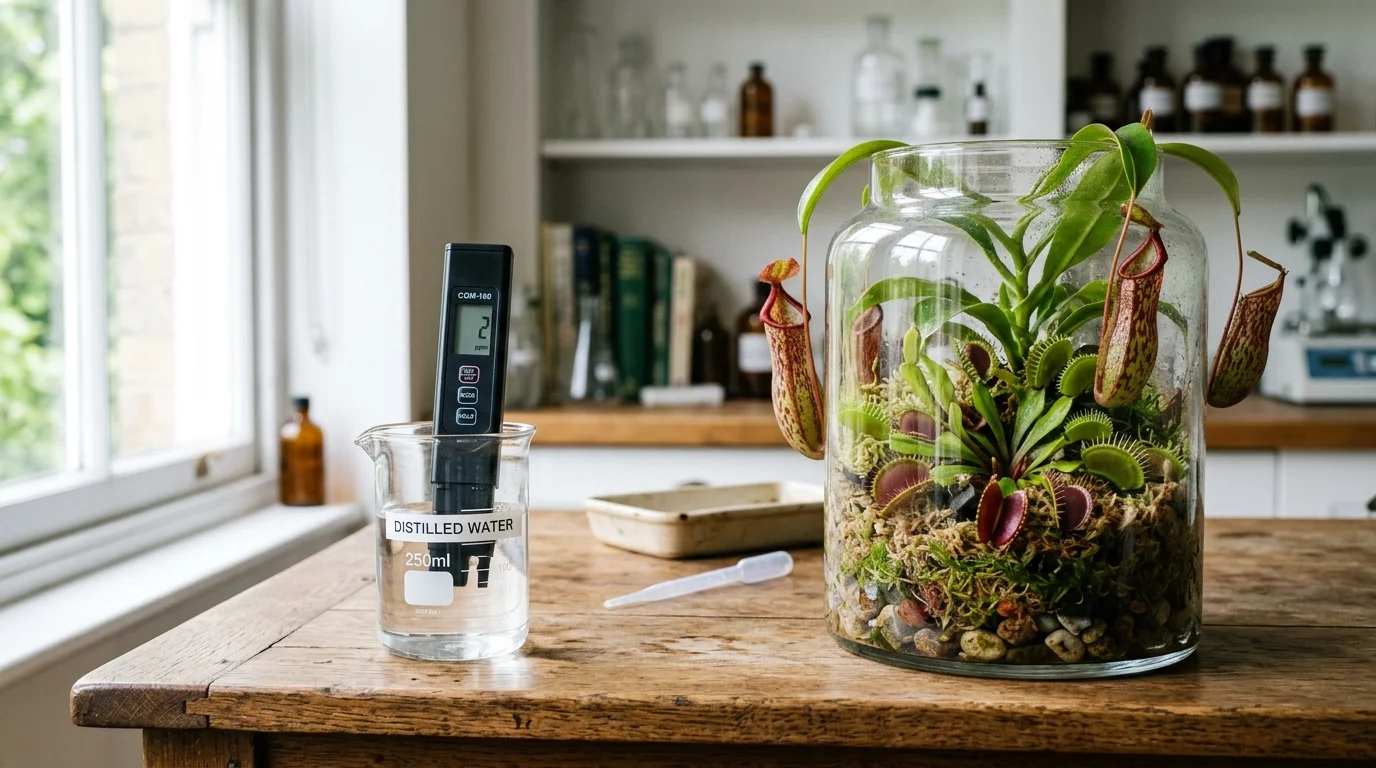
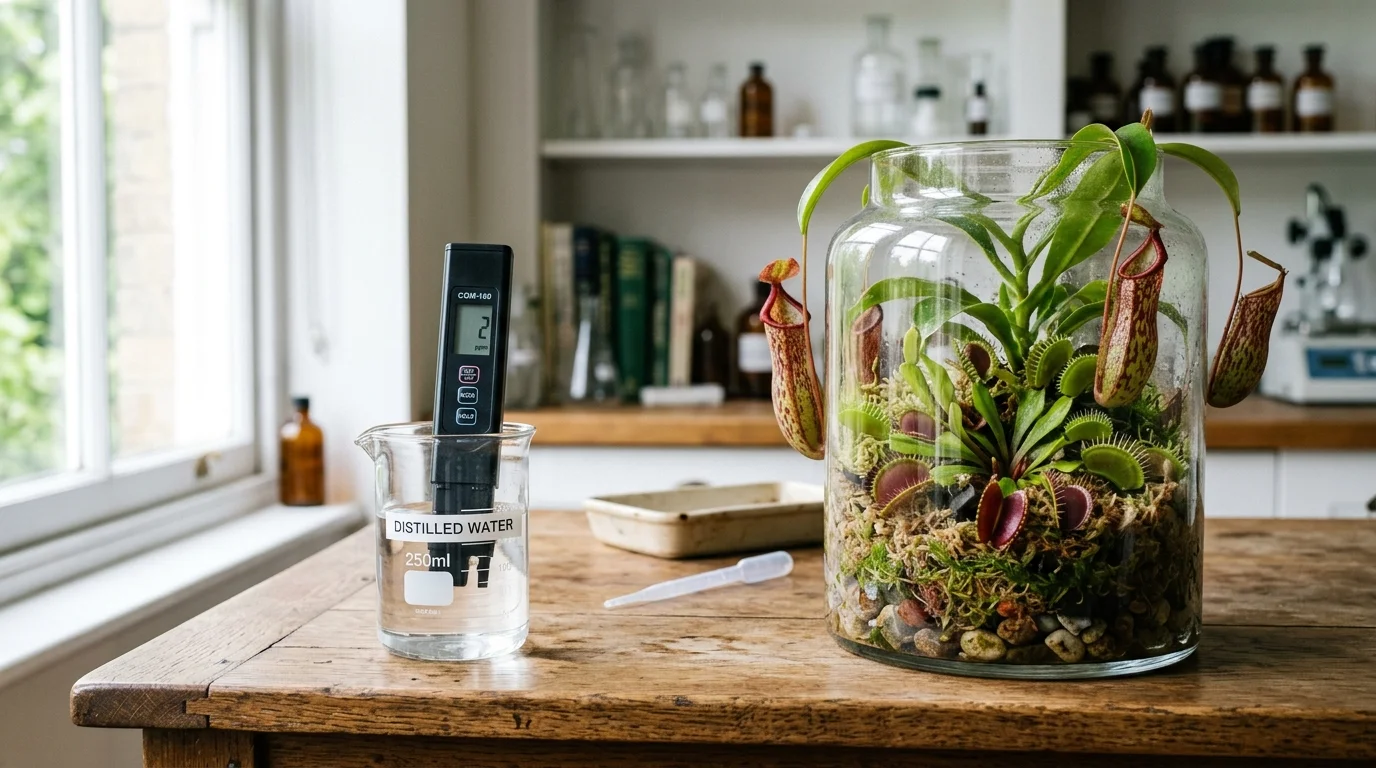
Fresh steam-distilled water typically registers between 0 and 5 ppm Total Dissolved Solids (TDS), frequently reading 0 to 2 ppm on consumer meters. Because it contains virtually zero dissolved ions, it provides a safe, repeatable irrigation baseline across all carnivorous genera—including sensitive seedlings, tissue-culture plantlets, and closed terrarium plantings. When purchasing distilled water, inspect the container label to verify that it specifies "distilled" rather than "purified drinking water" or "spring water," both of which often contain added minerals for taste.
2. Reverse Osmosis (RO) Water: The Collection Workhorse
Reverse osmosis purifies water by forcing it under pressure through a semi-permeable membrane with microscopic pores (approximately 0.0001 microns). A functional multi-stage residential or commercial RO system removes 90% to 98% of dissolved minerals, heavy metals, and particulate contaminants.
RO water typically reads under 15 ppm TDS (commonly 2 to 10 ppm with healthy membranes), placing it well within safe parameters for carnivorous plants. For hobbyists cultivating extensive collections, automated misting systems, or large outdoor bog bowls, a home RO system or bulk-dispensing refill station is significantly more economical than purchasing single-use plastic jugs of distilled water. However, growers should monitor the output with a TDS meter periodically: as the membrane ages or fouls, mineral bypass increases, quietly raising the baseline TDS.
3. Deionized (ZeroWater / DI Resin) Water
Deionization passes water through specialized ion-exchange resin beds that exchange dissolved mineral cations (such as calcium, magnesium, and sodium) for hydrogen ions (H+), and mineral anions (such as sulfates, chlorides, and carbonates) for hydroxide ions (OH-), combining to form pure water. Countertop pitchers like ZeroWater use multi-stage deionizing cartridges.
Fresh DI resin produces water reading 0 to 2 ppm TDS, performing identically to steam-distilled water. However, DI resin operates through finite chemical binding sites. When used on hard tap water (>200 ppm), the resin exhausts quickly. Once exhausted, it can suddenly release concentrated mineral ions and organic residues into the effluent. If relying on DI filtration, test the product water frequently and replace cartridges as soon as the reading rises above 5–10 ppm.
4. Clean Collected Rainwater
Rainwater is the natural moisture source that wild carnivorous plants evolved to receive. When precipitation forms in the atmosphere, it is naturally soft and acidic, typically testing below 25 ppm TDS when collected cleanly.
While rainwater is biologically ideal and free of municipal chemical additives, harvesting it in residential settings introduces contamination risks that require active management:
- Roofing and catchment surfaces: Avoid collecting rainwater from asphalt shingle roofs (which leach petroleum compounds and mineral granules), wood shingles treated with preservatives, or gutters with copper or lead flashing. Enamelled metal roofs, glazed tiles, and clean greenhouse panels produce the cleanest runoff.
- First-flush diversion: The initial runoff of a storm washes accumulated dust, pollen, bird droppings, and airborne pollutants from catchment surfaces. Discard the first 15 to 20 minutes of rain before directing downspouts into collection barrels.
- Storage hygiene: Store rainwater in dark, opaque, food-grade containers to prevent light penetration and algae growth. Adding a fractional biological mosquito dunk (Bacillus thuringiensis israelensis / BTI) prevents fungus gnats and mosquito larvae from breeding without harming plant roots.
5. Municipal Tap Water: Highly Variable and Often Risky
Municipal drinking water is treated for public health, meaning it is disinfected with chlorine or chloramines and often contains added fluoride. Crucially, tap water carries dissolved calcium and magnesium carbonates (water hardness) alongside sodium, sulfates, and trace minerals leached from aquifers and distribution pipes.
Tap water TDS varies widely by geographic region, ranging from 30 ppm in soft mountain-reservoir areas to over 500 ppm in hard groundwater districts. Specialist guidelines from the International Carnivorous Plant Society note that tap water reading below 50 ppm is generally safe, and water under 90 ppm can sometimes be tolerated by robust species in emergencies. However, tap water exceeding 100 ppm consistently damages carnivorous bog plants over time. If a plant was watered with tap water by mistake, immediate deep leaching with pure water can prevent irreversible root burn. Furthermore, municipal water frequently carries an alkaline pH (7.5–8.5), which neutralizes the natural acidity of sphagnum peat and accelerates media decomposition.
6. Softened Water: A Severe Hazard
Whole-house water softeners do not remove dissolved solids; they use ion-exchange resin charged with sodium chloride or potassium chloride to exchange calcium and magnesium ions for sodium or potassium ions. Softened tap water often has an even higher TDS reading than raw well water. Sodium is exceptionally harmful to carnivorous plant roots, creating severe osmotic stress that prevents roots from taking up moisture even when sitting in saturated media. Never use softened water on carnivorous plants. Always draw irrigation water from an unsoftened outdoor hose bibb or pre-softener bypass line.
How to Choose the Right Water for Your Setup
Selecting an irrigation source depends on collection size, local water hardness, and practical convenience:
- Small Windowsill Collection (1–5 plants): Purchase 1-gallon jugs of steam-distilled water or use a ZeroWater deionizing pitcher. At modest usage rates, commercial distilled water is convenient, reliable, and inexpensive.
- Intermediate Collection or Terrarium (5–20 plants): Collect clean rainwater during storm events, or purchase reverse-osmosis water from grocery refill stations using 5-gallon carboys. If building an enclosed display, consult our carnivorous plant terrarium build guide for false-bottom drainage protocols.
- Large Greenhouse or Outdoor Bog Garden (20+ pots): Install an under-sink reverse osmosis filtration system. An RO unit eliminates the physical labor of hauling heavy jugs, lowers long-term operating costs, and provides an abundant supply of pure water.
Understanding TDS & PPM: What Your Meter Tells You
A handheld Total Dissolved Solids (TDS) meter is an essential screening tool for any carnivorous plant grower, but understanding what it measures—and what it cannot—is critical for making sound care decisions.
What a TDS Meter Actually Measures
A TDS pen does not directly count or chemically identify dissolved particles. Instead, it applies a small electrical current between two metal electrodes and measures electrical conductivity (EC in microsiemens per centimeter, µS/cm). Because pure water is a poor electrical conductor, the presence of dissolved mobile ions (such as Ca²⁺, Mg²⁺, Na⁺, Cl⁻, and HCO₃⁻) increases conductivity. The meter applies an internal conversion algorithm (commonly a 0.50 NaCl scale or a 0.70 442 scale) to display an estimated concentration in parts per million (ppm), where 1 ppm represents approximately 1 milligram of dissolved solids per liter of water (mg/L).
What a TDS Meter Cannot Tell You
While a TDS meter is an invaluable screening instrument, it has important biological limitations:
- No chemical differentiation: A reading of 40 ppm reflects total ionic conductivity, but cannot distinguish between relatively benign trace calcium ions and highly toxic contaminants like sodium, boron, or copper.
- Blind to uncharged molecules: Non-ionic substances—such as dissolved organic matter, petroleum hydrocarbons leached from roof shingles, pesticides, and bacterial pathogens—do not conduct electricity and will not register on a TDS meter.
- Temperature dependence: Electrical conductivity rises with water temperature (approximately 2% per degree Celsius). Always use a TDS pen equipped with Automatic Temperature Compensation (ATC) and test samples at room temperature.
Using the Carnivorous Water TDS & Dilution Calculator
To help growers evaluate water safety and avoid waste, PlantSolve provides the dedicated Carnivorous Water TDS Calculator. Rather than forcing you to guess whether a particular water sample is safe, the tool performs two practical engineering calculations based on user inputs:
- Mass-Balance Dilution Ratios: The calculator accepts five specific inputs: raw source water TDS (
sourceTds), pure water baseline TDS (pureWaterTds, default 0 ppm), target blended TDS (targetTds, default 30 ppm), batch volume to prepare (batchVolume), and pot substrate volume (potVolume). It uses a mass-balance dilution formula to calculate the exact volume of tap water permitted and pure water required, displaying the resulting dilution ratio and rating the source water into four standardized safety tiers (Safe <50 ppm, Moderate 50–100 ppm, Caution 100–200 ppm, and Severe >200 ppm). - Evaporative Mineral Accumulation Modeling: Based on container substrate volume and an estimated 250 ml of weekly evaporative loss (assuming 50% pore-water volume and no flushing), the calculator estimates how many weeks of continuous bottom-watering can occur before accumulated substrate salts reach the 100 ppm toxicity baseline, providing an objective schedule for when to flush your pots.
The calculator provides a mathematical estimate based on average physical parameters. It cannot establish the specific chemical safety of contaminated water, nor does a safe dilution calculation eliminate the need for proper drainage and periodic top-flushing.
Water Quality vs. Watering Technique
Growers must clearly distinguish between water quality (chemical purity and mineral concentration) and watering practice (frequency, container hydrology, and saturation depth). Supplying pure distilled water does not prevent root rot if the plant's hydrological requirements are violated.
The Bottom-Watering Tray Method (For Bog Species)
Temperate bog plants—including Venus flytraps (Dionaea), North American pitcher plants (Sarracenia), and many sundews (Drosera capensis)—thrive using the tray method during their active summer growing season. The pot sits in a saucer holding 1 to 2 cm (0.5 to 1 inch) of pure distilled or rainwater. The substrate wicks moisture upward continuously, mimicking saturated bog conditions.
However, when temperate plants enter winter rest, keeping pots standing in deep stagnant water can trigger rhizome rot. As detailed in our guide on dormancy requirements for carnivorous plants, trays should be drained or removed during cold winter dormancy, keeping the peat damp rather than flooded.
Free-Draining Top Watering (For Epiphytes)
Tropical pitcher plants such as Nepenthes ventrata are scrambling epiphytes that grow in mossy canopies and well-drained volcanic slopes. Their roots require high oxygen levels alongside constant moisture. Never allow Nepenthes pots to stand in stagnant water trays. Instead, pour pure water through the top of the pot until it drains freely from the drainage holes, discarding any runoff that collects in the saucer.
Porous Mineral Drainage (For Mexican Butterworts)
Mexican butterworts like Pinguicula moranensis naturally anchor onto porous limestone cliffs and rocky crevices. While they benefit from clean water, they develop root rot quickly if kept in waterlogged peat bogs. They should be grown on porous wicking rocks or fast-draining pumice mixes that allow the root zone to dry slightly between irrigations, especially during their succulent winter resting phase.
Plant-Group Sensitivity and Growing Conditions
While low-mineral water is beneficial for all carnivorous plants, sensitivity reflects the plant's natural habitat and container hydrology rather than arbitrary numerical thresholds:
- Temperate Bog Plants (Venus flytraps, Sarracenia): Sits in standing water trays where solar heating and continuous surface evaporation rapidly concentrate dissolved minerals. They benefit from water kept strictly under 50 ppm TDS (ideally <20 ppm), as mineral accumulation burns root hairs and causes blackened leaf tips.
- Sundews (Drosera): Species such as Drosera capensis are exceptionally sensitive to dissolved salt buildup. When roots absorb mineral-laden water, tentacle glands lose their ability to secrete glistening mucilage (dew), and tentacles turn brown. Pure water (<50 ppm, ideally <20 ppm) is vital to sustain dew production.
- Tropical Pitcher Plants (Nepenthes): Because Nepenthes are cultivated in loose, airy media (sphagnum and perlite) and top-watered with free drainage, minerals do not concentrate as rapidly as in bottom-watered trays. While they thrive best on low-mineral water (<50 ppm), they can tolerate occasional higher-TDS water if pots are thoroughly flushed, provided the root zone remains well-aerated.
- Mexican Butterworts (Pinguicula): Native to calcicolous (calcium-rich) soils and limestone rock faces, species like Pinguicula moranensis have greater physiological tolerance for dissolved calcium carbonate than bog species. However, they remain highly vulnerable to sodium toxicity and root suffocation in dense, waterlogged media. Porous, fast-draining mineral mixes are more critical than pursuing absolute zero-TDS water.
- Specialized Pitcher Plants: Montane and localized pitcher species—such as Cephalotus follicularis (Australian pitcher plant), Darlingtonia californica (cobra lily), and sun pitchers (Heliamphora)—require ultra-pure water (strictly <30 ppm, ideally <10 ppm). Dissolved salts and stagnant warmth trigger rapid crown rot, and Darlingtonia additionally demands cool, oxygenated water running past its root zone.
- Aquatic and Semi-Aquatic Carnivores: Submerged species such as the waterwheel plant (Aldrovanda vesiculosa) and bladderworts (Utricularia) require pristine, tannin-rich soft water (<30 ppm). Dissolved minerals and hard tap water stimulate aggressive filamentous algae blooms that smother delicate free-floating traps.
- Rainbow Plants (Byblis): These active flypaper plants demand low-mineral water (<50 ppm, ideally <20 ppm); mineral buildup in loose silica sand mixes inhibits glandular droplet secretion along their upright foliage.
Four Critical Mistakes to Avoid
- Believing that boiling tap water produces mineral-free water: Boiling water causes temporary hardness (calcium and magnesium bicarbonates) to partially decompose and precipitate as insoluble scale. However, boiling does not remove permanent hardness (calcium and magnesium sulfates or chlorides), sodium, fluorides, or heavy metals. Furthermore, as steam evaporates during boiling, the concentration of remaining dissolved ions increases, frequently raising the measured TDS. Boiling tap water is not a substitute for distillation or reverse osmosis.
- Relying on standard carbon pitcher filters (Brita, PUR): Standard activated carbon filters use charcoal granules to adsorb chlorine taste, odors, and certain organic compounds. They do not contain reverse-osmosis membranes or deionizing resins, and their output TDS is virtually identical to raw tap water. Only ZeroWater or true RO systems reduce dissolved mineral ions.
- Using commercial bottled spring or "purified" drinking water: Bottled spring water comes from mineral-bearing underground aquifers, and "purified drinking water" frequently has calcium chloride and magnesium sulfate added back for consumer taste. Always verify the label specifies steam-distilled with zero added ingredients.
- Neglecting periodic top-flushing: Even when using pure distilled or RO water (5–15 ppm), evaporative moisture loss causes residual ions to slowly accumulate over months. Every 4 to 6 weeks, slowly pour pure water through the top of each pot until several pot volumes drain from the base, washing out accumulated trace salts.