How to Use Chelated Iron for Plants
A practical guide to diagnosing iron chlorosis, selecting the right iron chelate based on soil pH, and applying chelated iron correctly to houseplants, garden plants, lawns, and trees — plus why some iron products are herbicides, not fertilizers.
Quick Answer
First, confirm your plant actually has an iron deficiency (new leaves turn yellow while the veins stay green). Iron availability tends to drop as soil pH rises, so check your soil pH and choose a chelate suited to your conditions: EDTA is generally best suited to acidic soil, DTPA works across a broader range, and EDDHA is typically the most effective in alkaline or calcareous soil. Always follow the specific product's label for exact dosage — rates differ by planting type (houseplants, lawns, and trees are usually not treated at the same rate), so there is no single universal number. A diluted foliar spray can offer faster visible improvement than a soil drench, though timing varies by product and severity; a soil drench, applied per label, tends to offer longer-lasting correction. Finally, address the root cause (often high soil pH or overwatering) to prevent the chlorosis from returning. Note: iron products sold as broadleaf weed killers (labeled FeHEDTA) are a different product entirely — they work by iron toxicity, not nutrition.
Key Takeaways
- True iron deficiency causes interveinal chlorosis on the newest leaves first; older yellow leaves indicate a different problem.
- Soil pH affects which iron chelate works best: EDTA suits acidic soil, DTPA works across a broader range, and EDDHA is typically most effective in alkaline soil or for trees.
- Foliar sprays tend to offer faster, shorter-lived relief, while soil drenches tend to offer slower but longer-lasting correction.
- Lawns and trees generally call for a different label rate than tender houseplants or seedlings — always match the product's specific rate to the planting type.
- There is no universal dosage for chelated iron; always follow the specific product's label rather than a generic number.
- Products labeled FeHEDTA are selective weed killers, not plant fertilizers — check the active ingredient before buying.
- Chelated iron treats the symptom. To prevent recurrence, you must fix the underlying cause, which is often high soil pH or overwatering.
When a plant’s new leaves emerge pale yellow but the veins remain distinctly green, you are likely looking at iron chlorosis. It is a striking symptom, and many gardeners immediately reach for an iron supplement. But throwing generic iron at a plant without understanding why it is deficient often leads to frustration and wasted money.
Using chelated iron effectively requires a strategic approach: confirming the diagnosis, testing your soil pH, choosing the right formulation (EDTA, DTPA, or EDDHA), applying it correctly to your specific type of planting — houseplant, garden bed, lawn, or tree — and addressing the root cause. This guide breaks down the practical PlantSolve approach to treating iron deficiency, and clears up a common point of confusion: some products labeled 'chelated iron' are actually weed killers, not fertilizers.
1. Confirm the Problem: Is It Really Iron Deficiency?
Yellow leaves (chlorosis) are a plant's universal distress signal. Do not assume every yellow leaf needs iron. Iron is an immobile nutrient, which means the plant cannot move it from old tissue to new tissue. Therefore, true iron deficiency always shows up on the newest, uppermost growth first.
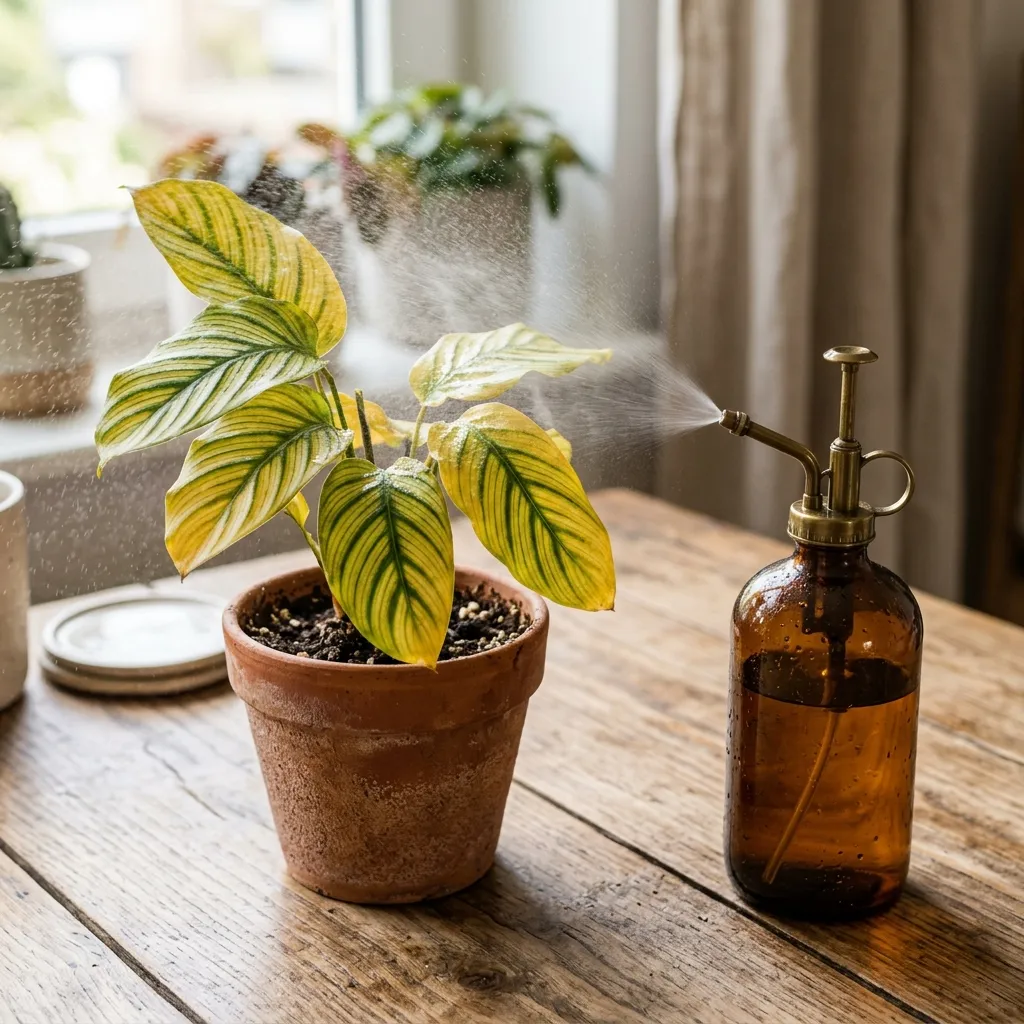
- Iron Deficiency: New leaves turn yellow or white; veins stay sharply green (interveinal chlorosis).
- Manganese Deficiency: Also affects new growth, but the yellowing looks more blotchy and irregular rather than sharply defined between the veins — easy to confuse with iron deficiency at a glance.
- Nitrogen/Magnesium Deficiency: Older, lower leaves turn yellow first, because the plant steals mobile nutrients to support new growth.
- Overwatering/Root Rot: Leaves turn a mushy yellow across the entire plant, starting at the bottom. The soil stays wet.
If your older leaves are turning yellow, chelated iron will not help. If your new leaves look like a green skeleton on a yellow background, proceed to the next step.
2. Understand the Role of Soil pH
Here is the most important fact about iron deficiency: your soil may already contain plenty of iron. The problem is that iron availability depends strongly on soil chemistry, not simply on how much iron is physically present.
As soil pH rises, a smaller share of the iron in the soil typically remains in a form roots can actually absorb. That means alkaline or calcareous soils can contain substantial total iron while still leaving very little of it plant-available. This condition — where high-pH soil locks up iron regardless of how much is actually there — is often called lime-induced chlorosis.
If you apply non-chelated iron (like iron sulfate, sometimes sold as 'Dr. Iron') to alkaline soil, it can become unavailable to roots fairly quickly. This is one reason gardeners turn to chelated iron: chelation surrounds the iron ion with an organic "claw" (a chelate) that helps keep it soluble and available for root uptake. Different chelates hold up differently as pH rises, which is why the choice of chelate matters as much as the decision to use iron at all.
3. Choose the Right Chelate: EDTA, DTPA, or EDDHA
Not all chelated iron is created equal. The type of "claw" used affects how well it performs across different soil conditions. Check the product label to see which chelate is used, and weigh it against what you know about your soil.
| Chelate Type | Typical Soil Suitability | Best Use Case | Appearance/Notes |
|---|---|---|---|
| Iron EDTA | Best suited to acidic soil conditions | Mildly acidic soils, foliar sprays, hydroponics (with pH monitoring) | Inexpensive, but tends to break down and become less effective as soil pH rises. Often a poor fit for lime-induced chlorosis. |
| Iron DTPA | Suitable across a broader range, including moderately higher pH | Slightly alkaline soils, general container potting mixes, standard aquaponics | A reliable middle-ground option, generally more expensive than EDTA. |
| Iron EDDHA | Broadest useful range of these three; particularly suited to alkaline or calcareous soil | Highly alkaline or calcareous soils, severe lime-induced chlorosis, trees | Stains everything dark red/purple. Generally the most effective option in difficult, high-pH soils. |
If you don't know your soil pH, or you know you have hard, alkaline tap water, EDDHA-based products are often the most appropriate of these three chelates for soil application — though it's still worth checking your specific product's own documentation, since formulations vary between manufacturers.
4. Quick Reference: Chelated Iron by Planting Type
Application method and dosage shift depending on what you're treating. There is no single universal rate for chelated iron, so use this as a starting orientation and always defer to your specific product's label for the actual dosage.
| Planting Type | Typical Method | Dosage Guidance | Notes |
|---|---|---|---|
| Houseplants / seedlings | Diluted foliar spray or light soil drench | Use the label's lowest recommended rate for tender or container plants | Tender tissue burns easily — when the label gives a range, start at the low end |
| Garden beds / vegetables / flowers | Soil drench, occasional foliar touch-up | Use the product's standard labeled rate | Water in gently; avoid contact with open blooms |
| Lawns | Hose-end sprayer or broadcast, foliage + root zone | Use the product's specific labeled turf/lawn rate | Rates vary meaningfully between brands and iron concentrations |
| Trees / woody shrubs / citrus | Foliar spray, soil drench along the drip line, or professional trunk injection for large trees | Use the product's labeled rate for woody plants or trees, not a houseplant rate | EDDHA is often preferred for trees in alkaline soil since it tends to hold iron available longest |
5. Follow the Product-Label Rate
Unlike generic potting soil recipes, there is no single "teaspoon per gallon" rule for chelated iron. The correct dosage depends entirely on the product's concentration (e.g., 5% vs. 11% iron), the formulation, and whether you are treating a small indoor Philodendron or a mature outdoor Gardenia.
Always read the label. Over-applying chelated iron can cause toxicity of other micronutrients (like manganese or zinc) by outcompeting them at the root level. For houseplants, err on the side of caution and use the lowest recommended dose for container plants. Product label directions should always take priority over any generic rate you find elsewhere, including in this guide.
6. Foliar Spray vs. Soil Drench: Which Should You Use?
Chelated iron can be applied directly to the soil (where it is taken up by roots) or sprayed directly onto the leaves (foliar feeding). For the best results, use a combination approach.
| Factor | Foliar Spray | Soil Drench |
|---|---|---|
| Speed of results | Often faster — some visible improvement is possible within days, depending on the product | Typically slower, often taking several weeks |
| Duration of effect | Temporary — only affects the leaves you sprayed | Generally longer-lasting; can supply new growth as it emerges |
| Bypasses soil pH issues? | Yes, delivers iron directly to leaf tissue | No — still affected by soil pH and chelate type |
| Best for | Faster cosmetic relief, severe active chlorosis | Longer-term correction, preventing recurrence |
Foliar Application (For Faster Relief)
Foliar feeding bypasses the roots entirely, delivering iron directly to the chlorotic tissue.
- Mix a dilute solution according to the "foliar spray" instructions on the label. (Never use a soil-drench concentration on leaves, or you will burn them.)
- If the product label recommends a compatible wetting agent or surfactant, use only the type and rate specified on the label.
- Spray the plant early in the morning or late in the evening, coating the foliage evenly according to the product label.
- Never spray in direct, intense sunlight, as the liquid can scorch the foliage, and check the label for any rain-window restrictions before applying.
Soil Application (For Longer-Term Correction)
While foliar sprays can act faster, they only affect the leaves you sprayed; new growth will still emerge yellow if the soil isn't addressed. Apply the remaining chelated iron solution directly to the soil as a drench, following the label's rate. Ensure the soil is slightly moist before applying to help prevent root shock, and check the label for any restrictions on applying before expected rainfall, which can wash the product away before roots absorb it.
A Word of Caution: Staining
Chelated iron, especially EDDHA, will stain concrete, stone, masonry, and clothing a dark red or purple. Mix and apply it carefully, and rinse any accidental spills off hard surfaces immediately with water to minimize staining.
7. How to Use Chelated Iron on Lawns
Chelated iron is a popular lawn treatment because it can produce a deeper green color without necessarily causing the flush of soft, fast growth that heavy nitrogen fertilizer often does.
- Method: Mix and apply the product according to its own lawn-specific label instructions, typically using a hose-end or pump sprayer to wet the foliage thoroughly.
- Rate: Follow the product's labeled turf/lawn application rate for your area — rates vary meaningfully between brands and iron concentrations, so there is no single number that applies to every product.
- Timing and aftercare: Follow the label's guidance on application timing (many products recommend cooler parts of the day), any watering-in instructions, and any recommended interval before mowing, since these details differ by product.
8. How to Use Chelated Iron on Trees and Shrubs
Established trees and woody shrubs, especially citrus, magnolias, and maples growing in alkaline soil, are prone to lime-induced chlorosis because their root systems sit in a large volume of high-pH soil.
- Chelate choice: Iron EDDHA is often a strong choice for trees in alkaline or calcareous soil, since it tends to remain effective even at high pH.
- Rate: Use the product's labeled rate for woody plants or trees rather than extrapolating from a houseplant or lawn rate — many labels specify a distinct, higher-strength rate for trees and shrubs.
- Application methods: Foliar spray can work for smaller ornamental trees; for larger, established trees, a soil drench applied around the drip line (where the feeder roots are concentrated) is often more practical. Severe cases in large, established trees are sometimes addressed with professional trunk injection — a specialized treatment typically performed by a certified arborist rather than a routine homeowner application.
- Patience required: Because trees have such a large root system and slower nutrient uptake, full correction can take a full growing season, even though foliar-sprayed leaves may show improvement sooner.
9. Chelated Iron as a Weed Killer: A Different Product Entirely
If you searched for "chelated iron to kill weeds," it's important to know this refers to a different category of product than the nutritional iron chelates (EDTA, DTPA, EDDHA) covered above. Iron-based herbicides use a chelate called FeHEDTA (iron hydroxyethylenediaminetriacetic acid) as their active ingredient, and they are registered and sold specifically as selective broadleaf herbicides — not fertilizers.
- How it works: Broadleaf weeds tend to absorb FeHEDTA far more aggressively than turfgrass. The excess iron triggers oxidative damage inside the weed's cells, causing the tissue to blacken and die, often within hours. Turfgrass absorbs the same iron more slowly and simply greens up instead.
- Common products: Some lawn herbicides use FeHEDTA as the active ingredient and are marketed as selective broadleaf weed controls; check the active ingredient listed on the label to confirm.
- Target weeds: These products are typically labeled for broadleaf lawn weeds such as dandelion, white clover, chickweed, creeping buttercup, ground ivy/creeping Charlie, and plantain, and may also affect moss and algae.
- Don't confuse the two: A nutritional iron product (EDTA/DTPA/EDDHA) will not kill weeds, and a FeHEDTA weed killer is not meant to be used as a general plant fertilizer — check the active ingredient on the label before buying.
10. Monitor and Fix the Underlying Cause
Chelated iron is a treatment, not a cure. If you don't fix the underlying issue, the chlorosis will return. After applying the iron, monitor the newest growth over the next few weeks. If the new leaves emerge a healthy green, the treatment worked. (Note: severely bleached older leaves may never fully regain their color).
How often to reapply: How long a soil application remains effective depends on the chelate used, the application rate, soil chemistry, irrigation, and the plant itself — so follow the product label's guidance on reapplication rather than a fixed universal interval. If chlorosis returns quickly after treatment, that's a sign to reassess the underlying cause rather than simply repeating the same application. If a foliar touch-up is needed in the meantime, repeat it only at the interval permitted by the product label.
Long-Term Solutions for Iron Chlorosis:
- Correct Your pH: If soil testing confirms excessively high pH, use an appropriate soil-acidification approach for your soil type and plant, following the specific product's directions. Elemental sulfur is one commonly used option, though the correct amount depends on your soil test results.
- Stop Overwatering: Waterlogged soil suffocates roots, preventing them from taking up nutrients even if the pH is perfect. Let the top few inches of soil dry out between waterings.
- Address Poor Root-Zone Conditions: Severely root-bound plants, compacted media, or degraded potting soil can all limit a plant's ability to take up nutrients, including iron. If a plant's container or root-zone condition appears to be contributing to the problem, repotting into fresh, well-draining soil can help restore normal nutrient uptake.
- Watch Soil Temperatures: Cold soil slows down root metabolism, heavily restricting iron uptake. Wait for spring warming before assuming a severe deficiency in outdoor plants.
Recommended next actions
Next Best Actions
Move from reading to action with related calculators, plant profiles, and quiz-based recommendations.
Guide
Yellow Houseplant Leaves: Diagnose & Fix Guide 2026
After diagnosing hundreds of yellow-leaf cases across dozens of plant species, we've mapped the ten distinct causes that look nearly identical at first glance — and built the only systematic guide that tells you not just what's wrong, but exactly how to confirm it and fix it.
Guide
Nitrogen Deficiency in Houseplants: Symptoms & Fix
With over 12 years of houseplant nutrition diagnostics and more than 2,400 nutrient deficiency cases assessed across tropical and subtropical indoor environments, we have developed a rapid-response framework that distinguishes nitrogen starvation from overwatering in a single visual assessment — and reverses visible chlorosis within 5 to 7 days using a precise liquid feed protocol.
Topic Guide
Foliar Feeding for Houseplants
Learn how foliar feeding works for houseplants. Discover when to spray leaves with fertilizer, which nutrients absorb best, and how to avoid chemical leaf.
Topic Guide
Nutrient Lockout in Plants: Causes, Diagnosis & How to Fix It
Learn to identify and fix nutrient lockout. Discover why plants can't absorb nutrients due to pH imbalance, salt buildup, or overfertilization, and how to.
Topic Guide
Micronutrients for Plants
Spot iron, zinc and boron deficiency signs in houseplants and correct trace mineral shortages before growth is affected.
Calculator
Soil pH Calculator: Add the Right Lime or Sulfur
Know exactly how much lime or elemental sulphur you need to reach your target soil pH. No more over‑application or wasted amendments.
Frequently Asked Questions
How do I know if my plant needs chelated iron?
How do you apply chelated iron to plants?
Can I use chelated iron on houseplants?
Should chelated iron be applied to soil or leaves?
What is the difference between iron EDTA and iron EDDHA?
Does soil pH affect chelated iron?
How long does chelated iron take to work?
Can too much chelated iron hurt plants?
Can I use chelated iron with other fertilizers?
Why are new leaves yellow but the veins stay green?
Can chelated iron fix yellow leaves caused by overwatering?
What should I do if chelated iron does not work?
How often should I apply chelated iron to plants?
When should I apply chelated iron?
Is chelated iron safe to use on lawns?
Does chelated iron kill weeds?
Will chelated iron stain my patio or clothing?
Explore More