Fiddle Leaf Fig Recovery: How to Save a Dying Ficus Lyrata
Is your Fiddle Leaf Fig dropping leaves or developing brown spots? Learn how to diagnose watering, light, root, and environmental problems and help your.

Quick Answer
To help a struggling Fiddle Leaf Fig, first check the roots, soil moisture, light, and recent environmental changes rather than treating leaf symptoms alone. Soggy soil with soft, dark roots suggests root problems and calls for improved drainage. Dry soil with crispy leaves can indicate underwatering, while sudden green-leaf drop often follows relocation, repotting, or drafts. Provide bright light, consistent temperatures, and good drainage, and avoid repeated changes while the plant recovers. Don't fertilize heavily while it's severely stressed.
Key Takeaways
- Leaf drop and brown spots do not identify a single cause; check soil moisture, roots, light, temperature, and recent environmental changes together.
- Fiddle Leaf Figs generally perform best in bright light with protection from sudden exposure to intense direct sun.
- Persistently wet soil and roots that are dark, soft, or deteriorating indicate a serious drainage or root-health problem that should be addressed promptly.
- Dry, crispy leaves and very dry potting mix are more consistent with water stress than soft, waterlogged roots.
- Sudden green-leaf drop can occur after relocation, repotting, temperature changes, drafts, or other environmental stress.
Quick Facts
- Scientific name Ficus lyrata
- Light Bright light; acclimate gradually when increasing direct sun to avoid leaf scorch
- Root warning signs Persistently wet soil combined with dark, soft, deteriorating, or foul-smelling roots indicates a root-health problem
- Dryness warning signs Very dry soil with crispy, curling, or wilted foliage indicates significant water stress
- Watering rule Water thoroughly when the upper portion of the potting mix has dried sufficiently for the plant and conditions; allow excess water to drain
- Recovery priority Correct the underlying environmental or root problem first; avoid stacking multiple major changes at once
- Fertilizer rule Avoid heavy feeding while roots are severely stressed; resume balanced feeding after active recovery begins
What Should I Do?
The soil is staying wet for a long time and the plant is declining
The soil is extremely dry and leaves are crispy, curled, or wilted
Leaves are yellowing while the potting mix remains wet
Leaves developed brown patches after moving into much stronger sunlight
Healthy green leaves started dropping soon after moving or repotting
The plant has tiny reddish or brown spots on newly developing leaves
The plant was recently fertilized and is severely stressed
The plant has stabilized but has a bare lower trunk
The plant is almost completely leafless
Fiddle Leaf Fig Problems: Symptoms, Causes & Solutions
| Symptom | Possible Cause | What to Check | Recommended Action | Urgency |
|---|---|---|---|---|
| Large dark brown or black areas with persistently wet soil | Root stress, root rot, or another moisture-related problem | Soil moisture, drainage, pot drainage holes, and root condition | Correct drainage and watering. If roots are severely damaged, remove affected roots and repot into an appropriate well-draining medium | High |
| Crispy brown leaf margins or tips with very dry soil | Underwatering or excessive water loss | Soil moisture, recent watering, heat, airflow, and light intensity | Rehydrate thoroughly when appropriate and establish a more consistent watering routine | Moderate |
| Pale or yellowing leaves with persistently wet soil | Excess moisture, poor drainage, root stress, or insufficient light | Root condition, drainage, soil moisture, and light exposure | Address excess moisture and drainage before increasing watering or fertilization | High |
| Brown patches after sudden exposure to strong direct sunlight | Leaf scorch or sun stress | Recent change in light intensity and whether the plant was acclimated | Reduce the intensity temporarily and acclimate gradually when increasing direct sunlight | Moderate |
| Healthy green leaves dropping shortly after a move or repot | Environmental or transplant stress | Recent relocation, repotting, temperature changes, drafts, and watering changes | Keep conditions stable and avoid additional unnecessary changes while the plant adjusts | Low to moderate |
| Small reddish or brown speckles on young leaves | Edema or other physiological stress; symptoms are not diagnostic on their own | Recent watering fluctuations, humidity, temperature, and leaf development | Maintain consistent moisture and environmental conditions and monitor new growth | Low unless symptoms spread rapidly |
| Bare lower trunk with healthy foliage concentrated near the top | Natural leaf loss, previous stress, age, or insufficient branching | Overall plant health and whether active new growth is occurring | Prioritize stable care. Pruning or notching can be considered only after the plant is healthy and actively growing | Low |
Why Fiddle Leaf Figs Decline
Fiddle Leaf Figs (Ficus lyrata) can react strongly when their growing conditions change. Leaf drop, yellowing, brown spots, and wilting are symptoms rather than diagnoses, so the most reliable recovery strategy is to investigate the plant's soil moisture, drainage, roots, light, temperature, and recent history before changing its care.
A plant that was recently moved, repotted, exposed to a draft, watered differently, or placed in substantially stronger or weaker light may respond even when no single factor appears extreme. The goal is to identify the most likely stressor, correct it, and then provide stable conditions long enough for the plant to recover.
Step 1: Check the Soil Before You Water
Start with the potting mix rather than the leaves. Push a finger or suitable moisture probe into the mix and determine whether it is still wet, moderately moist, or very dry. Also check whether water can escape freely through the drainage holes.
Persistently wet soil is a warning sign because roots require both moisture and oxygen. On the other hand, allowing the root ball to become excessively dry can cause wilting, crispy foliage, and leaf drop. Fiddle Leaf Figs do best with a consistent watering pattern that matches the plant, pot, growing medium, light, temperature, and season.
Step 2: Check the Roots if the Soil Stays Wet
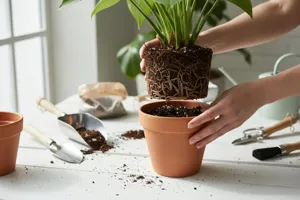
If the potting mix remains wet for an unusually long time and the plant is declining, inspect the root system when appropriate. Healthy roots are generally firm rather than mushy. Dark, soft, deteriorating roots, especially when accompanied by an unpleasant odor, indicate significant root stress and may be consistent with root rot.
If extensive root damage is present, remove the affected roots with clean, sterilized tools and repot into fresh, well-draining medium in a container with adequate drainage. Do not use a rigid soil recipe for every Fiddle Leaf Fig; the ideal mix depends on the pot, growing conditions, and how quickly the medium dries.
After repotting, avoid keeping the new medium continuously saturated. The goal is to restore a healthy balance between moisture and root-zone aeration.
Step 3: Correct the Light
Fiddle Leaf Figs generally perform best in bright light. A consistently dark location can reduce growth and contribute to weak or declining foliage. Move the plant toward a brighter location when necessary, but avoid making an extreme jump from low light to intense direct sunlight.
If the plant is moving from a dim interior location to a sunny window, increase exposure gradually. Sudden exposure to strong sunlight can scorch leaves that were not acclimated to the intensity.
When evaluating recovery, focus on the condition of new leaves. Existing brown or scorched tissue will not become green again, but healthy new growth is a useful sign that conditions are improving.
Step 4: Understand the Pattern of Leaf Drop
Leaf drop is not automatically a sign of root rot. Look at the condition of the leaves, soil, roots, and recent environment together.
- Green leaves dropping soon after a move: Environmental shock is possible, especially after a change in light, temperature, humidity, or airflow.
- Crispy leaves with very dry soil: Water stress or excessive water loss is more likely.
- Yellowing leaves with persistently wet soil: Excess moisture, poor drainage, root stress, or inadequate light should be investigated.
- Dark or soft leaf damage combined with wet soil: Root problems become more concerning and should be investigated promptly.
- Brown damage after sudden strong sunlight: Consider leaf scorch, especially when the affected side faces the strongest light.
Step 5: What About Red or Brown Spots on New Leaves?
Small reddish or brown spots on developing Fiddle Leaf Fig leaves can occur with edema, a physiological disorder in which water uptake exceeds the leaf's ability to lose water. Edema can be associated with fluctuating moisture and environmental conditions, but the spots alone are not enough to diagnose the cause of a plant's decline.
Rather than treating the spots directly, stabilize watering, avoid extremes in moisture, and maintain appropriate light, temperature, and airflow. Watch subsequent leaves for signs of healthy development.
Step 6: Stabilize the Plant During Recovery
Once you have corrected the likely problem, resist the temptation to make several additional changes at once. Fiddle Leaf Figs can respond poorly to repeated relocation, repotting, pruning, and changes in watering.
Choose a suitable location with good light, keep temperatures reasonably stable, protect the plant from strong drafts, and water according to the condition of the potting mix. Allow excess water to drain completely rather than leaving the pot standing in water.
Should You Fertilize a Sick Fiddle Leaf Fig?
Heavy fertilization is not an emergency treatment for a declining plant. If the roots are severely damaged or the plant is under major environmental stress, adding fertilizer can create additional salt stress without solving the underlying problem.
Pause routine feeding while the plant is severely compromised. Once it has stabilized and is producing active new growth, resume a balanced fertilizer appropriate for Fiddle Leaf Figs and follow the product's dilution and application instructions.
Can a Nearly Leafless Fiddle Leaf Fig Recover?
A leafless or nearly leafless plant is not automatically dead. First check whether the trunk and branches remain firm and whether the root system is still viable. If the plant retains living tissue, correcting the underlying environmental or root problem may allow dormant buds to produce new growth.
Recovery can take weeks or months. Do not repeatedly water, repot, prune, or fertilize simply because new leaves have not appeared yet. Stable conditions are usually more helpful than repeated emergency interventions.
Notching and Pruning for Branching
Once a Fiddle Leaf Fig is healthy and actively growing, selective pruning or notching may be used to influence branching. Notching involves making a shallow cut near a node on the stem or trunk in an attempt to encourage a dormant bud to activate.
Notching is not a rescue treatment. Do not perform it on a severely stressed, recently repotted, or actively declining plant. If the objective is to restore a healthy plant, prioritize roots, light, watering, and environmental stability first.
What Not to Do During Recovery
- Do not water on a rigid calendar: Check the potting mix and environmental conditions instead.
- Do not assume every brown spot means root rot: Examine soil, roots, light exposure, and the pattern of damage.
- Do not move the plant repeatedly: Choose a suitable location and allow the plant time to adjust.
- Do not repot unnecessarily: Repot when the root or soil condition warrants it rather than treating every leaf symptom with a new pot.
- Do not heavily fertilize a severely stressed plant: Correct the underlying problem first.
- Do not expose a low-light plant suddenly to intense sunlight: Acclimate gradually to stronger light.
- Do not expect damaged leaves to repair themselves: Evaluate new growth as the primary indicator of recovery.
Long-Term Recovery and Prevention
After the immediate problem is corrected, focus on consistency. Provide strong appropriate light, a potting medium that drains well, a container with drainage holes, and watering that responds to the plant's actual moisture needs.
Keep the plant away from persistent hot or cold drafts and avoid large environmental changes whenever possible. Clean dusty leaves gently so the foliage can receive adequate light, and inspect the plant regularly for pests or new symptoms.
The most important sign of successful recovery is not the return of an old damaged leaf. Look for stable foliage, firm stems, healthy roots, and eventually new leaves that develop normally.
Frequently Asked Questions
How do I know if my Fiddle Leaf Fig has root rot?
Can a Fiddle Leaf Fig recover after losing most of its leaves?
How much light does a Fiddle Leaf Fig need?
Why is my Fiddle Leaf Fig dropping healthy green leaves?
What causes brown spots on Fiddle Leaf Fig leaves?
What are the tiny red or brown spots on new Fiddle Leaf Fig leaves?
Should I fertilize a recovering Fiddle Leaf Fig?
When should I repot a Fiddle Leaf Fig with brown leaves?
Can I save a Fiddle Leaf Fig with no leaves?
What is notching on a Fiddle Leaf Fig?
Sources & References
-
Source: hgic.clemson.edu
Type: extension
-
Source: gardeningsolutions.ifas.ufl.edu
Type: extension
-
Source: extension.umn.edu
Type: extension
Explore More