Pink Princess Philodendron Care Guide
Care for a pink princess philodendron with the light, humidity and pruning techniques that maintain strong pink variegation.
-
Difficulty
Medium
-
Light
Bright indirect
-
Temperature
18-25°C (64-77°F)
-
Growth
Moderate
-
Expert Insight
Master-grower data coming soon.
-
Common Mistake
Real-world care data coming soon.
-
Environment
Real-world conditions coming soon.
Quick Answer
Pink Princess Philodendron needs bright indirect light to maintain strong pink variegation, consistent moisture without waterlogging, and high humidity. Insufficient light causes new leaves to revert to solid green. Prune above a node to encourage new growth and remove any fully reverted, non-variegated stems to preserve pink coloring.
Key Takeaways
- Provide bright indirect light to maintain strong pink variegation.
- Water when the top 1-2 inches of soil feel dry; avoid soggy conditions.
- Maintain moderate to high humidity for lush, unblemished leaf growth.
- Prune fully green, reverted stems to preserve pink variegation over time.
- Avoid direct sun, which can scorch the more delicate pink leaf tissue.
Overview
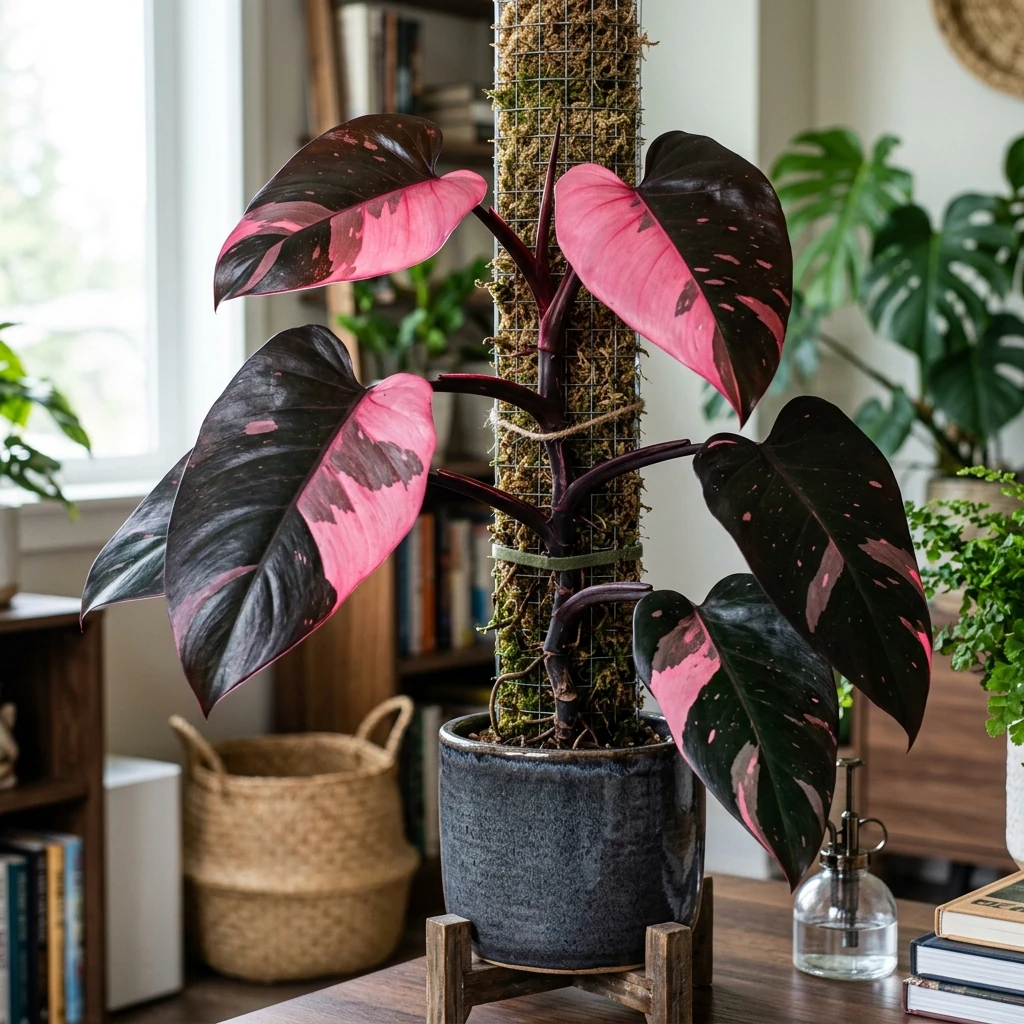
Pink Princess Philodendron (Philodendron erubescens) is a tropical climbing aroid prized for its dark green foliage marked with naturally occurring pink variegation. It grows as a climbing vine and performs best with bright indirect light, warm temperatures, moderate to high humidity, and a loose, well-draining growing medium. Its main care challenge is maintaining healthy growth and attractive variegation without exposing the foliage to excessive direct sunlight.
Watering
Water Pink Princess Philodendron when the upper portion of the growing medium has dried, then water thoroughly and allow excess water to drain freely. Avoid keeping the root zone continuously saturated, as prolonged wetness can contribute to root problems. The plant generally uses water more quickly during warm, bright periods of active growth and more slowly during cooler or darker conditions.
Light
Provide bright indirect light to support vigorous growth and help maintain strong pink variegation. Insufficient light can lead to slower growth, longer spaces between leaves, and reduced variegation. Strong direct afternoon sunlight can scorch the foliage, particularly the pale pink sections, which contain less chlorophyll and can be more vulnerable to light damage. Acclimate the plant gradually when increasing light exposure.
Soil
Use a loose, chunky, well-draining growing medium that provides both moisture retention and good airflow around the roots. A tropical aroid mix containing materials such as orchid bark, perlite, and organic components can work well. Avoid dense soil that stays saturated for prolonged periods and always use a container with drainage holes.
Temperature
Pink Princess Philodendron prefers warm, stable conditions around 18–27°C (65–81°F). Protect it from cold drafts, sudden temperature changes, and prolonged exposure to temperatures near or below 13°C (55°F). Avoid placing it directly beside heating or cooling vents, where rapid changes in temperature and humidity can stress the foliage.
Humidity
Moderate to high humidity, around 50–70%, generally supports healthy Pink Princess Philodendron growth and attractive foliage. The plant can adapt to average household conditions, but very dry air may contribute to brown edges and slower development. A humidifier can provide more consistent humidity than occasional misting. Maintain adequate airflow to reduce the risk of fungal or bacterial problems.
Fertilizer
Feed Pink Princess Philodendron during active growth with a balanced houseplant fertilizer according to the product instructions. Regular moderate feeding can support new leaves and climbing growth when light and watering are appropriate. Avoid excessive fertilizer, which can cause salt buildup and root stress. Reduce or pause feeding when growth slows substantially.
Repotting
Repot Pink Princess Philodendron when roots substantially fill the container, growth slows because of root restriction, the growing medium breaks down, or the plant becomes unstable. Move it into a container only moderately larger than the existing one and use fresh, airy aroid mix. Repotting during active growth is generally less stressful than disturbing the root system during a period of slow growth.
Growth
Pink Princess Philodendron is a climbing plant that produces successive leaves along a central stem. With suitable support, mature plants can develop longer stems and larger foliage. Growth is strongest under warm conditions with bright indirect light and adequate moisture and nutrition. Plants grown without support may trail or sprawl, while vertical support can encourage a more natural climbing habit.
Support
Provide a moss pole, coir pole, trellis, or another sturdy vertical support if you want Pink Princess Philodendron to climb. Its aerial roots can attach to suitable support and help stabilize the stem. Climbing can encourage larger, more mature foliage and a more compact vertical growth habit. Tie the stem loosely rather than restricting developing nodes or leaves.
Variegation
Pink Princess Philodendron is valued for its pink and cream variegation, but the amount and pattern of variegation can vary considerably from leaf to leaf. Adequate light is important for maintaining attractive coloration and supporting healthy growth, but increasing light cannot reliably create a specific amount of pink on every new leaf. Highly variegated leaves contain less chlorophyll and may grow more slowly than predominantly green leaves.
Reversion
Pink Princess Philodendron can produce new growth with reduced variegation or predominantly green leaves. If several successive leaves become increasingly green, pruning back to a stem section that contains desirable variegated growth can sometimes encourage new shoots from tissue carrying the preferred pattern. However, variegation is variable and cannot be guaranteed on every new leaf. Avoid removing healthy foliage simply because one leaf has less pink.
Pruning
Pruning can be used to control vine length, encourage branching, remove damaged growth, and manage unwanted reversion. Make clean cuts just above a suitable node using sterilized scissors or pruners. Healthy stem sections containing nodes can be propagated. When pruning for variegation, focus on the pattern present along the stem rather than judging the plant from a single leaf.
Propagation
Pink Princess Philodendron is commonly propagated from stem cuttings containing at least one viable node. Select healthy sections with suitable variegated growth and root them in water, sphagnum, perlite, or another appropriate propagation medium. A cutting must contain a viable node to produce new growth; a leaf without a node cannot independently create a new plant. Keep cuttings warm, humid, and in bright indirect light while roots develop.
Flowering
Pink Princess Philodendron can produce the characteristic inflorescences of a mature aroid, but flowering is uncommon in typical indoor cultivation and is not a primary reason to grow the plant. Strong vegetative growth, adequate maturity, warmth, and suitable growing conditions are more relevant to most indoor growers than encouraging flowers.
CommonProblems
Yellowing leaves can result from excessive moisture, root stress, natural aging, or environmental changes. Brown edges may be associated with dry air, inconsistent watering, or excessive fertilizer salts. Small leaves and long spaces between nodes commonly indicate insufficient light, inadequate support, or generally weak growing conditions. Reduced variegation can occur naturally and should not automatically be treated as a nutritional deficiency.
SeasonalCare
Pink Princess Philodendron generally grows most actively during warm, bright periods. During this time it may require more frequent watering and regular feeding. When temperatures and light levels decline, growth slows and the growing medium may remain moist for longer. Reduce watering and fertilizer accordingly while maintaining the brightest suitable indirect light and protecting the plant from cold drafts.
OutdoorCare
Pink Princess Philodendron can be grown outdoors in warm, frost-free climates with bright filtered light or partial shade. Plants moved outdoors from indoor conditions should be acclimated gradually to stronger light and increased airflow. Protect the foliage from intense direct sun, heavy exposure to wind, and cold temperatures. Bring container-grown plants indoors before unsuitable temperatures arrive.
Toxicity
Pink Princess Philodendron contains insoluble calcium oxalate crystals and is toxic if chewed or ingested. Contact with plant tissue can cause irritation, while ingestion can result in oral discomfort and other symptoms. Keep the plant away from pets and children who may chew the foliage or stems.
Troubleshooting & Diagnostics Guide
1 Why is my Pink Princess losing its pink variegation?
Diagnosis: Low light – reverting to green
Treatment: Move to brighter indirect light; prune green shoots to encourage pink.
Prevention: Provide bright indirect light; stable genetics.
2 Why are the leaves turning yellow?
Diagnosis: Overwatering – root rot
Treatment: Reduce watering; check roots; repot if needed.
Prevention: Water when top inch is dry.
3 Why are the leaves curling and getting crispy edges?
Diagnosis: Low humidity or underwatering
Treatment: Increase humidity; water when dry.
Prevention: Maintain moderate humidity and consistent watering.
Authoritative Resources
For additional peer-reviewed information on plant diseases, toxicity, and care, consult these trusted botanical and agricultural extensions:
Frequently Asked Questions
How much light does a Pink Princess Philodendron need?
How do I get more pink on my Pink Princess Philodendron?
Why is my Pink Princess Philodendron producing green leaves?
Can a Pink Princess Philodendron revert completely?
Does Pink Princess Philodendron need a moss pole?
How often should I water Pink Princess Philodendron?
How fast does Pink Princess Philodendron grow?
How do I propagate Pink Princess Philodendron?
Why are my Pink Princess Philodendron leaves turning yellow?
Why are the pink parts of my leaves turning brown?
Can Pink Princess Philodendron grow in low light?
Is Pink Princess Philodendron toxic to cats and dogs?
Explore More