Golden Barrel Cactus Care Guide
Keep a golden barrel cactus thriving with correct watering intervals, bright light and fast-draining soil to prevent rot and stunted growth.
-
Difficulty
Medium
-
Light
Bright indirect
-
Temperature
18-25°C (64-77°F)
-
Growth
Moderate
-
Expert Insight
Master-grower data coming soon.
-
Common Mistake
Real-world care data coming soon.
-
Environment
Real-world conditions coming soon.
Quick Answer
Golden Barrel Cactus needs full, direct sun and a fast-draining, gritty cactus mix. Water deeply but infrequently, letting the soil dry out completely between waterings, roughly every 2-4 weeks depending on season. Overwatering in cool or low-light conditions is the leading cause of rot and stunted, discolored growth.
Key Takeaways
- Provide full, direct sunlight for at least 6 hours daily for healthy growth.
- Use a fast-draining cactus or succulent mix, never regular potting soil.
- Water deeply only when soil is completely dry, roughly every 2-4 weeks.
- Reduce watering further during winter dormancy to prevent root rot.
- Watch for soft, discolored patches, an early sign of overwatering.
Repotting
Golden Barrel Cactus develops a substantial taproot and dislikes frequent disturbance, so repot only when clearly root-bound or when the current pot restricts the plant's slow, steady girth increase — often every 2-4 years for younger plants and less often as it matures. Choose a container only slightly larger than the previous one, since excess soil volume around a small root mass holds moisture too long. Always use thick gloves or folded newspaper to handle the plant, as its dense, sharp spines make bare-handed repotting risky. Let the plant settle in dry soil for about a week before resuming watering, allowing any root damage to callus over.
Growth
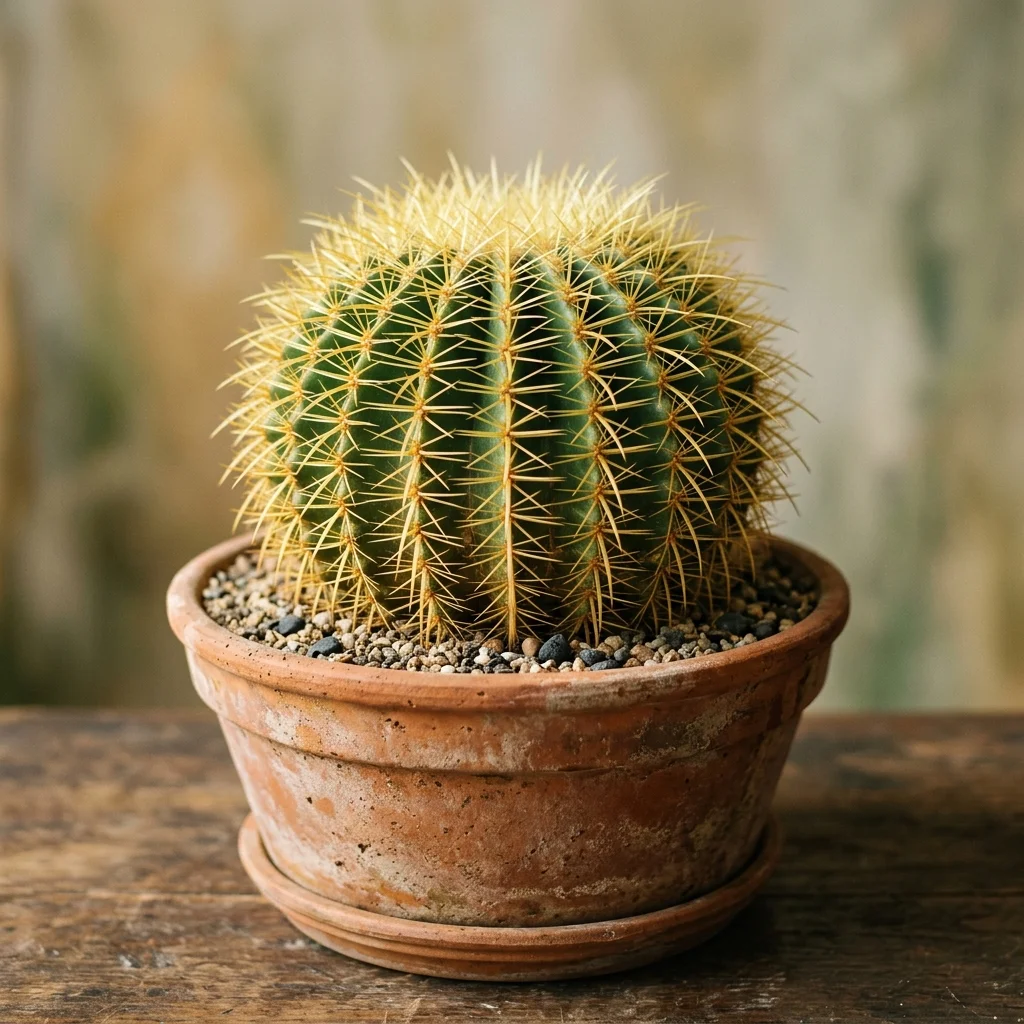
Golden Barrel Cactus grows as a solitary, ribbed sphere that slowly elongates into a more barrel-like shape with age, typically adding only modest size each year even under good conditions. Growth is fastest in warm weather with strong light and essentially stops in winter. Young plants are noticeably rounder, while specimens grown for many years can eventually reach a substantial size, though this takes many years indoors or in containers. Offsets are uncommon in this species compared to many other cacti, so most plants remain single, unbranched specimens rather than forming clusters.
Flowering
Golden Barrel Cactus can produce small yellow flowers in a ring near the top of the plant, but only once it reaches sufficient maturity and size, which commonly takes a decade or more, and blooming is far more likely outdoors or in a greenhouse than on an indoor windowsill. Flowering generally requires strong direct sun, a distinct cooler winter rest, and an established root system. Indoor specimens, especially smaller or younger ones, often never flower, and this is normal rather than a sign of poor care.
OutdoorCare
In warm, arid to semi-arid climates, Golden Barrel Cactus is commonly grown outdoors in full sun and well-draining rocky or sandy soil, where it typically performs better than in most indoor settings. Plants moved outdoors for the season should be acclimated gradually over a couple of weeks, since a plant grown indoors or in a nursery under shade cloth can scorch if placed abruptly into intense summer sun. Outdoor plantings benefit from raised beds or slopes that shed heavy rain quickly, since prolonged saturation is a common cause of decline. This species tolerates brief light frost once mature and well-established, but sustained freezing temperatures or wet, cold conditions can cause serious damage, so cold-climate growers generally treat it as a container plant that's brought indoors or covered before frost.
Dormancy
Golden Barrel Cactus goes through a genuine winter dormancy in response to shorter days and cooler temperatures, during which growth stops almost entirely rather than merely slowing. During this period the plant needs very little water — many growers withhold it almost completely unless the plant shows signs of significant shriveling — since the combination of cold and wet soil is a major cause of rot in dormant cacti. Reduced light tolerance also changes during dormancy: a plant that handled full sun in summer may need protection from intense, low-angle winter sun if grown in a climate with strong winter light. Normal watering and feeding can resume gradually as temperatures warm and new growth becomes visible in spring.
Fertilizer
Golden Barrel Cactus doesn't need much feeding, especially compared to leafy houseplants. In the wild it grows in poor, sandy soil, so it's used to getting by on very little. During spring and summer, when the plant is actively growing, you can feed it occasionally with a cactus or succulent fertilizer — just mix it weaker than the bottle recommends. Look for one that's lower in nitrogen and higher in the other two nutrients (usually written as three numbers on the label, like 2-7-7); too much nitrogen can cause soft, mushy growth that's more likely to rot. Stop feeding completely in winter, since the plant isn't growing then and won't use the nutrients. Water the soil first, then fertilize — never feed a completely dry plant, and skip feeding if the plant looks stressed or was recently repotted.
Troubleshooting & Diagnostics Guide
1 Why is my Golden Barrel cactus turning yellow at the base?
Diagnosis: Overwatering or poor drainage
Treatment: Stop watering; allow soil to dry completely; if rot spreads, unpot and cut away damaged tissue.
Prevention: Water only when soil is bone dry; use gritty cactus mix.
2 Why are the spines on my Golden Barrel turning brown?
Diagnosis: Natural aging or sunburn
Treatment: If sunburn, move to light shade; if natural, no action.
Prevention: Provide some afternoon shade in hottest climates.
3 Why is my cactus not growing?
Diagnosis: Insufficient light or cool temperatures
Treatment: Move to brightest spot; ensure temperatures above 15°C for growth.
Prevention: Give full sun and warm conditions.
Authoritative Resources
For additional peer-reviewed information on plant diseases, toxicity, and care, consult these trusted botanical and agricultural extensions:
Frequently Asked Questions
How often should I water a Golden Barrel Cactus?
Does Golden Barrel Cactus need full sun?
How fast does Golden Barrel Cactus grow?
How often should I repot a Golden Barrel Cactus?
When does Golden Barrel Cactus flower?
Does Golden Barrel Cactus need water in winter?
Can Golden Barrel Cactus grow outdoors?
Why is my Golden Barrel Cactus turning yellow or becoming soft?
Does Golden Barrel Cactus need fertilizer?
Does Golden Barrel Cactus need pruning?
How do I safely handle a Golden Barrel Cactus?
How big can a Golden Barrel Cactus get?
Explore More