NPK 30-10-10 Fertilizer Calculator for Orchids & Foliage Plants
Use the NPK calculator pre-loaded with the 30-10-10 fertilizer ratio.
Quick Answer
NPK 30-10-10 contains 30% nitrogen, 10% phosphate expressed as P₂O₅, and 10% potash expressed as K₂O. It is best known as a high-nitrogen fertilizer for orchids and other plants grown in bark or tree-fern media, where the growing medium itself consumes nitrogen as it breaks down. The ratio alone does not determine how much to apply. Use the calculator with your product label rate or a chosen nitrogen concentration.
Enter your details
Recommended Output
Fertilizer to Add
Nitrogen (N)
Phosphate (P₂O₅)
Potash (K₂O)
Static Reference
How this calculator works: NPK 30-10-10
Visible baseline values
These baseline ratios and decision rules are included directly in the page so visitors can review core guidance before using the interactive calculator.
| Scenario | Baseline Rule | Safety Note |
|---|---|---|
| Inputs used by this tool | Calculation Mode, Fertilizer NPK, Label Dose Rate, Label Dose Unit | The interactive calculator refines the result from these inputs. |
| Outputs generated | Fertilizer to Add, Nitrogen (N), Phosphate (P₂O₅), Potash (K₂O) | The static table gives baseline logic; final value depends on entered values. |
The Problem
Most NPK calculators online are built for field-scale agriculture — hectares, acres, kg/ha, Urea/DAP/MOP. Home growers with a bottle of liquid feed and a windowsill of houseplants need a calculator scaled to a watering can or a single pot, not a wheat field.
When to Use This Tool
Use this calculator when you want to measure fertilizer according to a manufacturer's label rate, intentionally dilute that rate (e.g. half or quarter strength for sensitive plants), or calculate the fertilizer amount needed to reach a specific nitrogen concentration (ppm).
Who is this for?
- Houseplant growers
- Container gardeners
- Small-scale home growers
What is NPK 30-10-10?
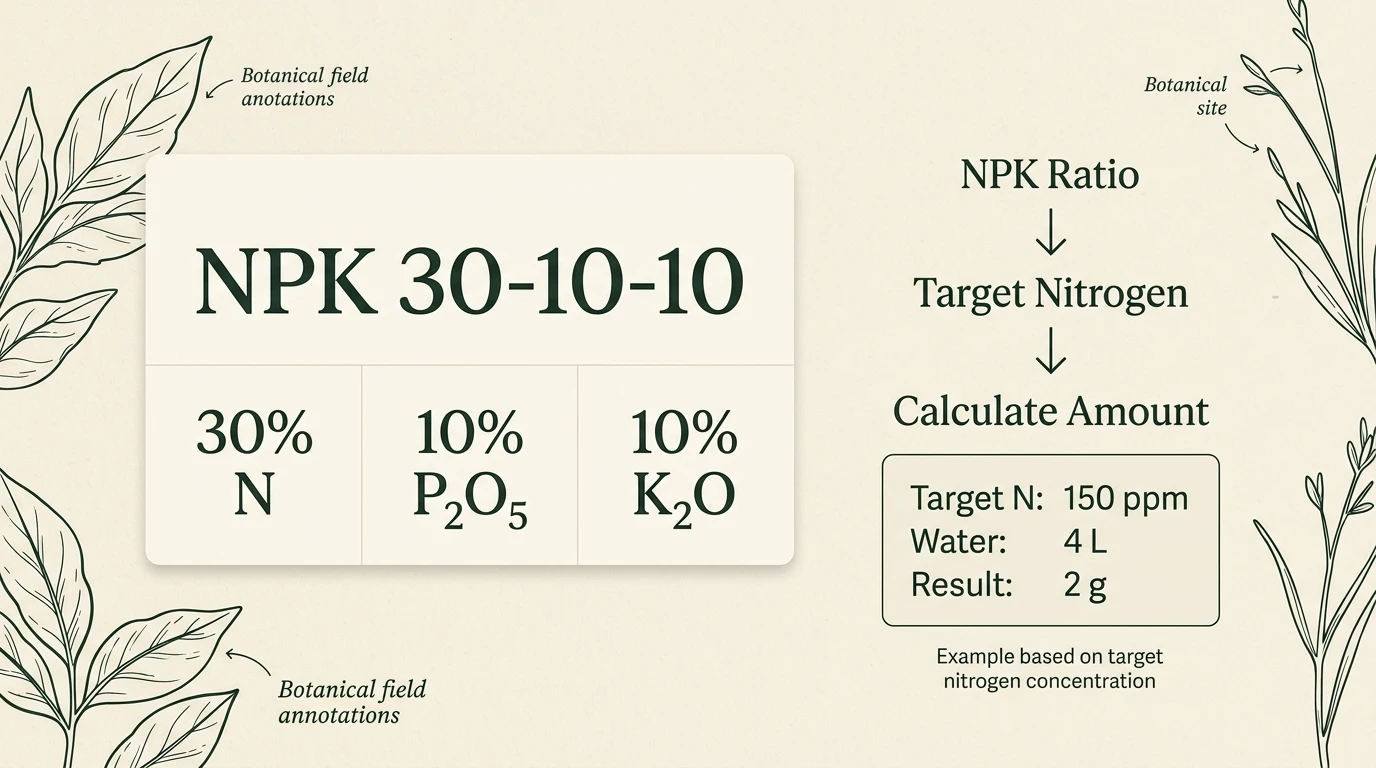
NPK 30-10-10 is a fertilizer analysis containing 30% nitrogen (N), 10% phosphate expressed as P₂O₅, and 10% potash expressed as K₂O — a 3-1-1 ratio, with three times as much nitrogen as phosphate or potash.
The three numbers use the conventional fertilizer-label notation. They describe the guaranteed analysis of nitrogen, available phosphate expressed as P₂O₅, and soluble potash expressed as K₂O rather than directly representing elemental phosphorus and potassium.
Where 30-10-10 Is Commonly Used
Unlike balanced 1-1-1 ratios such as 10-10-10 or 20-20-20, 30-10-10 is not a general all-purpose fertilizer. It is best known as the classic high-nitrogen formula for orchids and other plants grown in bark or tree-fern fiber media. Bark and tree-fern growing media consume nitrogen as they slowly decompose, so orchid growers using 30-10-10 supply extra nitrogen to compensate for this, in addition to feeding the plant itself. It is widely sold and marketed specifically for orchids and foliage houseplants for this reason.
Because it is nitrogen-heavy relative to phosphate and potash, 30-10-10 is not typically recommended as a universal substitute for a balanced fertilizer, and some orchid growers alternate it with a bloom-booster formula during flowering.
How to Calculate With 30-10-10 Fertilizer
To determine how much fertilizer to mix, follow these calculation steps:
- Read the fertilizer analysis. A 30-10-10 fertilizer contains 30% total nitrogen (N), 10% available phosphate expressed as P₂O₅, and 10% soluble potash expressed as K₂O.
- Confirm the prefill. Use the calculator with the 30-10-10 ratio already selected.
- Enter calculation inputs. Choose your calculation mode (Label Dose Dilution or Target Nitrogen PPM), enter your specific application rate or concentration target, and specify the volume of water you are preparing.
- Review the calculated result. The calculator computes the required fertilizer amount and the resulting nutrient breakdown.
- Verify product safety. For actual product application, compare the calculated result with the manufacturer's label directions. Do not treat the 30-10-10 NPK ratio itself as a universal application rate.
Worked Example: Target Nitrogen PPM
Because the 30-10-10 analysis contains 30% nitrogen, achieving a specific nitrogen concentration requires less fertilizer mass than a lower-nitrogen formula. For example, to reach a target of 150 ppm nitrogen in 4 liters of water, the calculation uses the 30% nitrogen content: (150 ppm × 4 L) ÷ (10 × 30) = 2 grams of fertilizer.
Application Rate and Your Product Label
The appropriate application rate for an NPK 30-10-10 product depends on the specific formulation, product label, crop or plant, application method, growing medium, and growing conditions. The 30-10-10 analysis alone does not establish a universal dose.
Because this analysis has substantially more nitrogen than phosphate or potash, it should not be treated as interchangeable with a balanced fertilizer. Whether a high-nitrogen analysis is appropriate depends on the growing medium and nutrient requirements of the plant.
Use the full NPK calculator page for calculations with other fertilizer analyses.
Troubleshooting & Diagnostics Guide
1 The calculated fertilizer amount seems much higher or lower than expected.
Diagnosis: The label dose, water volume, or measurement unit may have been entered incorrectly.
Treatment: Check the selected label-dose unit and water-volume unit and confirm they match what is printed on your fertilizer label.
2 I am unsure whether 30-10-10 is appropriate for my plants.
Diagnosis: 30-10-10 is a specialty high-nitrogen formula, and the analysis alone does not establish whether it suits a particular growing medium.
Treatment: Check whether your plant is grown in bark, tree-fern fiber, or another medium that consumes nitrogen as it decomposes. For plants in ordinary potting soil, consider whether a more balanced ratio is more appropriate, and consult your specific product label.
Glossary of Terms
- PPM (Parts Per Million)
- A measurement of concentration. For dilute aqueous solutions, 1 ppm is commonly expressed as approximately 1 mg/L.
- N-P₂O₅-K₂O
- The nutrient-analysis convention used on fertilizer labels for nitrogen, phosphate expressed as P₂O₅, and potash expressed as K₂O.
- Half Strength
- Using 50% of a fertilizer's label-recommended dose for the same water volume, a common practice for houseplants to reduce the risk of salt buildup in containers.
Frequently Asked Questions
What does NPK 30-10-10 mean?
What is 30-10-10 fertilizer used for?
Is 30-10-10 good for regular houseplants in potting soil?
How much 30-10-10 fertilizer should I use?
What is the difference between Label Dose Dilution and Target Nitrogen PPM?
Sources & References
-
Source: homegarden.cahnr.uconn.edu
-
Source: ask2.extension.org
-
Source: ag.umass.edu
-
Source: scottsmiraclegro.com
-
Source: ag.ndsu.edu
-
Source: umass.edu
-
Source: nacaa.com.customers.tigertech.net