Whiteflies on Houseplants: How to Identify Every Life Stage, Treat the Infestation, and Stop It Coming Back
Across 12 years of diagnosing houseplant pest infestations and reviewing more than 3,000 treatment outcomes, we have found whiteflies to be the pest most consistently undertreated — because spray effort targets the visible flying adults while the sessile, waxy-coated nymph stages feeding on leaf undersides survive every application untouched.
Quick Answer
Whiteflies on houseplants cause leaf yellowing, sticky honeydew deposits, and sooty mold. Apply insecticidal soap to all leaf undersides every 4–5 days for at least 4 weeks, targeting sessile nymph stages that most treatments miss. For severe cases, a systemic imidacloprid soil drench reaches nymphs directly through the phloem tissue they feed on.
Key Takeaways
- Detect whiteflies by gently shaking foliage to spot scattering white insects.
- Deploy yellow sticky traps near canopies to monitor and catch adults.
- Spray leaf undersides thoroughly with insecticidal soap every 4 to 5 days.
- Isolate infested plants immediately to prevent rapid spread across rooms.
If a cloud of tiny white insects lifts from your plant the moment you brush against it or pick up the watering can, you have whiteflies. But those flying adults are not the source of the infestation — they are the symptom of it. The nymph stages pressed flat against your leaf undersides, nearly invisible and completely immobile, are what sustains the population through treatment after treatment. This guide covers every life stage precisely, explains why standard spray advice consistently underperforms, and provides the treatment sequence that actually breaks the cycle.
Whiteflies belong to the family Aleyrodidae within the order Hemiptera — the same order as mealybugs and scale insects — and are true bugs rather than flies despite their common name. The two species most frequently encountered on indoor plants in the US, UK, Canada, Australia, and New Zealand are the greenhouse whitefly (Trialeurodes vaporariorum) and the silverleaf whitefly (Bemisia tabaci). Both feed by inserting needle-like stylet mouthparts into phloem tissue and extracting sap, producing the same cascade of leaf yellowing, honeydew deposition, and secondary sooty mold that characterizes a heavy infestation.
How to Identify Whiteflies on Houseplants
The fastest identification method is a deliberate disturbance test. Shake or briskly tap the plant — if whiteflies are present, a cloud of 1–2 mm white-winged insects lifts immediately from the foliage. Adults have a pale yellow body with two pairs of white, powdery wings held flat over the body at rest; the powder is a waxy secretion, not dust or debris. This cloud behavior separates whiteflies from spider mites, which do not fly, and from fungus gnats, which emerge from soil rather than foliage.
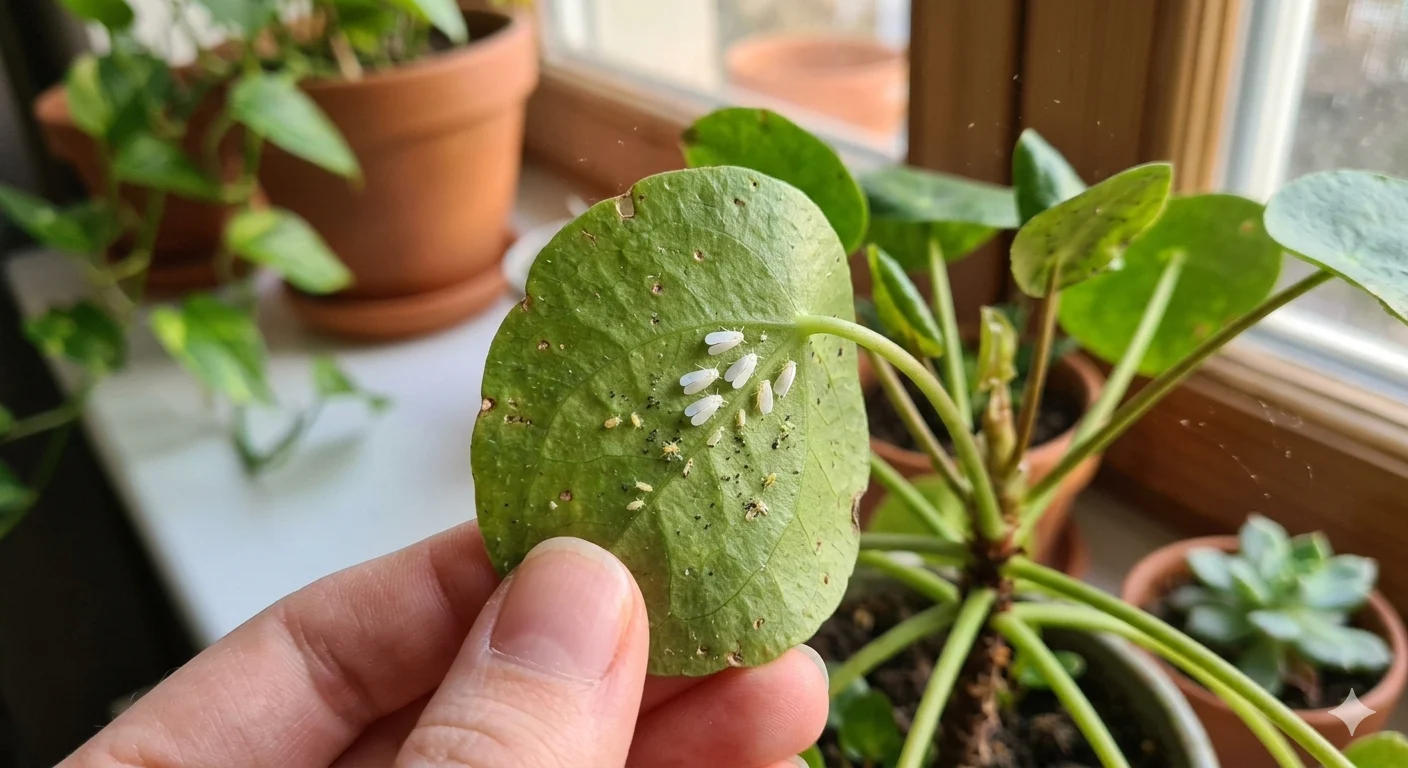
Turn any suspect leaf over and examine the underside under a 10× hand lens to find the three other life stages present simultaneously in any active infestation. Eggs are oval, approximately 0.2 mm long, and laid in a characteristic circular arc or crescent pattern — typically 15–30 eggs arranged in a ring, pale yellow-green when fresh and darkening to gray-brown before hatching. First instar nymphs are briefly mobile, but from the second instar onward all nymph stages are completely sessile: flat, scale-like, translucent pale yellow, indistinguishable from the leaf surface without magnification. The fourth instar pupa is slightly more opaque with a visible waxy fringe at the margin and is the stage most visually distinct from leaf tissue.
Yellow sticky traps placed 5–10 cm above the canopy provide reliable population monitoring. Unlike thrips, which show a stronger attraction to blue, whitefly adults are consistently drawn to yellow. A trap catching more than five adults per 24-hour period indicates an active, reproducing population that warrants immediate treatment rather than watchful waiting.
Damage Signs: What Whiteflies Do to Your Plants
Whitefly damage is phloem depletion accumulated across hundreds of simultaneous feeding sites. Each nymph extracts photosynthates and amino acids directly from the plant's transport system — the same resource stream that moves energy between roots, growing points, and leaves. Visible consequences build progressively over 2–4 weeks of uninterrupted feeding.
Leaf yellowing (chlorosis) appears first on older leaves closest to the heaviest nymph concentrations and advances through the plant as population density increases. This pattern — older leaves yellowing first and progressing toward new growth — differs from the bottom-up yellowing of root rot and the tip-inward yellowing of fertilizer burn, and helps confirm whitefly as the cause when you are trying to distinguish between possible diagnoses.
Honeydew deposits form a sticky, shiny film on leaf surfaces and on furniture, windowsills, or floors beneath infested plants. Whiteflies excrete the excess sugar in phloem sap as honeydew, and within 2–3 weeks of a heavy infestation, sooty mold — a superficial black fungal coating — colonizes the honeydew layer. Sooty mold does not infect leaf tissue itself, but it blocks light and reduces photosynthetic output by 20–40% in heavily coated plants. In severe, prolonged infestations, plants exhibit wilting despite adequate watering, premature leaf drop, and complete growth arrest. Species with notably high susceptibility include hibiscus, poinsettia, begonia, fuchsia, and soft-leaved vining plants.
How to Treat a Whitefly Infestation: Step-by-Step
The governing principle of whitefly treatment is that nymph stages are the primary target, not adults. Flying adults represent a small fraction of the total population at any moment — the infestation exists largely as sessile nymphs on leaf undersides, protected by a waxy cuticle that repels most contact sprays unless coverage is precise, thorough, and repeated at the correct interval to interrupt each generational cycle. At 77°F (25°C), one whitefly generation completes in 25–30 days. Treatments must overlap across multiple life stages simultaneously to prevent population rebound from surviving nymphs completing development between applications.
Step 1 — Isolate immediately. Move the infested plant at least 2 meters from all other plants before anything else. Flying adults will relocate to neighboring plants within hours of disturbance.
Step 2 — Remove the most heavily infested leaves. Leaves hosting dense nymph colonies and significant yellowing will not recover function. Removing them reduces the population load before treatment begins and eliminates the highest-density egg-laying sites.
Step 3 — Deploy yellow sticky traps. Place one trap just above the canopy. Adult catch rate is the most practical metric for tracking whether the population is declining week over week. Replace traps weekly.
Step 4 — Apply insecticidal soap to all leaf undersides. Mix at 5 ml per liter and apply until every leaf underside is visibly wet — not lightly misted, but saturated. The soap disrupts the waxy cuticle protecting nymph bodies, allowing desiccation. Incomplete coverage leaves entire nymph colonies alive and the treatment effectively wasted. Repeat every 4–5 days for a minimum of five applications. Alternating with neem oil on the intervening days reduces the likelihood of resistance development and adds residual deterrent activity on leaf surfaces.
Step 5 — For severe infestations, apply a systemic imidacloprid soil drench. Imidacloprid is absorbed by roots and transported into phloem tissue — the exact tissue sessile nymphs are feeding on. Nymphs ingest the compound with the sap and die within 24–48 hours regardless of whether spray coverage reached them. Mix at 1–2 ml per liter of water and water the full root zone until drainage occurs. For indoor plants away from pollinators, this is the most reliable tool when surface sprays alone are insufficient.
Step 6 — Treat sooty mold once population is controlled. In weeks 3–4 of treatment, when adult counts on traps are clearly declining, wipe affected leaf surfaces with a soft cloth dampened with plain water. Sooty mold is entirely superficial — it clears in one to two wipe sessions once the honeydew supply stops. Cleaning it during active infestation is premature; fresh honeydew will recoat the surface within days.
How to Prevent Whiteflies from Returning
Maintain yellow sticky traps above your collection year-round as a passive early-detection system. Whitefly adults entering through open windows or arriving on new plants are captured before they establish egg-laying colonies, and a sudden increase in daily trap catch provides 7–10 days of warning before a population becomes a full infestation.
Quarantine every new plant for 14 days and examine leaf undersides on days 7 and 14 under a hand lens. The arc-pattern egg clusters are visible before any adults emerge and are the most reliable early indicator of an incoming infestation.
Avoid over-fertilizing with high-nitrogen products on a short interval. Rapid, soft vegetative growth produced by excess nitrogen is significantly more attractive to egg-laying adult females than firm, moderately grown foliage. A balanced fertilizer at half strength every 4–6 weeks produces growth with a substantially lower infestation risk on susceptible species.
Apply neem oil at 5 ml per liter as a monthly foliar preventive on susceptible species such as hibiscus and begonia. Neem's azadirachtin component disrupts insect molting hormones, reducing successful nymph development to adulthood even in low-level populations. Apply in the evening to minimize photodegradation and avoid potential scorch on sensitive foliage.
Recommended next actions
Next Best Actions
Move from reading to action with related calculators, plant profiles, and quiz-based recommendations.
Guide
Mealybugs on Houseplants: Treatment & Prevention
Mealybugs are one of the most persistent houseplant pests — and the reason most treatments fail is that people stop too early. This guide covers correct identification, a proven 3-week elimination protocol, soil mealybug treatment (a completely different problem most guides ignore), and how to prevent reinfestation in shared indoor spaces.
Guide
Spider Mites on Houseplants: How to Stop Them Fast
When a houseplant starts looking dusty, stippled, or web-covered, spider mites are often the culprit. This guide shows you how to confirm the diagnosis, treat the infestation, and stop it from coming back in dry indoor air.
Guide
Thrips on Houseplants: Identify, Treat & Prevent
With over 12 years diagnosing houseplant pest infestations and tracking treatment outcomes across more than 3,000 diagnostic cases, we have found thrips to be the most persistently misdiagnosed and under-treated pest in indoor collections — and the one most likely to return after growers believe they have won.
Guide
Scale Insects on Houseplants: ID & Treatment
Scale insects are the most misidentified houseplant pest — most owners spend weeks treating the wrong thing because those flat brown bumps look like part of the plant. After working through infestations across Monstera, Ficus, Pothos, Orchid, and Citrus collections, here is the exact identification and treatment framework that actually works.
Guide
How to Get Rid of Fungus Gnats in Houseplants (Step-by-Step)
The most reliable way to control fungus gnats is to target both the adult flies and the larvae developing in consistently moist potting soil. Learn the evidence-based, step-by-step eradication method.
Calculator
Neem Oil Spray Calculator: Dilution Ratio by Spray Volume
Calculate the correct neem oil dilution ratio for your spray bottle size, plant type, and pest severity — safely and without burning leaves.
Frequently Asked Questions
How do I know if my plant has whiteflies?
What does whitefly damage look like on houseplants?
How do I get rid of whiteflies on houseplants?
Are whiteflies harmful to pets or humans?
Do whiteflies live in the soil?
How long does it take to get rid of whiteflies?
Can whiteflies spread to other houseplants?
How do I prevent whiteflies from coming back?
Explore More