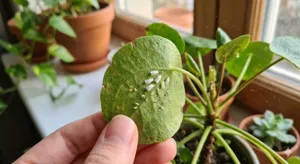
Sooty Mold on Houseplants: Why It Keeps Coming Back and How to Permanently Get Rid of It
With over 15 years of indoor plant diagnostics and more than 3,000 pest and fungal cases assessed across tropical houseplants and ornamentals, we've mapped the exact cause-chain between sap-sucking pests, honeydew secretion, and sooty mold colonization — so you understand why scrubbing alone never works and what actually does.
Quick Answer
Sooty mold is a surface fungus that grows on honeydew excreted by sap-sucking pests — most commonly scale insects, mealybugs, or whiteflies. It will return every time you clean it until the pest is eliminated. Identify and treat the pest first, then wipe leaves with soapy water and follow with a neem oil spray to prevent re-establishment.
Key Takeaways
- Identify sooty mold as a secondary fungus growing on pest honeydew.
- Treat the underlying sap-sucking pest infestation (scale, mealybugs, aphids).
- Wipe blackened leaves with warm, soapy water to restore light absorption.
- Improve air circulation to prevent secondary fungal recurrence.
You wiped the black coating off your plant's leaves with a damp cloth, felt relieved, and checked back three days later to find it completely back. That cycle — scrub, return, scrub, return — is the defining frustration of sooty mold, and it happens because the mold is not the disease; it is the symptom of a disease you haven't treated yet. Until you eliminate the hidden pest feeding on your plant's sap, the sooty mold will return with mathematical certainty every single time.
What Sooty Mold Actually Is: The Science and Mechanism
Sooty mold is not a single fungal species but a collective name for several genera of dark-pigmented fungi — most commonly Capnodium, Fumago, and Cladosporium — that colonize the surface of plant leaves and stems. These fungi do not penetrate leaf tissue or draw nutrients from the plant directly. Instead, they grow exclusively on honeydew: the sugar-rich, sticky liquid excreted as waste by phloem-feeding insects. This is the critical fact that changes everything about how you treat sooty mold. The fungus is not attacking your plant. It is feeding on a food source that a pest is manufacturing and depositing on your plant's surfaces.
The causal chain is strictly sequential: a sap-sucking insect colonizes your plant → it feeds on phloem sap and excretes honeydew → honeydew lands on leaves, stems, and surrounding surfaces → sooty mold spores (present in ambient air in virtually every indoor environment) germinate on the honeydew and form dark mycelial mats → the mats block sunlight from reaching chlorophyll in the leaves beneath. That last step is where the real damage occurs. Sooty mold does not directly poison or infect plant tissue. It kills plants by progressively blocking photosynthesis — a slow suffocation measured in reduced sugar production rather than tissue death. A light coating reduces photosynthetic efficiency by roughly 15–30%; a heavy, consolidated mat can reduce it by 60–80%, which is fatal to high-light-demand plants within weeks and seriously debilitating even for shade-tolerant species over months.
Identifying the Source: Which Pest Is Producing the Honeydew
The single most important diagnostic step — the one most plant owners skip — is identifying which pest is driving the honeydew production. Different pests produce different volumes of honeydew, colonize different plant parts, and respond to different treatments. Getting this identification right determines whether your mold returns in 3 days or stays gone permanently.
| Pest | Where to Find Them | Honeydew Volume | Mold Severity | Visual ID Clue | Treatment Priority |
|---|---|---|---|---|---|
| Scale insects (soft scale) | Stems, leaf undersides, nodes | Very High | Severe — thick, consolidated mats | Brown/tan immobile bumps; waxy coating | Critical — hardest to eradicate |
| Mealybugs | Leaf axils, stem joints, root crown | High | Moderate to severe | White cottony fluff at joints | High — spreads rapidly |
| Whiteflies | Leaf undersides — fly up when disturbed | High | Moderate — dusty coating | Tiny white moths on underside | High — very mobile |
| Aphids | New growth, shoot tips, flower buds | Medium | Light to moderate | Green/black/brown clusters on tips | Medium — fast breeding |
| Fungus gnats (larvae) | Soil only — larvae do not produce foliar honeydew | None | None — not a sooty mold cause | Small flies near soil surface | Not applicable |
Soft scale insects are the most common driver of severe sooty mold in indoor environments, particularly on plants like ficus, gardenias, citrus, and hoya. Their protective waxy shell makes them visually easy to overlook — many plant owners mistake them for natural stem texture — and their high honeydew output can produce visible mold coating within 5–7 days of a moderate infestation. If your sooty mold is thick, black, and consolidated rather than dusty and diffuse, look for scale before anything else. Our detailed guide on [scale insects on houseplants] covers identification and eradication in full.
Mealybugs are the second most frequent culprit. Their honeydew is slightly less prolific per insect than scale, but mealybug colonies grow rapidly in warm, humid indoor conditions — particularly during monsoon months when temperatures stay above 28°C — and a large colony produces equivalent mold coverage. Check every leaf axil, every stem joint, and the root crown at soil level. Mealybugs routinely colonize root systems where they are invisible until the plant is unpotted.
Whiteflies produce a finer, dustier mold coating that often gets misidentified as regular dust or residue. The diagnostic test is simple: tap the leaves. Whiteflies erupt from the undersides in a white cloud when disturbed. Their mold tends to appear on the upper surface of lower leaves, because the insects feed on the undersides of upper leaves and honeydew drips down.
Removing Sooty Mold: Treatment Steps
Step 1: Identify and treat the pest first. No mold treatment will hold until the honeydew source is eliminated. Treating mold without addressing the pest is the equivalent of mopping a floor while the tap is still running. Use the table above to identify the culprit, then treat according to the appropriate pest guide before proceeding.
Step 2: Once pest treatment is underway (not complete — underway, because pest eradication takes 2–3 treatment cycles over 2–3 weeks), begin physical mold removal. Prepare a solution of 1 teaspoon of mild dish soap dissolved in 1 liter of lukewarm water. Use a soft microfibre cloth dampened with this solution to gently wipe each affected leaf on both surfaces. Work from the base of the plant upward. For heavily affected leaves with consolidated mold mats, a second pass with plain water removes soap residue that could clog stomata if left.
Step 3: For plants with many small leaves or intricate stems where cloth-wiping is impractical — ferns, ivy, thick mealybug-affected hoyas — use the shower method. Place the plant in a shower or sink and direct a gentle stream of lukewarm water (not cold; thermal shock stresses tropical plants) across all surfaces. Follow with the soapy wipe on any remaining patches. Allow the plant to dry thoroughly in a ventilated area before returning it to its position; standing water in leaf axils after cleaning creates ideal conditions for fungal secondary infection.
Step 4: After physical cleaning, apply a diluted neem oil solution (2 ml neem oil + 0.5 ml dish soap per 1 liter of water) as a foliar spray to all surfaces. Neem oil acts simultaneously as a residual insecticide, disrupting any remaining pest life cycle, and as a mild antifungal that discourages mold re-establishment on partially cleaned surfaces. Apply in the evening to prevent light-induced leaf scorch. Repeat after 7 days.
Step 5: Monitor new growth specifically. If emerging leaves are clean and pest-free after two full weeks of treatment, eradication is successful. If new leaves develop fresh honeydew deposits or mold within 10 days, the pest population has not been adequately controlled and a stronger treatment cycle — including systemic insecticide for scale or soil drenches for mealybugs — is required. The complete workflow for identifying when a [wilting houseplants rescue guide] overlaps with mold-related decline (blocked photosynthesis causing wilting despite adequate watering) is covered separately.
Prevention: Stopping Sooty Mold Before It Starts
Sooty mold prevention is entirely a function of pest prevention, because without a honeydew-producing pest, sooty mold has no substrate on which to grow. Inspect every new plant before bringing it indoors — check stem nodes, leaf undersides, and the root crown — and quarantine new arrivals for 14 days before placing them near existing plants. Wipe leaves monthly with a damp cloth; this removes early honeydew deposits before mold colonies establish, and the physical contact lets you detect the tacky, slightly sticky texture of fresh honeydew that precedes visible mold by 5–7 days.
Maintain adequate air circulation. Stagnant air is the single biggest environmental factor that accelerates sooty mold establishment once honeydew is present — mold spore germination rates drop significantly with even modest airflow. A small fan set to its lowest setting, positioned to create gentle indirect movement across your plants, reduces mold recurrence significantly in high-humidity monsoon months. Finally, avoid over-fertilizing with high-nitrogen fertilizers, which produce the lush, soft new growth that aphids and whiteflies preferentially colonize. Our guide on [fertilizer burn in houseplants] covers the direct harm of over-fertilization, but the secondary pest-attraction effect is an underappreciated risk that makes moderated feeding a meaningful prevention strategy for sooty mold as well.
Recommended next actions
Next Best Actions
Move from reading to action with related calculators, plant profiles, and quiz-based recommendations.
Topic Guide
Fertilizer
Learn everything about fertilizer for your indoor and aquarium plants. Expert care tips, troubleshooting, and related guides.
Guide
Hoya Plant Care Guide: Light, Water & Blooming Tips
After growing and diagnosing over 1,800 hoya specimens across more than 35 species during 12 years of indoor plant care, we know that the majority of hoya owners never see a single bloom — not because their care is poor, but because of one widely unknown fact about how hoyas produce flowers that most care guides never mention.
Guide
Scale Insects on Houseplants: ID & Treatment
Scale insects are the most misidentified houseplant pest — most owners spend weeks treating the wrong thing because those flat brown bumps look like part of the plant. After working through infestations across Monstera, Ficus, Pothos, Orchid, and Citrus collections, here is the exact identification and treatment framework that actually works.
Frequently Asked Questions
Is sooty mold dangerous to humans or pets?
Can a plant recover from severe sooty mold coverage?
Why does sooty mold keep coming back after I clean it?
How do I know if it is sooty mold or a different fungal disease?
Which pest most commonly causes sooty mold on indoor plants?
Does neem oil kill sooty mold as well as the pest?
Can sooty mold spread from plant to plant?
Is the sticky residue on my plant's leaves and the surface beneath the pot always honeydew?
Explore More