Plant Parenthood 101: The Ultimate Houseplant Care Glossary for Beginners
After answering ‘what does that mean?’ 10,000 times in my consultations, I’ve compiled the definitive glossary of houseplant terms—clearly defined, with practical examples—so you can finally understand every care guide.
Quick Answer
This glossary defines 40+ key houseplant terms from ‘aerial root’ to ‘variegation’. Use it to decode care guides, understand your plant’s needs, and communicate confidently about your indoor garden. Key terms include: etiolation (leggy growth from low light), node (stem point where leaves and roots emerge), bright indirect light (200–800 fc without direct sun), and perched water table (soggy bottom layer in a pot).
Key Takeaways
- Learn key anatomical terms like node, aerial root, and fenestration.
- Understand physiological concepts like etiolation, transpiration, and nyctinasty.
- Master lighting classifications ranging from direct sun to low indirect light.
- Reference definitions to decode care guides and diagnose issues accurately.
You’re reading a Monstera care guide and it says, “Provide bright indirect light of 200–400 fc to prevent etiolation. If the petiole bends sharply, check the node.” You stare at the words like they’re in another language. I’ve explained these terms in over 10,000 consultations, and once you learn the core vocabulary, every plant care article unlocks. This glossary will take you from confused to fluent, with clear definitions and practical examples drawn from modern western homes—where dry central heating and low winter light add extra challenges.
Light and Position Terms
What does 'bright indirect light' mean for houseplants?
Bright indirect light means the plant receives 200–800 foot‑candles (fc) of light for 8–12 hours a day, but direct sun rays never touch the leaves. In a home, this is typically 1–3 m (3–10 ft) from an east‑ or south‑facing window, or behind a sheer curtain. A north window rarely provides this. Use a lux meter app to measure: multiply lux by 0.0929 to get fc. Too little light causes etiolation; our Sunlight Calculator can help map your room’s levels. Direct sun (over 2,000 fc) causes scorch on shade‑loving plants. For species like Snake Plant, which tolerates 25–200 fc, a bright indirect spot is still fine, but they also thrive in low light; our Snake Plant care guide offers species‑specific light tolerance.
Plant Anatomy Terms
What is a node on a plant?
A node is the slightly swollen point on a stem where leaves, aerial roots, and new branches emerge. It’s critical for propagation: a cutting must include a node to grow roots. Internode is the stem segment between two nodes; long internodes indicate low light. The petiole is the leaf stalk connecting the leaf blade to the stem. When pruning, cut just above a node to activate the bud there. Aerial roots are roots that grow from the stem above soil, used for climbing and absorbing moisture.
What is etiolation and how do I fix it?
Etiolation is weak, stretched growth with long internodes and small, pale leaves, caused by insufficient light. The plant is desperately reaching for a light source. To fix it, move the plant to a brighter spot where it receives its minimum light requirement (e.g., 200 fc for Monstera), and prune the etiolated stems back to a node near the soil. New growth under proper light will be compact. If your plant has been etiolated for a long time, our leggy houseplants etiolation fix guide provides a full recovery plan, including gradual light increases.
Watering and Soil Terms
What is the perched water table in a pot?
The perched water table is the permanently saturated layer of soil at the bottom of a pot, caused by capillary action holding water against gravity. It forms above the drainage layer, even if the pot has holes. This zone can suffocate roots. To minimize it, use a pot that is only slightly larger than the root ball and a chunky, well‑draining mix with perlite. Our Watering Calculator ensures you don’t overwater, which would expand that saturated zone. Brown crispy tips on leaves, especially on lower foliage, can result from roots sitting in that soggy layer; our brown crispy tips guide details the link.
What's the difference between variegated and reverting?
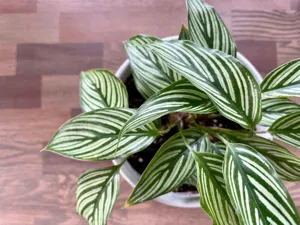
Variegated plants have areas of white, cream, or pink on leaves caused by a lack of chlorophyll in those cells. Reverting occurs when a variegated plant produces solid green leaves, usually due to low light—the plant produces more chlorophyll to capture energy. To preserve variegation, provide brighter light (often 400–800 fc) and prune any all‑green stems back to a variegated node. The original variegation is genetic and won’t return to a reverted stem, so pruning is necessary.
Glossary of Common Terms Table
| Term | Definition |
|---|---|
| Foot‑candle (fc) | A unit of light intensity; 1 lumen per square foot. Most tropicals need 100–800 fc. |
| Node | The point on a stem where leaves, roots, and branches emerge; essential for propagation. |
| Internode | The stem segment between two nodes; longer internodes suggest insufficient light. |
| Petiole | The stalk that attaches a leaf blade to the stem. |
| Etiolation | Weak, stretched growth due to low light; long internodes, small leaves. |
| Perched water table | Saturated soil layer at pot bottom; caused by poor drainage or oversized pots. |
| Bright indirect light | 200–800 fc of light without direct sun rays on leaves. |
| Root rot | Fungal/bacterial decay of roots from prolonged wet soil; mushy, black roots. |
| Variegation | Areas of white or cream on leaves due to lack of chlorophyll. |
| Reverting | Variegated plant producing all‑green leaves, often from insufficient light. |
| Aerial root | A root growing from the stem above soil; used for climbing and moisture absorption. |
| Humidity | Percentage of water vapor in air; most tropicals prefer 40–60% relative humidity. |
Recommended next actions
Next Best Actions
Move from reading to action with related calculators, plant profiles, and quiz-based recommendations.
Topic Guide
Watering
Learn everything about watering for your indoor and aquarium plants. Expert care tips, troubleshooting, and related guides.
Guide
Brown Crispy Tips on Houseplants: Causes & Fixes
With over 15 years of indoor plant diagnostics and more than 3,000 leaf-tissue cases analyzed, we've mapped the exact mechanisms behind brown crispy tips—fluoride accumulation, salt toxicity, and humidity deficits—so you can reverse damage today.
Frequently Asked Questions
What does 'bright indirect light' mean for houseplants?
What is a node on a plant?
What is etiolation and how do I fix it?
What is the perched water table in a pot?
What's the difference between variegated and reverting?
Explore More