Calathea Summer Crisping Fix: Humidity Without the Mold Risk
Having rescued 1,000+ crispy Marantaceae in dry western homes, I’ll show you exactly how to raise humidity to 60% without that white fuzz on the soil—even when AC runs non‑stop.
Quick Answer
Fix Calathea summer crisping by keeping relative humidity at 55–65% while ensuring constant gentle airflow. Use a cool‑mist humidifier aimed near the plant but not directly at leaves, and place the pot on a pebble tray filled with water that stays below the pot base. To prevent mold on the soil surface, top‑dress with a 1 cm (½ inch) layer of coarse horticultural sand and water only from the bottom. Avoid misting, which wets leaves but doesn’t raise ambient humidity enough to stop edge crisp.
Key Takeaways
- Use ultrasonic humidifiers to sustain 55–65% relative humidity without soaking leaves.
- Ensure continuous gentle air circulation to prevent foliar fungal growth.
- Top-dress potting soil with coarse sand and switch to sub-irrigation.
- Avoid direct overhead misting, which encourages bacterial leaf spot.
You’ve got a cool‑mist humidifier running 12 hours a day, your Calathea orbifolia is still developing brown, papery edges, and now you’ve noticed a fine white fuzz spreading across the potting soil. I’ve corrected this exact frustration in over 1,000 homes where summer air conditioning drops ambient humidity to 30% while overcooling the root zone. The typical reaction—blasting a humidifier directly at the plant and keeping the soil moist—creates a perfect mold incubator. The real solution is a balance: high humidity around the leaves, drier soil surface, and gentle air movement. Here’s how to achieve it without inviting fungal problems.
Diagnosing the Crisp: Humidity vs. AC Dryness
Why does my Calathea get brown crispy edges in summer even with a humidifier?
Most small humidifiers raise the humidity only in a tiny 15‑cm (6‑inch) radius directly in front of the nozzle. The rest of the room—and the plant’s leaves that are farther away—still sits at 30–35% RH. Calatheas need a consistent 55–65% RH across the entire canopy. Place a digital hygrometer at leaf height on the far side of the plant from the humidifier. If it reads below 50%, you need either a larger humidifier (rated for the room’s square footage) or to group several Calatheas together to create a shared microclimate. Our Watering Calculator helps adjust watering frequency because in low humidity the soil surface dries faster but the root ball may still be damp, causing overwatering if you water on a calendar.
Should I mist my Calathea leaves when the air conditioner is running?
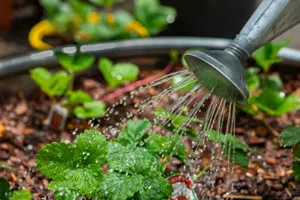
No. Misting only wets the leaf surface for a few minutes and evaporates quickly, doing almost nothing for ambient humidity. Worse, if water droplets sit in the crown of the plant or between unfurling leaves, they become a breeding ground for bacterial leaf spot. Instead, use a pebble tray: a shallow tray filled with pebbles and water to just below the top of the pebbles. Set the pot on the pebbles, not in the water. As the water evaporates, it humidifies the air directly around the leaves. A 25 cm x 35 cm (10 x 14 inch) tray can raise local humidity by 10–15%. For a deeper dive into Calathea care specifics, our Calathea orbifolia guide details the ideal balance.
Mold‑Free Humidity Strategies
How do I raise humidity for my Calathea without causing mold on the soil?
The white mold on soil is almost always saprophytic fungus, harmless to the plant but a sign of consistently damp soil surface and stagnant air. To eliminate it while keeping humidity high, first top‑dress the soil with 1 cm (½ inch) of coarse horticultural sand or fine aquarium gravel. This acts as a dry barrier—mold spores can’t germinate on its surface. Second, water exclusively from the bottom: place the pot in a basin of water for 20–30 minutes, then let it drain completely. The soil surface stays dry while the root zone absorbs moisture. Third, position a small USB fan 1 m (3 ft) away, oscillating on the lowest setting, to keep air moving across the soil and leaves. This prevents the stagnant conditions mold requires, without drying the leaves further if humidity is already 60%. If you already have a white fuzzy outbreak, our white mold on soil guide has immediate treatment steps.
Environment Setup for Summer AC Rooms
Can I put my Calathea in the bathroom to fix the humidity?
Only if the bathroom has a window providing bright indirect light (200–400 fc). A dark bathroom with 80% humidity will slowly weaken the plant because it still needs light for photosynthesis. The ideal summer location is a bright east‑facing room where morning sun is gentle, paired with a humidifier and pebble tray. Keep the plant at least 2 m (6 ft) away from an AC vent; the direct cold airflow causes leaf cell collapse. If you can’t avoid the vent, install a clear plastic deflector shield over the vent. Monitor with a hygrometer: when the AC kicks on, humidity may drop from 60% to 35% in 15 minutes. A larger evaporative humidifier with a built‑in humidistat will automatically compensate.
Calathea Summer Humidity Setup Table
| Setup Component | Specification | Effect on Humidity | Mold Prevention |
|---|---|---|---|
| Cool‑mist humidifier | Rated for room size, aimed 60 cm (2 ft) from plant | Raises room to 55–65% | Keep nozzle clean, use distilled water to avoid white dust |
| Pebble tray | Water level below pebbles, pot on top | +10–15% local humidity | Replace water every 3 days, rinse pebbles monthly |
| Soil top‑dressing | 1 cm (½ in) coarse sand or fine gravel | None (dries top) | Prevents fungal germination on soil surface |
| USB fan | Low oscillation, 1 m (3 ft) away | Slightly lowers, but humidifier compensates | Disrupts stagnant air; crucial for mold prevention |
| Bottom‑watering routine | Soak 20–30 min, drain fully | None | Keeps soil surface dry, roots moist |
Recommended next actions
Next Best Actions
Move from reading to action with related calculators, plant profiles, and quiz-based recommendations.
Topic Guide
Watering
Learn everything about watering for your indoor and aquarium plants. Expert care tips, troubleshooting, and related guides.
Guide
Calathea Orbifolia Care: Tips for Big Striped Leaves
After cultivating over 50 Calatheas and maintaining high-humidity greenhouse environments for 5 years, we have mastered the art of keeping Calathea Orbifolia thriving indoors without brown edges.
Guide
White Mold on Houseplant Soil — Causes & Treatment
With over 12 years of houseplant disease diagnostics and more than 2,400 soil-pathology cases reviewed across tropical and semi-arid climates, we've mapped every form of white growth that appears on potting mix — and the vast majority of what you're seeing right now is not what you fear.
Frequently Asked Questions
Why does my Calathea get brown crispy edges in summer even with a humidifier?
How do I raise humidity for my Calathea without causing mold on the soil?
Should I mist my Calathea leaves when the air conditioner is running?
Can I put my Calathea in the bathroom to fix the humidity?
Explore More