Misting vs Humidifier: The Truth About Indoor Plant Humidity
Does misting increase humidity for houseplants? Compare the brief, localized effect of misting with the consistent humidity control of a room humidifier. Learn the risks of leaf rot and the best ways to raise ambient moisture.
Quick Answer
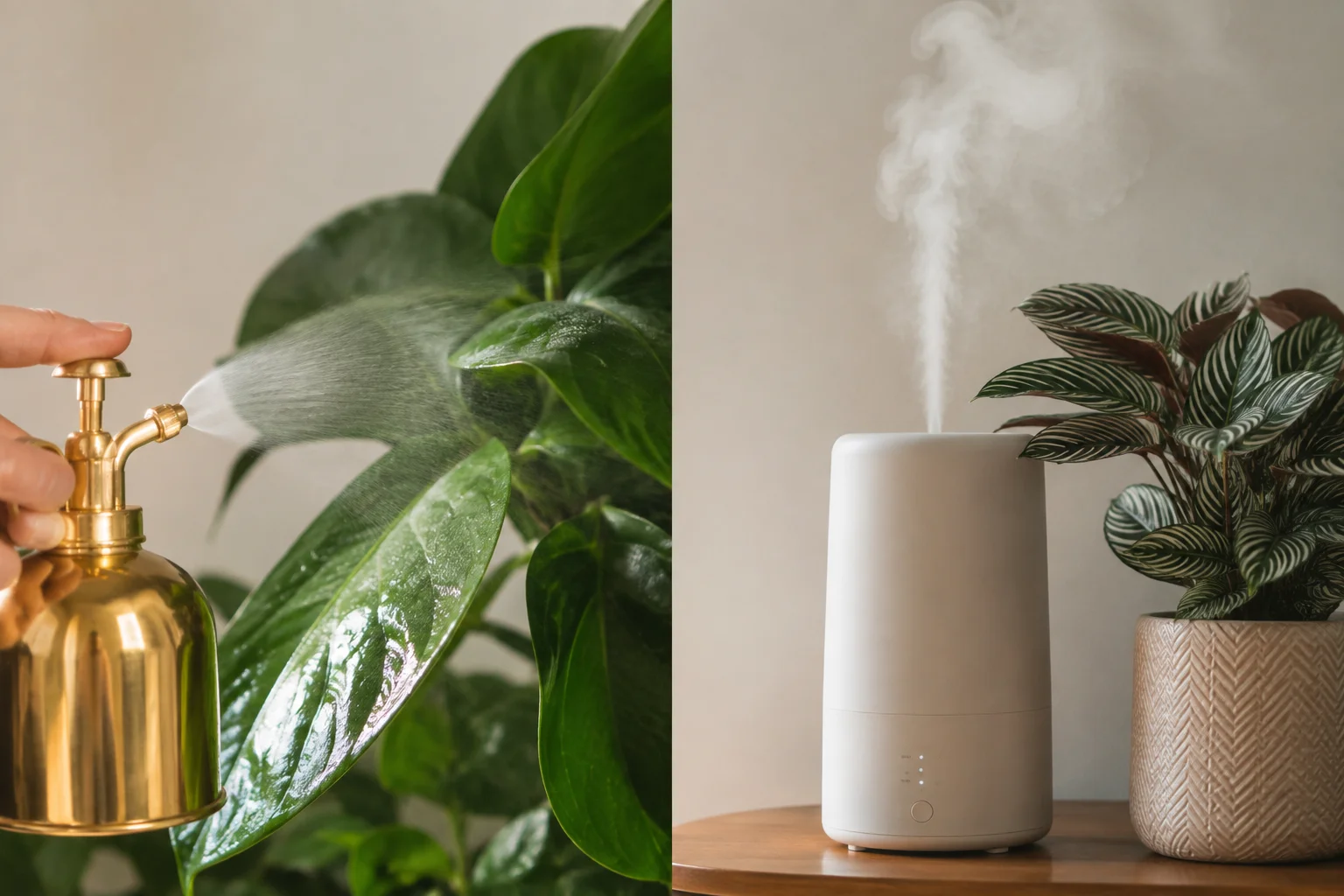
Misting only temporarily increases moisture around a plant as water evaporates, usually dissipating within minutes. It does not provide the sustained increase in room humidity that tropical plants need. A room humidifier is significantly more effective for raising and maintaining ambient humidity. Furthermore, frequent misting leaves foliage wet, which can invite fungal and bacterial leaf diseases if airflow is poor.
Key Takeaways
- Misting only temporarily increases moisture and dissipates quickly, having a negligible effect on sustained room humidity.
- A humidifier provides controllable and consistent ambient humidity, making it the best choice for tropicals.
- Persistently wet foliage combined with poor indoor airflow can trigger bacterial or fungal leaf diseases.
- Passive methods like pebble trays and plant grouping are safer alternatives to misting.
- Always use a digital hygrometer to measure actual room humidity rather than relying on guesswork.
Quick Facts
- Misting Temporary, localized moisture spike lasting only minutes
- Humidifier Consistent, measurable control of ambient room humidity
- Leaf-wetness risk Prolonged wet foliage favors fungal/bacterial leaf spot and powdery mildew
- Best measurement tool Digital hygrometer to monitor actual relative humidity (RH)
Misting vs Humidifier
| Feature | Misting | Humidifier |
|---|---|---|
| Effect on humidity | Temporary and localized (minutes) | Consistent and room-wide (hours/days) |
| Control & Measurement | Low (unmeasurable) | High (can be paired with a hygrometer) |
| Foliage wetness | Directly wets leaves, increasing rot risk | Increases ambient vapor, leaves remain dry |
| Maintenance | Requires repeated daily manual application | Requires periodic refilling and tank cleaning |
| Best use | Loosening dust before wiping leaves | Maintaining optimal humidity for tropicals |
The Misting Myth: Why Spraying Leaves Falls Short
Misting is frequently recommended as a simple hack to increase humidity around tropical houseplants like Calatheas, Alocasias, and Ferns. However, spraying water onto foliage only temporarily increases moisture in the immediate area. As the droplets evaporate, the localized humidity spike dissipates—often within 10 to 15 minutes. How long it lasts depends heavily on room temperature, HVAC airflow, and your home's baseline relative humidity.
More importantly, misting can actively harm your plants. Prolonged leaf wetness creates the perfect microclimate for bacterial and fungal pathogens, such as powdery mildew or leaf spot. When indoor airflow is poor and ambient temperatures are moderate, wet leaves become a liability rather than a benefit. Misting should never be treated as a viable substitute for managing the overall relative humidity of a room.
The Humidifier Reality: Consistent Ambient Moisture
A room humidifier adds continuous water vapor to the surrounding air, raising ambient relative humidity evenly. This makes it a highly effective and practical option for houseplants that genuinely require sustained humidity levels between 50% and 70%.
Humidifiers come in evaporative, warm mist, and ultrasonic (cool mist) models, all of which excel at maintaining a stable environment. However, not every indoor plant requires greenhouse-level moisture. Species, temperature, light levels, and seasonal acclimation all dictate a plant's true needs. Always use a digital hygrometer to measure the actual humidity in your plant zone rather than guessing based on how the air feels.
Alternative Methods to Raise Humidity
If you aren't ready to invest in a humidifier, there are passive, safer ways to improve local humidity without wetting foliage. Grouping plants together creates a shared microclimate; as plants release moisture through transpiration, they naturally humidify the air for their neighbors. Pebble trays—shallow dishes filled with pebbles and water placed underneath the plant pot—can also provide a slight, continuous localized humidity boost as the water evaporates. Lastly, avoid placing plants near HVAC vents, radiators, or drafty windows, which rapidly strip moisture from the air.
Which Approach Should You Choose?
If your goal is to reliably raise and maintain ambient humidity, a humidifier is the undisputed winner. Misting provides only a fleeting boost and carries a high risk of fungal disease. Save the spray bottle for cleaning dusty leaves, and rely on a humidifier, pebble trays, or strategic plant grouping to keep your tropicals thriving.
Frequently Asked Questions
Does misting actually increase humidity for plants?
Can misting harm my houseplants?
Is a humidifier better than misting for tropical plants?
Are pebble trays better than misting?
What type of humidifier is best for indoor plants?
How can I tell whether my plants actually need more humidity?
Sources & References
-
Source: extension.umd.edu
Type: extension
-
Source: extension.psu.edu
Type: extension
Explore More