Indoor Greenhouse Overheating: Managing Fan Airflow and Heat in Plant Cabinets
Stop your IKEA Milsbo or indoor plant cabinet from overheating this summer. Learn fan placement, venting, light timing, and humidity balance to keep.
Quick Answer
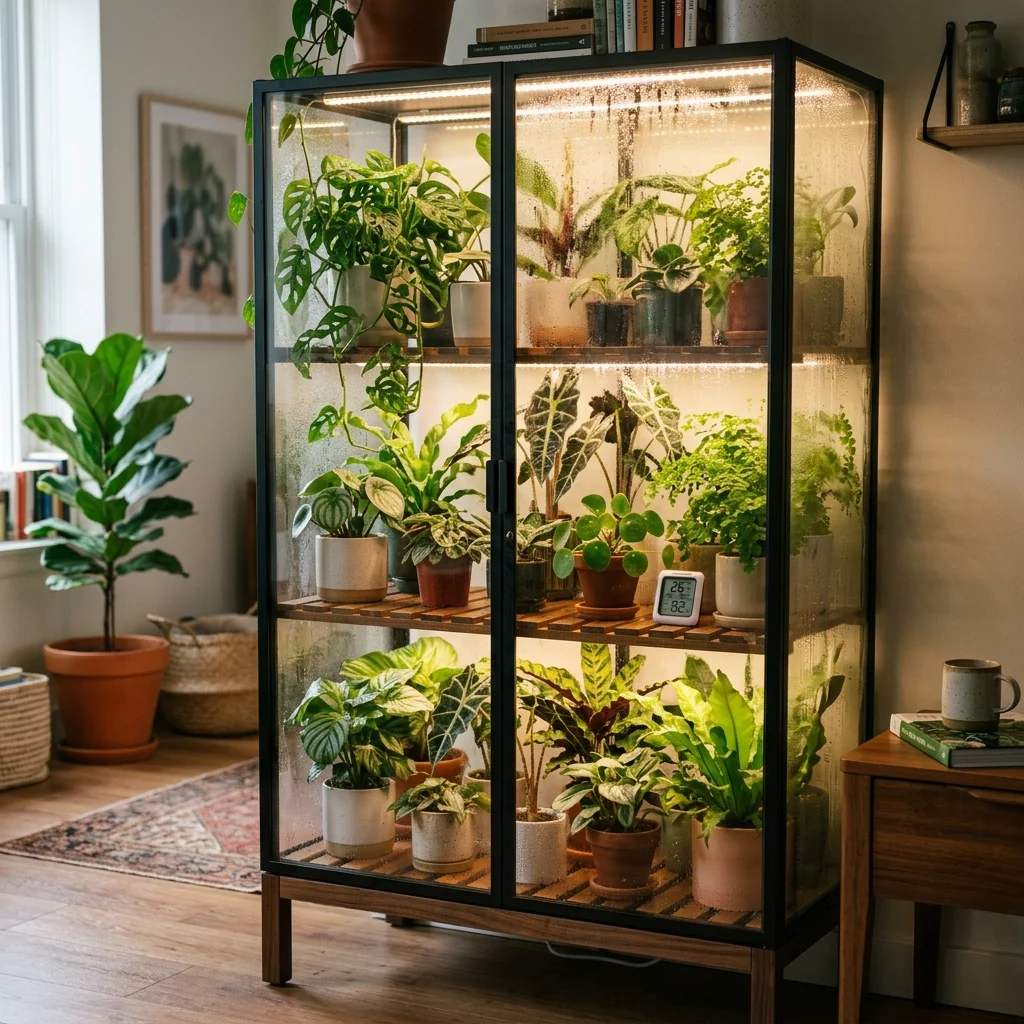
Cool an overheating plant cabinet by installing two USB fans: one at the bottom pulling cool air in, one at the top exhausting hot air out. Add a small circulation fan inside to move air across leaves. Reduce grow light duration from 14 to 10 hours during heatwaves, and move lights 5–8 cm further from plants. If cabinet temperature exceeds 32°C with lights on, open doors during peak heat or turn lights off during the hottest part of the day.
Key Takeaways
- A sealed cabinet with grow lights can reach 35°C (95°F) or higher—well above the 30°C (86°F) threshold where many aroids show heat stress.
- The most effective cooling setup uses three fans: bottom intake, top exhaust, and internal circulation—all running 24/7 during summer.
- Reduce grow light photoperiod from 14 to 10 hours during heatwaves and shift the on-time to the coolest part of the day.
- Raising grow lights just 5–8 cm (2–3 inches) reduces leaf surface temperature by 2–3°C (3–5°F) without significantly affecting light delivery.
- Briefly opening cabinet doors during peak heat is safe—humidity drops temporarily but plants recover quickly once resealed.
Quick Facts
- Target temperature Below 30°C (86°F) for most aroids; below 32°C (90°F) in emergencies
- Fan configuration Bottom intake + top exhaust + internal circulation
- Heatwave light schedule Reduce from 14h to 10h; shift to early morning
- Light height adjustment Raise 5–8 cm (2–3 inches) above normal
- Door venting strategy Crack open 5 cm (2 inches) during hottest 2–3 hours
- Temperature measurement Use probe thermometer at plant height
What Should I Do?
Cabinet temperature exceeds 32°C (90°F) with lights on
Cabinet temperature is 5–10°C above room temperature
Plants show leaf curling, crisping, or yellowing despite adequate humidity
Cabinet overheats during afternoon hours only
You need to cool the cabinet but maintain high humidity for aroids
Cabinet Cooling Strategies: Effectiveness Comparison
| Strategy | Temperature Reduction | Humidity Impact | Implementation Difficulty | Best For |
|---|---|---|---|---|
| Bottom intake + top exhaust fans | 3–5°C (5–9°F) | Minimal (5–10% drop) | Low – USB fans install in minutes | All cabinets; first-line solution |
| Internal circulation fan only | 1–2°C (2–4°F) | None | Low – clip fan on shelf | Preventing hotspots; not a primary cooling solution |
| Reduce light duration (14h→10h) | 2–4°C (3–7°F) | None | Minimal – timer adjustment | Heatwaves; complements fan setup |
| Raise lights 5–8 cm | 2–3°C (3–5°F) at leaf surface | None | Minimal – adjust light hangers | Preventing leaf scorch while maintaining light levels |
| Open doors during peak heat | 5–8°C (9–14°F) | Significant (80% → 50–60%) | Simple but temporary | Emergency cooling during extreme heatwaves |
Diagnosing and Measuring Cabinet Heat
Why is my plant cabinet overheating in summer? A sealed cabinet with powerful LED grow lights acts like a miniature greenhouse—light enters, heats surfaces, and the infrared radiation gets trapped by the glass, raising the internal temperature 5–10°C (9–18°F) above the room. In a 25°C (77°F) apartment, the cabinet can easily reach 35°C (95°F). The heat comes primarily from the LED drivers and the light energy absorbed by dark leaves and shelves.
Use a digital thermometer with a probe placed at plant height to measure the true temperature. If it surpasses 30°C (86°F) for sensitive aroids, action is needed. Leaf temperatures above 32°C (90°F) can cause photosynthetic shutdown in many tropical plants. Monitor regularly during heatwaves—temperatures can spike quickly, especially in south-facing rooms.
Fan Placement and Airflow Design
Where should I place fans in an IKEA greenhouse cabinet? Use two 80mm or 120mm USB computer fans. Mount one at the bottom of the cabinet, oriented to pull cool room air in through a gap or a small drilled hole. Place the second at the top, oriented to exhaust warm air out. This creates a negative pressure loop that continually flushes the cabinet with fresh air.
Inside the cabinet, position a third small clip fan (or one of the two angled inward) to circulate air across leaves, preventing micro‑hotspots. All three fans can run off a single multi‑port USB hub and should run 24/7 during summer—they use less than 5 watts total. If your cabinet is heavily weatherstripped, you may need to peel back a 2‑cm (¾‑inch) section of the door seal at the top and bottom to act as passive intake and exhaust vents, protected with fine mesh to keep pests out. This alone can drop the temperature by 3–5°C (5–9°F).
For light measurement at each shelf level, a light meter can help determine if you can safely reduce light duration while maintaining adequate Daily Light Integral (DLI) for your plants.
Light Management During Heatwaves
Should I turn off grow lights during a heatwave? Not completely, but reduce their photoperiod. If you typically run lights for 14 hours, drop to 10 hours during a heatwave, and shift the on‑time to the coolest part of the day (early morning, e.g., 5am–3pm).
If the room has ambient natural light from a window, measure how many foot‑candles reach the cabinet. If it's above 200 fc for several hours, you can turn off the grow lights during that window entirely. Also, raise the light fixtures 5–8 cm (2–3 inches) higher than usual. Light intensity drops exponentially with distance, so a small lift can reduce leaf surface temperature by 2–3°C (3–5°F). For particularly heat‑sensitive plants like some Philodendron or Anthurium, move them to the bottom shelf where it's naturally cooler.
Balancing Cooling and Humidity
Can I open the cabinet doors to cool it down without killing humidity? Yes, if you do it strategically. During the hottest 2–3 hours of the day, crack one door open about 5 cm (2 inches) and position a fan to blow the hot air out. The humidity will temporarily drop from 80% to 50–60%, but this is acceptable for a few hours and far better than cooking the plants. Immediately after closing, run the humidifier or mist the interior surfaces to bring humidity back up.
A better long‑term solution is a thermostatically controlled exhaust fan that automatically turns on at a set temperature, preserving the seal when it's cool. If you start seeing leaf crisping despite your efforts, differentiate between heat damage and low‑humidity scorch—they require different fixes. Heat damage typically affects leaves uniformly and may cause curling; low humidity causes browning at leaf edges and tips.
Summer Cabinet Cooling Setup Table
| Component | Specification | Placement | Effect on Temperature |
|---|---|---|---|
| USB intake fan | 80mm, 2000 RPM | Bottom, pulling air in | -2–3°C (3–5°F) |
| USB exhaust fan | 80mm, 2000 RPM | Top, pushing air out | -2–3°C (3–5°F) |
| Internal circulation fan | Small clip fan, low speed | Middle shelf, angled across leaves | Prevents hot spots |
| Light timer adjustment | Reduce from 14h to 10h | Early morning schedule | -2–4°C (3–7°F) during on‑time |
| Lifted lights | Raise 5–8 cm (2–3 in) | Above top shelf | -2–3°C (3–5°F) at leaf surface |
Additional Considerations
Choosing the Right Fans
For plant cabinets, 80mm or 120mm USB fans are ideal. Look for models with:
- Low noise (under 25 dB) for indoor use
- Speed control (adjustable airflow)
- Durable bearings (sleeve bearings are fine; hydraulic or fluid bearings are better for 24/7 operation)
Airflow Optimization
Airflow is more important than fan power. The goal is gentle, consistent air movement across all plant surfaces. Aim for:
- Air exchange rate: 5–10 cabinet volumes per hour
- Leaf-level airflow: barely perceptible movement (leaves should tremble slightly)
- Even distribution: no stagnant corners or strong drafts
Monitoring During Heatwaves
Check cabinet temperature at least twice daily during hot spells—once at midday (peak heat) and once before lights turn off. Record your temperature readings to identify patterns and adjust your setup accordingly.
Frequently Asked Questions
Why is my plant cabinet overheating in summer?
Where should I place fans in an IKEA greenhouse cabinet?
Should I turn off grow lights during a heatwave?
Can I open the cabinet doors to cool it down without killing humidity?
What temperature is too hot for plants in a cabinet?
Will more fans always cool better?
How do I know if my plants are stressed by heat?
Sources & References
-
Source: content.ces.ncsu.edu
Type: extension
-
Source: extension.umn.edu
Type: extension
-
Source: aroid.org
Type: general
Explore More