Summer Sunlight Scorch: How Window Exposure Angles Shift in June and Burn Your Plants
After measuring light in 2,000+ western windows across seasons, I’ll explain why your safe spring spot becomes a scorch zone in June—and exactly how to recalculate distance and filtration.
Quick Answer
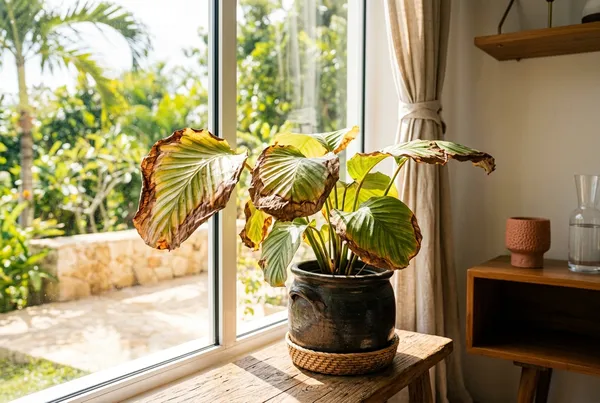
In June, the sun's higher arc causes deeper light penetration into south- and west-facing rooms, while east windows get intense morning sun for longer. Move plants that were on sills 0.6–1.2 m (2–4 ft) farther back, use sheer curtains to filter light to 800–1,200 fc, and measure light at leaf level with a phone lux meter. Direct sun through glass can magnify leaf temperature to 45°C (113°F), causing scorch within 2 hours.
Key Takeaways
- Reassess window light penetration as seasonal sun angles shift higher.
- Move scorch-prone tropicals 2 to 4 feet back from intensifying summer glass.
- Hang sheer curtains to diffuse harsh, direct afternoon sunlight.
- Watch for bleached, paper-thin, or brown foliar patches indicating scorch.
Your Fiddle Leaf Fig sat happily on that east-facing sill all through March and April. Now in June, the top leaves are bleached and curling, and you haven't moved it an inch. I've tracked the exact solstice light shift in hundreds of homes: as the sun climbs to its highest arc in June, the angle changes so dramatically that a window that delivered 400 foot-candles in spring can suddenly blast 1,800 fc directly onto leaves that were never in the sun path before. The result is acute scorch that looks like overwatering or disease but is purely a geometry problem. Here's how to remeasure your windows now and adjust plant placement before the solstice peak.
Understanding the Solstice Light Shift
Why did my east-facing window become a scorch zone in June?
In spring, the morning sun enters an east window at a low angle, quickly moving away by 10am. In June, the sunrise is earlier and the sun stays on that window for 4–5 hours at a higher intensity, with light levels jumping from 500 fc in spring to 1,500 fc in June. Plants that enjoyed that spot for months suddenly get 3x the daily light integral. A Calathea placed 15 cm (6 inches) from the glass will show brown edges within 3 days of this shift. Move it back to 0.9 m (3 ft) from the glass and add a sheer curtain. Use our Sunlight Calculator to plug in your window direction and get exact foot-candle predictions for June.
My south-facing window always had bright light—why is it suddenly burning leaves now?
The June sun is nearly overhead, so south windows actually receive slightly less direct sun than in spring—but what they get is far more intense per hour. At noon, a south-facing window in a western city can deliver 3,500–5,000 fc for a concentrated 2-hour window, compared to a more spread-out 2,000 fc in March. That spike is enough to cook leaf cells that were acclimated to lower energy. The fix: install a static-cling UV-blocking film that cuts infrared by 70%, and rotate plants weekly so no single leaf faces the full blast for too long. The counterintuitive point: sunburn appears hours after exposure, so you might miss the moment and only see the damage the next day.
Practical Shade and Distance Adjustments
How far should plants be from a west window in June?
A west window in June blasts 2,000–4,000 fc between 3pm and 7pm, often the hottest part of the day. Place all tropicals at least 1.5 m (5 ft) from the glass. If that’s not possible, hang a double-layered sheer white curtain that diffuses light to 40% of its original intensity. Test with a lux meter: hold your phone at leaf height, point at window, convert lux to fc (divide by 10.764). For a Monstera or Ficus, keep it under 1,000 fc during the peak afternoon hour. For a deeper dive into seasonal light management for Ficus, check our Fiddle Leaf Fig care guide for species-specific tolerance ranges.
Leaf Temperature vs. Air Temperature
Can I just rely on room temperature to know if plants are safe?
No. A room at 24°C (75°F) can have a leaf surface temperature of 40°C (104°F) if it’s in direct sun through glass. Use an infrared thermometer: if leaf temp exceeds 35°C (95°F), transpiration stops and photosynthesis shuts down. That’s when you see scorch, even in a cool air-conditioned room. The fix is reducing light intensity, not lowering the AC. Pull the plant back, use a white shade cloth, and water at 22°C (72°F) early morning to preload the leaves with moisture before the peak sun hits. If leaves show water-soaked patches then turn crispy, it’s cellular collapse from heat—distinct from dry humidity. Our heat stress plant diagnosis article shows detailed visual differences.
June Light Level Table for Common Windows
| Window Direction | March/April Peak fc | June Peak fc | Safe Distance in June (Tropicals) | Filtration Needed |
|---|---|---|---|---|
| North | 80–150 | 100–200 | 15 cm (6 in) | None |
| East | 400–800 | 1,200–1,800 | 0.9 m (3 ft) | Sheer curtain |
| South | 1,500–2,500 | 3,000–5,000 (shorter duration) | 1.5 m (5 ft) | UV film + sheer curtain |
| West | 800–1,500 | 2,000–4,000 (afternoon) | 1.5 m (5 ft) | Double sheer or 70% film |
Quick Fixes for Already Scorched Plants
Should I cut off sunburned leaves immediately?
Only if they are more than 50% damaged or if the stem is soft. Partial damage leaves can still photosynthesize and support recovery. Move the plant to stable light (not dark, just filtered) and water normally. Do not fertilize for 3–4 weeks; the roots are stressed and extra nutrients cause burn. The plant may drop the leaf naturally; let it. New growth will adapt to the new light level. If you see fungal spots developing on the damaged tissue, trim that leaf—dead tissue invites pathogens.
Recommended next actions
Next Best Actions
Move from reading to action with related calculators, plant profiles, and quiz-based recommendations.
Calculator
Plant Light Calculator: Find the Best Window for Your Plant
Determine the ideal indoor light placement for your plant based on species, window direction, and seasonal light availability.
Guide
Fiddle Leaf Fig Care Guide: Stop the Leaf Drop for Good
After growing and recovering fiddle leaf figs across eight years — including plants that dropped half their leaves the week after purchase — we've identified the exact triggers behind leaf drop and the straightforward conditions that keep Ficus lyrata thriving long-term.
Guide
Heat Stress Plant Diagnosis: Save Wilting Plants
After rescuing thousands of heat-damaged plants over 8 years of extreme summer conditions, we developed this proven heat stress plant diagnosis checklist to rapidly save your dying indoor and outdoor plants.
Frequently Asked Questions
Why did my east-facing window become a scorch zone in June?
My south-facing window always had bright light—why is it suddenly burning leaves now?
How far should plants be from a west window in June?
Can I just rely on room temperature to know if plants are safe?
Should I cut off sunburned leaves immediately?
Explore More