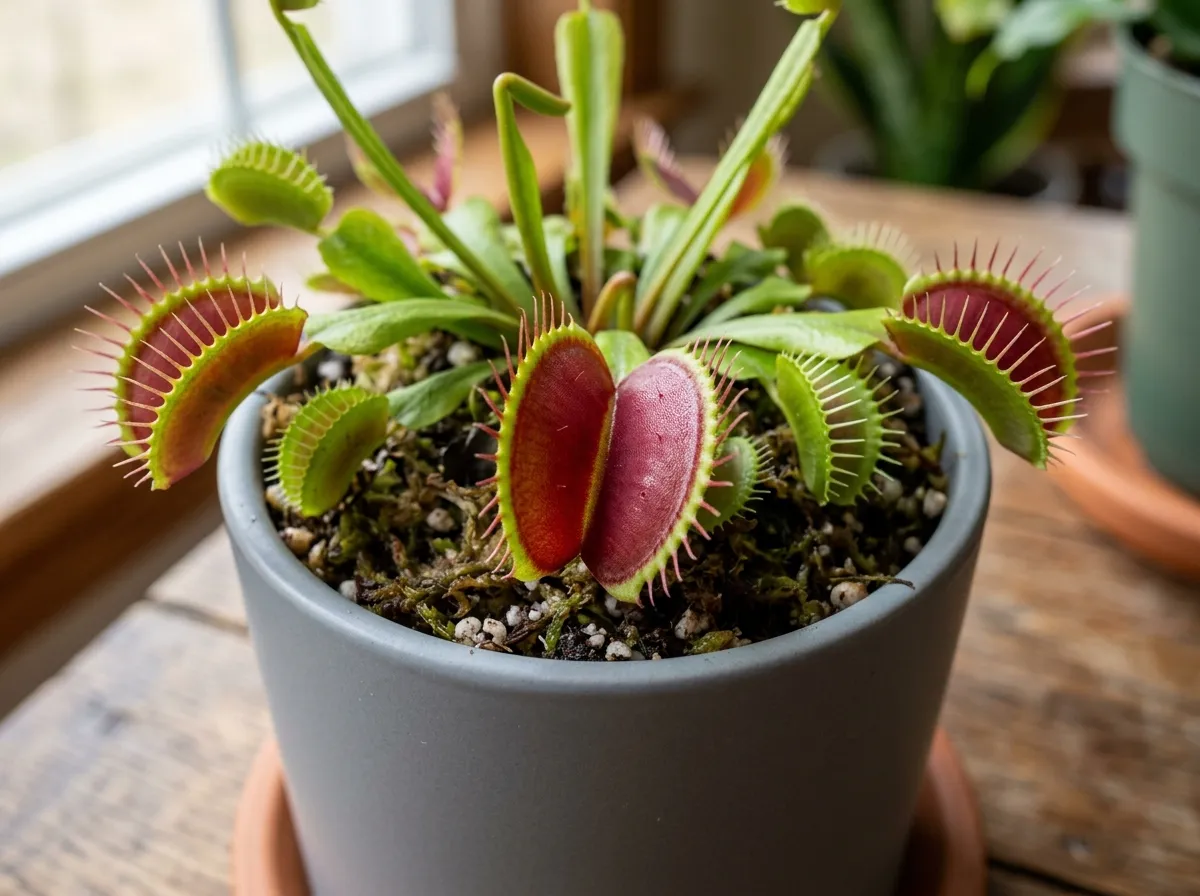
Few sights cause indoor growers more panic than finding a prized Venus flytrap (Dionaea muscipula) with blackened, shriveled traps. Because carnivorous plants are renowned for their specialized environmental needs, growers often assume any blackening indicates fatal decline. However, in our nursery cultivation trials, we regularly observe that blackened leaves are frequently part of the plant's normal physiological lifecycle rather than an acute catastrophe.
Understanding whether your plant is experiencing harmless trap renewal, entering necessary seasonal dormancy, or suffering from root toxicity depends on where the blackening starts and the condition of the central growth point. This guide provides a systematic triage framework to accurately diagnose your plant and take immediate corrective action.
Quick Answer: Why Venus Flytraps Turn Black
A Venus flytrap turning black is most often a normal physiological process: individual traps naturally blacken and die after closing 3 to 5 times or digesting 1 to 3 meals. Blackening is also a normal seasonal response when entering winter dormancy in autumn. However, if the central rhizome or all new emerging growth turns black and mushy, the plant is suffering from crown root rot—usually triggered by stagnant water without light, or mineral salt toxicity from tap water (TDS > 50 ppm). Trim dead black leaves at the base with clean scissors, maintain intense light (12+ hours or full sun), and ensure low-mineral water.
Symptom Comparison Table: Normal vs Pathological Blackening
| Symptom Pattern | Location on Plant | Central Heart Condition | Primary Cause | Recommended Action |
|---|---|---|---|---|
| Single outer leaf blackens | Oldest peripheral leaves | Firm, active, bright green | Natural trap senescence (3–5 closures) | Trim leaf at base when fully dead. No environmental change needed. |
| Gradual widespread blackening | Outer half of rosette in late autumn | Firm, compact, pale green/white | Onset of seasonal winter dormancy | Reduce tray water, move to cool location (35°F–50°F / 2°C–10°C) for 3–4 months. |
| Single trap rots around prey | One individual trap holding an insect | Healthy, unaffected | Prey too large; incomplete digestive seal | Leave alone until leaf turns fully dry, then snip off. Avoid feeding oversized prey. |
| Burnt margins on new traps | Fresh emerging shoot tips | Stunted, deformed, scorched | Mineral burn from tap water or fertilizer | Immediate top-flush with distilled water (<20 ppm); measure runoff TDS. |
| Center collapses into black mush | Growing point and rhizome crown | Black, waterlogged, soft, foul odor | Rhizome crown rot (fungal/anaerobic) | Unpot immediately, excise rotted tissue, repot in fresh, damp 1:1 peat/perlite. |
1. Natural Leaf Senescence (Harmless Turnover)
Every Venus flytrap trap is an energetically costly biological engine. Trigger hairs, electrical action potentials, and enzymatic secretion require substantial metabolic energy. Consequently, a single trap has an evolved functional lifespan:
- A trap can snap shut and reopen empty roughly 3 to 5 times before the cell-expansion mechanism fatigues.
- A trap that successfully captures and digests prey can typically digest only 1 to 3 meals before dying.
When a trap reaches the end of its useful lifespan, the plant systematically withdraws chlorophyll and carbohydrates into the underground rhizome. The trap turns yellow, then dark brown, and finally jet black and dry. As long as this process is confined to the oldest outer leaves while new, vibrant green leaves unfurl from the center, your plant is entirely healthy. Learn more about healthy growth morphology in our complete Venus flytrap care guide.
2. Seasonal Winter Dormancy Dieback
Venus flytraps are native strictly to coastal peat bogs in North and South Carolina, where winter temperatures routinely drop near freezing. To survive winter cold and shorter days, they undergo a mandatory 3- to 4-month cold dormancy period.
Beginning between October and November, diminishing daylength triggers dormancy. During this transition, a significant percentage of the plant's summer foliage turns black and collapses. The plant pulls its energy reserves into the underground bulbous rhizome, producing smaller, low-lying, ground-hugging leaves. Many beginner growers mistakenly discard their plants during this phase thinking they have died. If the central crown is firm and creamy white just beneath the soil line, the plant is simply resting. Review temperature thresholds and care adjustments in our comprehensive carnivorous plant winter dormancy guide.
3. Mineral Burn from Tap Water or Fertilizers
Carnivorous plants evolved in nutrient-deprived, acidic bogs with virtually zero dissolved minerals. Their delicate, hairless root structures are extraordinarily sensitive to osmotic shock. When growers water with municipal tap water, well water, or bottled mineral water, dissolved mineral ions (calcium, magnesium, chloride, and sodium) accumulate in the substrate.
As mineral concentrations climb past 50 ppm Total Dissolved Solids (TDS), moisture is drawn osmotically out of root cells. If your plant suffered mineral burn from accidental tap water exposure, follow our emergency flush protocol immediately. The earliest visible symptom of mineral salt buildup is not outer leaf yellowing, but blackening of fresh new growth emerging from the center. Traps emerge deformed, blackened at the margins, or fail to form teeth. If you suspect mineral damage, check your water quality with a calibrated TDS meter and reference our distilled water for carnivorous plants guide, or use our interactive water TDS checker.
4. Rhizome Crown Rot from Stagnant Conditions
While Venus flytraps love damp bogs, they are not aquatic water lilies. In native bogs, rainwater continuously percolates through porous peat and silica sand. In artificial cultivation, three conditions combine to trigger lethal anaerobic crown rot:
- Deep stagnant water trays indoors: Pots kept submerged in inches of stagnant water without adequate airflow.
- Insufficient light: Kept on dim windowsills without the 12+ hours of intense direct light or high-output LED illumination they require.
- Decomposed or compacted media: Degraded peat that forms an airless sludge around the rhizome.
Crown rot attacks the growth heart first. If the center turns black, mushy, and releases a sulfurous odor, you must act within 24 hours: unpot the plant, wash the root zone in pure distilled water, gently cut away blackened mush with a sterilized blade until only firm white tissue remains, and repot in fresh, airy 1:1 sphagnum peat and coarse silica sand from our carnivorous plant substrate guide.
5. Step-by-Step Triage Checklist
- Inspect the center: Gently brush back surface moss around the heart. Is the center firm and pale green/white? If yes, the plant is viable.
- Prune fully dead tissue: Use clean scissors to snip off black, dried leaves near the base. Leave partially green leaves intact so the plant continues photosynthesizing.
- Test your water: Verify that your water reads under 50 ppm (ideally under 20 ppm) on a TDS meter. If higher, immediately flush the pot with 3 times its volume in distilled or RO water.
- Assess lighting: Provide at least 4 to 6 hours of direct outdoor sun or 12 to 14 hours beneath a dedicated full-spectrum LED grow light. Light is the engine that drives recovery.
- Adjust water tray depth: During active summer growth, keep 1 to 2 cm (0.5 inch) of water in the tray. During winter dormancy, remove the tray and water from the top only when the soil surface begins to dry.