What this calculator does
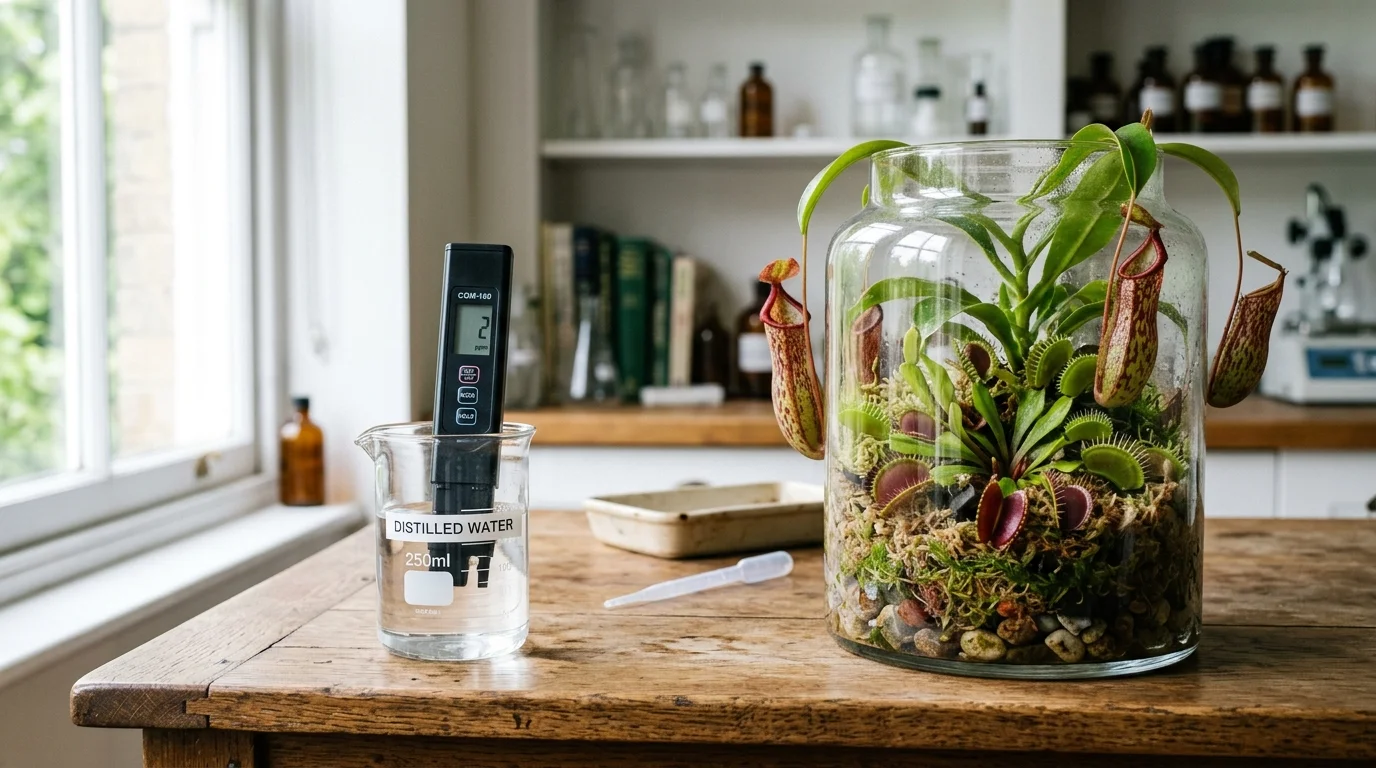
Tap water that looks clean can still kill carnivorous plants slowly. This calculator turns a handheld TDS reading into three practical answers: how safe your water is, how much tap water you can blend into pure RO, distilled or rain water to reach a safe target, and how quickly minerals will build up in a pot if you never flush it.
Why TDS matters for carnivorous plants
Carnivorous plants evolved in nutrient-poor bogs, where rain is the main water source and the soil holds almost no dissolved salts. Their roots cope poorly with dissolved calcium, magnesium, sodium and bicarbonate, which accumulate in the substrate and damage root tissue. Sensitive plants include Nepenthes ventrata, Mexican butterworts such as Pinguicula moranensis, and sundews such as Drosera capensis, although tolerance varies by species. As a rule, the lower the TDS, the safer the plant.
The four safety tiers
- Optimal (under 20 ppm): ideal for any species, including seedlings and sensitive plants.
- Safe (under 50 ppm): acceptable for most species, with occasional flushing of the substrate.
- Marginal (50-100 ppm): risky, because evaporation concentrates minerals quickly. Dilute it or use it only with frequent flushing.
- Lethal / Toxic (over 100 ppm): do not use undiluted. Plants usually decline over weeks to months.
The tier describes your raw source water. After blending to your target, the mixture should fall in the optimal or safe tier.
How the dilution works
The calculator uses a mass-balance equation:
$$V_{\text{tap}} = V_{\text{total}} \times \frac{\text{TDS}_{\text{target}} - \text{TDS}_{\text{pure}}}{\text{TDS}_{\text{tap}} - \text{TDS}_{\text{pure}}}$$
With 180 ppm tap water, 5 ppm RO water and a 30 ppm target, only about 14% of a batch can be tap water. A 5 L batch uses about 0.71 L of tap and 4.29 L of RO, a 6.0 : 1 ratio. Harder water leaves even less room: a 420 ppm well supply contributes only about 6% of a batch at 30 ppm. At that point, ask whether the tap water is worth using at all, because the saving is small and a small meter error shifts the result noticeably.
Why evaporation turns low-TDS water toxic
Water evaporates from the substrate surface, the pot walls, the tray and the plant, but dissolved minerals do not evaporate with it. Each time you top up with the same water, you add another dose of minerals to a pot that already holds the earlier ones. The concentration in the substrate climbs well above the number on your meter.
Water that reads 60-80 ppm can therefore turn toxic within weeks, and how long depends on the volume of water the system holds. A small pot with 0.75 L of pore water and 250 ml of weekly evaporation can cross 100 ppm in one to two weeks at 70 ppm. A bottom-watering tray system holding about 4 L of water takes around six to seven weeks at the same reading. Bottom-watering trays are especially unforgiving because the reservoir loses water continuously and never rinses minerals out.
Treat the accumulation estimate as a flushing schedule: slowly pour pure water through the substrate from the top, well before the estimated number of weeks, and let it drain from the base.
Myths: boiling, standing and filter jugs
- Boiling does not lower TDS. Boiling removes water as steam and leaves the minerals behind, so the remaining water is more concentrated. Some carbonate may precipitate as limescale, but the water that remains is still far from safe.
- Letting tap water stand overnight does not lower TDS. Chlorine gas escapes, but calcium, magnesium and sodium stay, and evaporation slightly raises the concentration.
- Carbon pitcher filters do not remove dissolved ions. Activated carbon removes chlorine and some organics, so filtered tap water usually reads about the same as the unfiltered supply. Only RO, distillation, DI resin or clean rainwater reliably give low-TDS water.
Commercial Water Filter Reality-Check: Standard carbon pitchers (like Brita or PUR) remove chlorine and taste compounds but do NOT reduce dissolved mineral ions (TDS). Only Reverse Osmosis (RO) or deionization (ZeroWater) purifies water to safe carnivorous thresholds.
Measuring accurately
A TDS pen measures electrical conductivity and converts it to ppm with a fixed factor, so readings are estimates and brands can disagree. What matters is using the same meter consistently. Test your pure water first: if it reads above about 10-15 ppm, your RO membrane or DI resin may need replacing. Rinse the probe in pure water between samples and measure at room temperature.
Using the result in your setup
- Terrariums and enclosed displays: little water leaves an enclosure, so salts accumulate fast. See the carnivorous plant terrarium build guide for drainage and flushing layouts.
- Substrate choice: the peat and perlite or sand mixes in the carnivorous plant substrate guide add no minerals. Garden soil and houseplant mixes do.
- Rock mounts: a wicking rock concentrates salts in its pores, so Mexican butterworts need very low-TDS water. See the Pinguicula rock setup guide.
- Winter dormancy: pots stay barely damp in winter, which makes mineral crust easy to miss. Flush before the spring wake-up described in the dormancy requirements guide.
- Plants used as gnat traps: living traps watered with tap water decline and stop making sticky leaves. See carnivorous plants for fungus gnats.
A simple routine
- Measure your pure water and your tap water.
- Choose a target of 30 ppm or lower. If your tap TDS is several hundred ppm, consider using pure water alone.
- Enter the values and mix the batch using the volumes shown.
- Check the final blend with the meter before use.
- Flush each pot with pure water on the schedule suggested by the accumulation estimate.