🧮
Calculators
🌿
Plants
💧
Watering
☀️
Sunlight
🧪
Fertilizers
🪴
Potting Mix
🎯
Quizzes
tools

EC Meter Guide for Plants

Written by PlantSolve Editorial Team16 min read
EC Meter: What It Measures, How to Use It & Safe Ranges for Plants - Plant Care Guide
⚠ DIAGNOSTIC TRIAGE // SYMPTOMS & ROOT CAUSESTriage Telemetry

Observed Symptoms(5)

  • !
    Leaf tip burn

    Brown, crispy edges on leaves, especially in succulents and houseplants

  • !
    White salt crust on soil

    Visible crystalline buildup on the soil surface indicating accumulated fertiliser salts

  • !
    Poor growth despite fertilizing

    Stunted growth with adequate light and water, suggesting nutrient lockout from excess salts

  • !
    Suspected over-fertilisation

    After using full-strength fertiliser, mixing errors, or following generic advice without measuring

  • !
    Hydroponic nutrient monitoring

    Essential for maintaining correct nutrient strength in water-based growing systems

Underlying Causes(5)

  • ▸
    Over-fertilisation

    Applying fertiliser at full strength or more frequently than needed raises EC beyond safe levels

  • ▸
    No drainage holes

    Pots without drainage trap salts that would otherwise flush out with excess water

  • ▸
    Hard water

    Tap water with high mineral content adds baseline salts before fertiliser is even added

  • ▸
    Infrequent flushing

    Without periodic plain-water flushing, salts accumulate with each feeding

  • ▸
    Peat-heavy soil

    Soils high in peat moss have poor leaching capacity and retain salts longer

🔬 DIAGNOSIS PROTOCOL4 Steps

Diagnosis Protocol

1
If EC too high (>2.5 mS/cm)
Flush soil immediately with 2–3× the pot volume of plain water
2
Retest after 48 hours
Measure runoff EC again to confirm salts have been flushed
3
Reduce fertiliser strength
Cut dose to 1/4 strength and gradually increase based on plant response
4
Monitor weekly
Track EC trends to ensure salts are not reaccumulating
✓ BEST PRACTICES & COMMON MISTAKES(8)
  • ✓
    Calibrate your meter monthly with fresh standard solution
  • ✓
    Measure fertiliser solution after mixing, before applying
  • ✓
    Measure runoff EC monthly to detect hidden salt buildup
  • ✓
    Clean the probe with distilled water after each use
  • ✓
    Store the probe in storage solution or distilled water
  • ✓
    Use distilled water for soil slurry tests
  • ✓
    Record readings in a plant journal to track trends
  • ✓
    Use a meter with automatic temperature compensation (ATC)
⚠ Common Grower Mistakes(8)
  • ✕
    Measuring immediately after watering
    ↳ Recommended Fix:Wait until water has fully saturated the soil profile before testing
  • ✕
    Not calibrating the meter
    ↳ Recommended Fix:Calibrate monthly; an uncalibrated meter can be off by 20% or more
  • ✕
    Using tap water as a zero reference
    ↳ Recommended Fix:Use distilled water for baseline readings; tap water contains minerals
  • ✕
    Ignoring temperature compensation
    ↳ Recommended Fix:Use a meter with ATC, or measure at consistent temperatures
  • ✕
    Confusing EC and pH
    ↳ Recommended Fix:EC measures salt concentration; pH measures acidity. Both matter but are different
  • ✕
    Drying out the probe
    ↳ Recommended Fix:Store probe moist; dried probes lose sensitivity and may not recover
  • ✕
    Measuring dry soil directly
    ↳ Recommended Fix:Always create a soil slurry with distilled water for accurate readings
  • ✕
    Using the wrong TDS conversion factor
    ↳ Recommended Fix:Know whether your meter uses 500×, 640×, or 700× conversion
🛡 Proactive Prevention Guidelines7 Guidelines
  • ▸
    Start fertiliser at 1/4 to 1/2 label strength
  • ▸
    Water until 20% drains from the bottom with each feeding
  • ▸
    Flush soil with plain water every 4–6 weeks
  • ▸
    Use pots with drainage holes
  • ▸
    Measure EC before and after fertilizing
  • ▸
    Adjust feeding for seasons—reduce by 50% in winter
  • ▸
    Use coarse, well-draining potting mix

What Is an EC Meter?

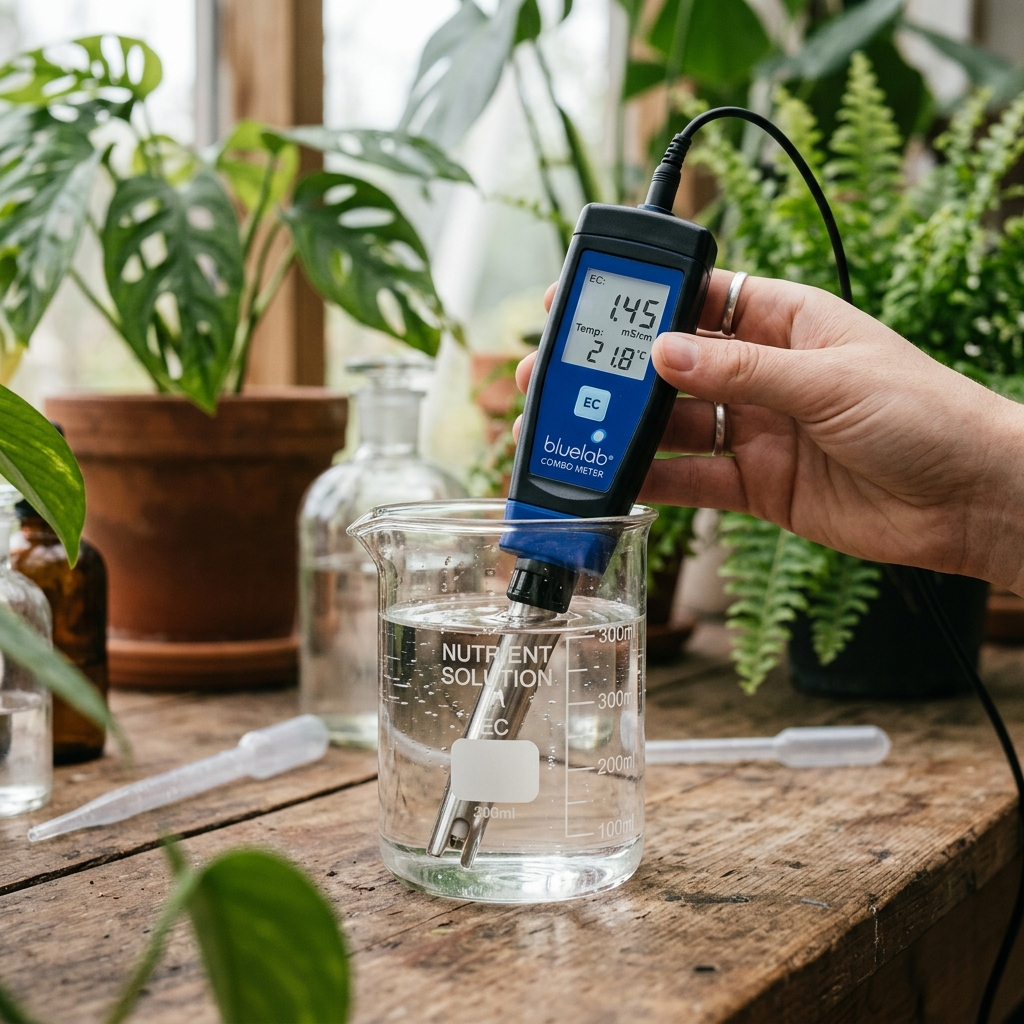
An EC (Electrical Conductivity) meter is a handheld digital device that measures how well a liquid conducts electricity. In plant care, it is used as a proxy for the total concentration of dissolved fertiliser salts in water, soil, or hydroponic nutrient solution. The higher the EC reading, the more dissolved salts are present.

EC is measured in millisiemens per centimeter (mS/cm) or sometimes decisiemens per meter (dS/m). For most home growers, mS/cm is the standard unit displayed on consumer-grade meters.

In one sentence: An EC meter measures the electrical conductivity of water or nutrient solution to estimate the concentration of dissolved fertiliser salts, helping prevent over-fertilisation and root burn.

How Does an EC Meter Work?

When fertiliser salts dissolve in water, they break into positively and negatively charged ions (e.g., nitrate NO₃⁻, potassium K⁺, calcium Ca²⁺). These ions carry electrical current. An EC meter sends a small electrical charge between two probes and measures how easily the current flows. More ions = higher conductivity = higher EC reading.

Most modern EC meters also include temperature compensation, because water conductivity changes with temperature. A reading taken at 25°C is the standard reference. If your meter lacks automatic temperature compensation (ATC), readings will drift in hot or cold conditions.

EC vs TDS: What's the Difference?

← Scroll horizontally to inspect full matrix →
FeatureEC MeterTDS Meter
What it measuresElectrical conductivity (mS/cm)Total dissolved solids (ppm)
How it worksMeasures current flow between probesMeasures EC, then converts to ppm using a factor
UnitsmS/cm or µS/cmppm (parts per million)
AccuracyDirect measurement; more preciseConverted value; depends on conversion factor
Best forScientific accuracy, hydroponics, researchQuick reference, general gardening
ConversionTDS = EC × conversion factor (usually 500 or 700)EC = TDS ÷ conversion factor

Important: TDS meters are actually EC meters with a built-in conversion. The conversion factor varies by manufacturer (500× for NaCl standard, 700× for KCl standard). Always check which factor your meter uses. For fertiliser solutions, 640× is a common horticultural standard.

Why EC Matters for Plant Health

EC is the most reliable way to verify your fertiliser dose is correct. Here's why it matters:

  • Prevents fertiliser burn — high EC means high salt concentration, which draws water out of roots through osmosis
  • Prevents nutrient lockout — excess salts block uptake of other nutrients, causing deficiencies even when nutrients are present
  • Optimizes feeding — low EC means underfeeding; plants grow slowly and leaves pale
  • Monitors salt buildup — rising EC over time indicates accumulating salts that need flushing
  • Calibrates custom mixes — homemade nutrient solutions need EC verification for consistency

When Should You Use an EC Meter?

Use an EC meter whenever you suspect salt-related problems or want to optimise feeding:

  • Leaf tip burn — brown, crispy edges on leaves, especially in succulents and houseplants
  • White salt crust — visible crystalline buildup on soil surface
  • Poor growth despite fertilizing — stunted growth with adequate light and water
  • Suspected over-fertilisation — after using full-strength fertiliser or mixing errors
  • Hydroponic nutrient monitoring — essential for maintaining correct nutrient strength in water-based systems
  • After repotting — verify that new soil doesn't have residual high salts
  • Before switching fertilisers — establish a baseline with your current product

Safe EC Levels for Different Plants

← Scroll horizontally to inspect full matrix →
Plant TypeSafe EC Range (mS/cm)Notes
Seedlings / Cuttings0.4 – 0.8Very sensitive; use 1/8 to 1/4 strength fertiliser
Most Houseplants0.8 – 1.5Standard range for tropical foliage plants
Heavy Feeders (Tomato, Pepper)1.5 – 2.5Outdoor vegetables in peak growth
Succulents / Cacti0.4 – 1.0Low tolerance; prone to burn
Orchids0.6 – 1.2Epiphytic roots are sensitive to salts
Hydroponics (Leafy Greens)1.0 – 1.6Lettuce, spinach, herbs
Hydroponics (Fruiting Plants)1.8 – 2.8Tomatoes, peppers, cucumbers
Danger Zone> 2.5Root burn likely; flush immediately

How to Use an EC Meter: Step-by-Step

  1. Calibrate your meter — use a calibration solution (usually 1.413 mS/cm or 2.76 mS/cm) monthly
  2. Prepare your sample — for soil, mix 1 part soil with 2 parts distilled water, stir, let settle 30 minutes, then measure the liquid
  3. For nutrient solution — stir your fertiliser mix thoroughly, then dip the probe directly into the solution
  4. For runoff — collect water draining from the pot bottom after watering; this shows accumulated soil salts
  5. Read the display — note the mS/cm value and the temperature
  6. Compare to safe ranges — use the table above to determine if your reading is safe
  7. Record and track — keep a log to spot trends over time

Diagnosis: What Your EC Reading Means

← Scroll horizontally to inspect full matrix →
EC ReadingInterpretationAction
Below 0.4 mS/cmVery low nutrients; underfeedingIncrease fertiliser strength gradually
0.4 – 0.8 mS/cmLow; acceptable for seedlings and sensitive plantsMonitor growth; increase slightly if pale
0.8 – 1.5 mS/cmOptimal for most houseplantsMaintain current feeding regimen
1.5 – 2.5 mS/cmHigh; acceptable for heavy feeders onlyReduce strength or frequency for most plants
Above 2.5 mS/cmDangerous; root burn likelyFlush soil with 2–3× pot volume of plain water; retest in 48 hours

Best Practices

  • Calibrate monthly — EC probes drift over time; calibration solutions are inexpensive
  • Measure after mixing fertiliser — always verify your mixed solution before applying
  • Measure runoff occasionally — runoff EC reveals accumulated soil salts that surface readings miss
  • Clean the probe after each use — rinse with distilled water and gently wipe dry
  • Store properly — keep the probe moist (in storage solution or distilled water) to prevent drying out
  • Use distilled water for soil slurries — tap water minerals will skew readings
  • Measure at consistent temperatures — or use a meter with automatic temperature compensation (ATC)
  • Record readings in a plant journal — trends are more informative than single measurements

Common Mistakes

  • Measuring immediately after watering — wait until water has fully saturated the soil profile
  • Not calibrating — an uncalibrated meter can be off by 20% or more
  • Using tap water as a reference — tap water contains minerals that raise baseline EC
  • Ignoring temperature compensation — a 10°C difference can change EC by 20%
  • Confusing EC and pH — EC measures salt concentration; pH measures acidity. Both matter but measure different things
  • Drying out the probe — dried probes lose sensitivity and may not recover
  • Measuring dry soil directly — always create a soil slurry with distilled water
  • Using the wrong conversion factor — TDS meters use 500×, 640×, or 700×; know which one yours uses

Tools

Problems

Concepts

RECOMMENDED WORKFLOWS

Next Best Actions & Diagnostic Tools

All Plant Calculators →
⚡
PPM Explained for Plant Feeding
PPM, or Parts Per Million, is a concentration unit indicating how many milligrams of dissolved solids, primarily fertilizer salts and minerals, are present in each liter of water. It gives growers an objective, numerical way to describe nutrient solution strength rather than relying on imprecise terms like half-strength or quarter-strength. PPM is closely related to EC and TDS measurements, though each is derived slightly differently: EC measures electrical conductivity directly, while TDS and PPM are typically estimated from that EC reading using a conversion factor. Understanding these relationships helps growers interpret meter readings consistently across different devices and brands.
⚡
TDS Meter Guide: PPM, EC Conversion & Safe Ranges for Plants
A TDS (Total Dissolved Solids) meter estimates the concentration of dissolved minerals, salts, and fertilizers in water by converting electrical conductivity (EC) into parts per million (ppm). It is an essential tool for hydroponic growers and container gardeners to mix nutrient solutions accurately, monitor feeding strength, and prevent fertilizer burn before it damages sensitive roots. This approach helps maintain optimal conditions and prevents common issues that can affect your plant's overall health and longevity over time.
⚡
Osmotic Pressure in Plant Roots
Osmotic pressure is the physical force governing water movement across the semipermeable membranes of plant root cells, moving from areas of lower solute concentration toward areas of higher concentration. Under normal conditions, roots maintain a solute concentration slightly higher than the surrounding soil, creating a gradient that continuously pulls water inward. When fertilizer salts accumulate in the soil beyond what the plant can tolerate, this gradient reverses: soil solute concentration exceeds that inside the root cells, and water is instead pulled out of the roots. This reversal is the core mechanism behind fertilizer burn, even in soil that still feels moist.
⚡
Salt Buildup in Plants: Causes, Symptoms & How to Fix It
Salt buildup occurs when soluble salts from fertilizers, hard water, and soil amendments accumulate in the growing medium faster than they can be leached away. It raises soil EC, creates osmotic stress, and causes specific ion toxicities that damage roots and foliage. Common in container plants, indoor gardens, and arid climates, salt buildup is preventable through proper watering, periodic flushing, and regular EC monitoring. This approach helps maintain optimal conditions and prevents common issues that can affect your plant's overall health and longevity over time.
Hydration & Irrigation Tool

Plant Watering Calculator: Estimate the Ideal Watering Schedule

Calculate the correct watering frequency for your plant based on species, pot size, soil type, season, and climate.

Enter plant type, pot size, and conditions for a custom watering schedule.Free Evidence-Based Botanical Tool

Frequently Asked Questions

What EC is safe for houseplants?

Most houseplants thrive at an EC of 0.8–1.5 mS/cm. Seedlings and sensitive plants like succulents prefer 0.4–1.0 mS/cm. Heavy feeders like tomatoes can tolerate 1.5–2.5 mS/cm. Readings above 2.5 mS/cm indicate dangerous salt levels and require immediate flushing.

Is EC the same as TDS?

No, but they are closely related. EC (Electrical Conductivity) measures how well a solution conducts electricity in mS/cm. TDS (Total Dissolved Solids) is a converted value expressed in ppm. TDS meters measure EC internally and multiply by a conversion factor (usually 500, 640, or 700) to estimate total dissolved solids. EC is the more direct and scientifically accurate measurement.

Can an EC meter detect fertiliser burn before visible symptoms?

Yes. An EC meter can detect dangerous salt levels days or even weeks before visible leaf burn appears. If your soil or runoff EC exceeds 2.5 mS/cm, root damage is already occurring even if leaves still look green. Regular EC monitoring is the best early warning system for over-fertilisation.

Should I buy an EC meter or a TDS meter?

Buy an EC meter if you want scientific accuracy and plan to do hydroponics or precision growing. Buy a TDS meter if you want a simple ppm reading for general houseplant care. Many modern meters display both EC and TDS. For serious growers, an EC meter with ATC (automatic temperature compensation) is the better investment.

How often should I measure EC?

Measure your fertiliser solution every time you mix a new batch. Measure soil or runoff EC monthly for established plants, or weekly if you suspect problems. In hydroponics, measure the reservoir EC daily. Keep a log to track trends—rising EC over time indicates salt buildup that needs flushing.

How do I calibrate an EC meter?

Immerse the probe in a calibration solution of known EC (typically 1.413 mS/cm or 2.76 mS/cm). Press the calibration button and wait for the reading to stabilize. Rinse with distilled water between calibrations. Calibrate monthly, or more frequently if readings seem inconsistent. Always use fresh calibration solution—old solution absorbs CO2 from air and changes conductivity.

Can I use an EC meter for soil?

Yes, but not by sticking the probe directly into dry soil. Create a soil slurry: mix 1 part soil with 2 parts distilled water, stir thoroughly, let it settle for 30 minutes, then measure the liquid. Alternatively, collect runoff water after watering—this gives a good indication of soil salt levels without disturbing roots.

Keep exploring

Related Guides and Articles

PPM Explained for Plant FeedingPPM, or Parts Per Million, is a concentration unit indicating how many milligrams of dissolved solids, primarily fertilizer salts and minerals, are present in each liter of water. It gives growers an objective, numerical way to describe nutrient solution strength rather than relying on imprecise terms like half-strength or quarter-strength. PPM is closely related to EC and TDS measurements, though each is derived slightly differently: EC measures electrical conductivity directly, while TDS and PPM are typically estimated from that EC reading using a conversion factor. Understanding these relationships helps growers interpret meter readings consistently across different devices and brands.
Read guide →
TDS Meter Guide: PPM, EC Conversion & Safe Ranges for PlantsA TDS (Total Dissolved Solids) meter estimates the concentration of dissolved minerals, salts, and fertilizers in water by converting electrical conductivity (EC) into parts per million (ppm). It is an essential tool for hydroponic growers and container gardeners to mix nutrient solutions accurately, monitor feeding strength, and prevent fertilizer burn before it damages sensitive roots. This approach helps maintain optimal conditions and prevents common issues that can affect your plant's overall health and longevity over time.
Read guide →
Osmotic Pressure in Plant RootsOsmotic pressure is the physical force governing water movement across the semipermeable membranes of plant root cells, moving from areas of lower solute concentration toward areas of higher concentration. Under normal conditions, roots maintain a solute concentration slightly higher than the surrounding soil, creating a gradient that continuously pulls water inward. When fertilizer salts accumulate in the soil beyond what the plant can tolerate, this gradient reverses: soil solute concentration exceeds that inside the root cells, and water is instead pulled out of the roots. This reversal is the core mechanism behind fertilizer burn, even in soil that still feels moist.
Read guide →
Salt Buildup in Plants: Causes, Symptoms & How to Fix ItSalt buildup occurs when soluble salts from fertilizers, hard water, and soil amendments accumulate in the growing medium faster than they can be leached away. It raises soil EC, creates osmotic stress, and causes specific ion toxicities that damage roots and foliage. Common in container plants, indoor gardens, and arid climates, salt buildup is preventable through proper watering, periodic flushing, and regular EC monitoring. This approach helps maintain optimal conditions and prevents common issues that can affect your plant's overall health and longevity over time.
Read guide →