🧮
Calculators
🌿
Plants
💧
Watering
☀️
Sunlight
🧪
Fertilizers
🪴
Potting Mix
🎯
Quizzes
Botanical Topic

PPM Explained for Plant Feeding

Written by PlantSolve Editorial Team17 min read
PPM (Parts Per Million): What It Means, Ideal PPM for Plants & How to Measure It - Plant Care Guide
⚠ DIAGNOSTIC TRIAGE // SYMPTOMS & ROOT CAUSESTriage Telemetry

Observed Symptoms(7)

  • !
    Leaf tip burn (browning or necrosis at leaf margins)

    Classic sign of excessive nutrient concentration; salts accumulate at leaf edges and dehydrate tissue.

  • !
    White salt deposits on soil surface or pot rim

    Evaporation leaves behind undissolved fertiliser salts, indicating PPM is too high or frequency is excessive.

  • !
    Pale or yellowing foliage despite adequate light

    May indicate PPM is too low for the plant's growth stage, causing general underfeeding.

  • !
    Stunted or slow growth

    Insufficient dissolved nutrients (low PPM) limit metabolic processes and cell division.

  • !
    Wilting despite moist soil

    High PPM creates osmotic stress; roots cannot take up water against a strong salt gradient.

  • !
    Dark green, brittle leaves with clawing

    Nitrogen toxicity from excessive PPM, often accompanied by over-dark coloration and downward curling.

  • !
    Root browning or reduced root mass

    Chronically high PPM damages root hairs and encourages salt accumulation in the root zone.

Underlying Causes(8)

  • ▸
    Mixing fertiliser incorrectly

    Using volume measurements (teaspoons) instead of weight or PPM targets leads to inconsistent dosing.

  • ▸
    High baseline tap water PPM

    Tap water with 200–400 PPM of calcium, magnesium, and bicarbonates adds hidden salts that inflate total readings.

  • ▸
    Ignoring EC and relying solely on manufacturer dilution ratios

    Fertiliser labels assume average water; your actual PPM depends on source water quality and conversion factor.

  • ▸
    Using the wrong EC-to-PPM conversion factor

    A meter set to 500 scale will read lower than one set to 700 scale for the same solution, causing confusion.

  • ▸
    Measuring with an uncalibrated TDS meter

    Meters drift over time; an uncalibrated device can be off by hundreds of PPM.

  • ▸
    Evaporation concentrating nutrients

    In hydroponic reservoirs or warm growing environments, water evaporates faster than nutrients, raising PPM.

  • ▸
    Stacking multiple nutrient products without calculating total PPM

    Adding bloom booster, cal-mag, and base nutrients together can push PPM far beyond safe limits.

  • ▸
    Not accounting for growth stage

    Applying flowering-stage PPM to seedlings causes immediate burn; applying seedling PPM to mature plants causes starvation.

🔬 DIAGNOSIS PROTOCOL8 Steps

Step-by-Step PPM Troubleshooting

1
Measure your source water PPM before adding any fertiliser.
↳ Expected Outcome / Observation:Record the baseline. Tap water typically ranges 50–400 PPM depending on hardness.
2
Mix your complete nutrient solution and measure total PPM.
↳ Expected Outcome / Observation:Note the final reading. This includes both source water and fertiliser salts.
3
Subtract source water PPM from total PPM to isolate fertiliser contribution.
↳ Expected Outcome / Observation:Formula: Fertiliser PPM = Total PPM − Source Water PPM. This is your true dose.
4
Compare your fertiliser PPM against the target range for your plant and growth stage.
↳ Expected Outcome / Observation:If below target, increase fertiliser. If above target, dilute with plain water.
5
For soil growers: water until runoff and collect the first 10–20% of drainage.
↳ Expected Outcome / Observation:Runoff PPM reveals salt accumulation in the root zone. If runoff PPM is >20% above input, flush.
6
If PPM is too high: flush the growing medium with pH-balanced water at half the target PPM.
↳ Expected Outcome / Observation:Flush until runoff PPM drops close to input levels.
7
If PPM is too low: increase fertiliser concentration incrementally and retest.
↳ Expected Outcome / Observation:Raise by 100–200 PPM, wait 48–72 hours, and observe new growth.
8
Observe new growth over the next 1–2 weeks after adjustment.
↳ Expected Outcome / Observation:New leaves should emerge healthy and vibrant. Old damaged tissue will not recover but should not worsen.
✓ BEST PRACTICES & COMMON MISTAKES(7)
  • ✓
    Measure PPM of every nutrient batch before applying to plants—never assume consistency.
  • ✓
    Maintain a detailed feeding log with dates, products, doses, source water PPM, and final solution PPM.
  • ✓
    Check your source water PPM weekly; municipal water chemistry can shift seasonally.
  • ✓
    Know your meter's conversion factor (500, 640, or 700 scale) and stick to one standard.
  • ✓
    Monitor runoff PPM in potted plants every 2–4 weeks to catch salt buildup early.
  • ✓
    Allow mixed nutrient solutions to sit for 5–10 minutes before measuring; some salts dissolve slowly.
  • ✓
    Store your TDS meter in a dry place and calibrate monthly with a fresh EC standard.
⚠ Common Grower Mistakes(8)
  • ✕
    Confusing PPM with EC—they are related but not identical; PPM is a derived estimate from EC.
  • ✕
    Ignoring baseline source water PPM, which can add 100–400 PPM of hidden salts to your calculation.
  • ✕
    Switching between 500-scale and 700-scale meters without adjusting expectations.
  • ✕
    Measuring PPM immediately after mixing fertiliser; allow time for complete dissolution.
  • ✕
    Assuming all fertilisers produce identical PPM at the same dilution ratio—formulations vary widely.
  • ✕
    Chasing high PPM thinking more nutrients equals faster growth; excess causes lockout and burn.
  • ✕
    Forgetting that evaporation in hydroponic reservoirs raises PPM over time between changes.
  • ✕
    Applying the same PPM target across all growth stages and plant species.
🛡 Proactive Prevention Guidelines8 Guidelines
  • ▸
    Measure PPM with a TDS meter before every feeding or reservoir change.
  • ▸
    Keep a feeding log documenting date, fertiliser brand, dose, source water PPM, and final solution PPM.
  • ▸
    Calibrate your TDS meter monthly using a known EC standard solution.
  • ▸
    Use reverse osmosis (RO) or distilled water when precision matters, starting from a true 0 PPM baseline.
  • ▸
    Increase nutrient concentration gradually (100–200 PPM at a time) and observe plant response before raising further.
  • ▸
    Always subtract source water PPM from your final reading to calculate true fertiliser contribution.
  • ▸
    Monitor runoff PPM in container plants; a sharp rise signals accumulating salts.
  • ▸
    Match PPM targets to the plant's growth stage: seedlings < vegetative < flowering.

What Is PPM (Parts Per Million)?

PPM—Parts Per Million—is a unit of concentration that tells you how many milligrams of dissolved solids are present in one litre of water. In plant care, those dissolved solids are primarily fertilisers, minerals, and salts. A reading of 500 PPM means there are 500 milligrams of dissolved material in every litre of solution. It is the standard language growers use to communicate exactly how "strong" a nutrient solution is, eliminating the guesswork of "half-strength" or "quarter-strength" dilutions.

EC vs. TDS vs. PPM: What's the Difference?

These three terms are often used interchangeably, but they measure different things:

← Scroll horizontally to inspect full matrix →
MetricMeasuresUnitHow It's Derived
ECElectrical conductivitymS/cm or µS/cmDirect measurement of how well electricity passes through the solution
TDSTotal Dissolved SolidsppmEstimated from EC using a conversion factor
PPMConcentration of dissolved substancesppmA unit of expression; in plant care, usually displayed by a TDS meter

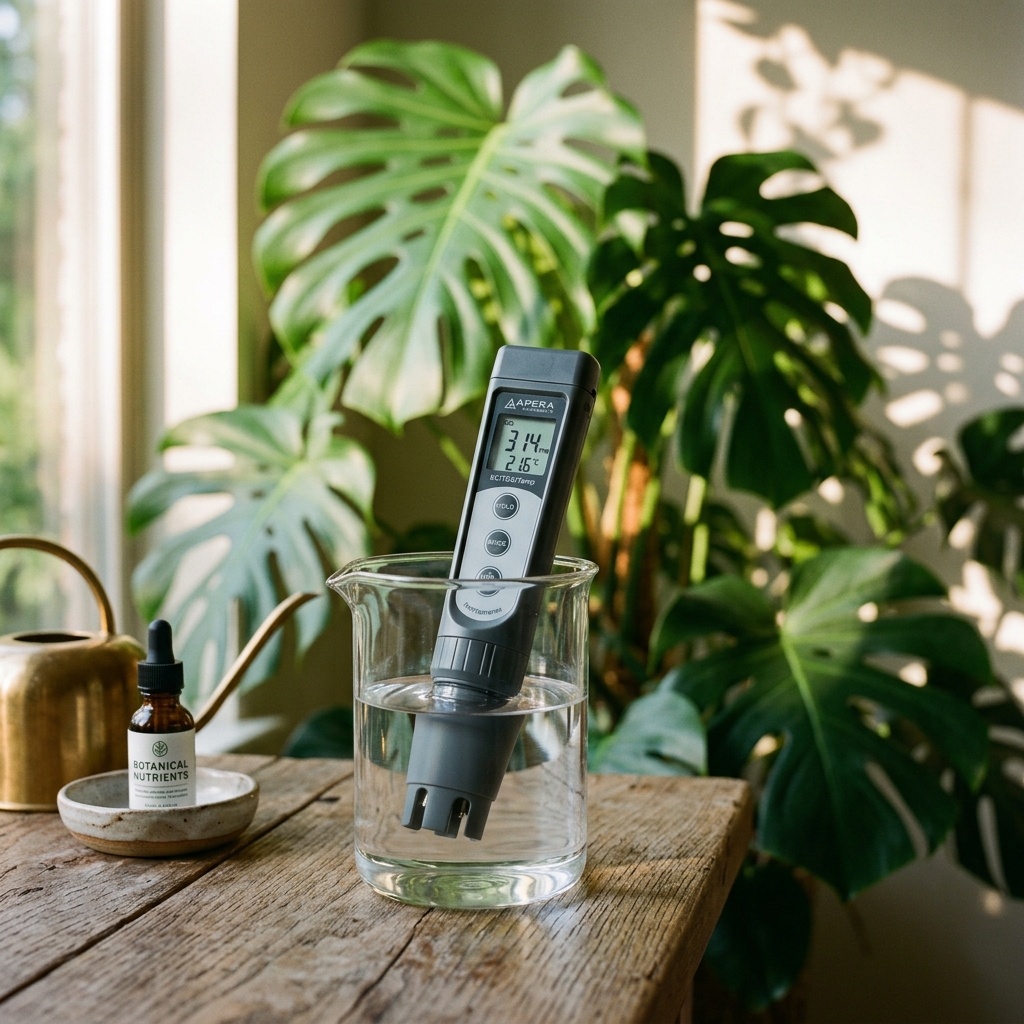
Importantly, TDS meters do not actually count dissolved particles. They measure EC and apply a mathematical conversion factor to estimate PPM. This is why two different TDS meters can give different PPM readings for the exact same solution.

The PPM Conversion Formula

Since PPM is derived from EC, understanding the formula is essential for accurate growing:

PPM = EC (in mS/cm) × Conversion Factor

Common conversion factors used by manufacturers:

  • 500 scale (NaCl): PPM = EC × 500 — Most common in North America (Hanna, BlueLab)
  • 640 scale: PPM = EC × 640 — Used by some European manufacturers
  • 700 scale (KCl): PPM = EC × 700 — Used by some Asian and Australian meters

Example: A solution with an EC of 1.2 mS/cm reads as 600 PPM on a 500-scale meter, but 840 PPM on a 700-scale meter. Always know which scale your meter uses.

Ideal PPM Ranges by Plant Type & Growth Stage

PPM targets vary dramatically depending on the plant's natural nutrient demands and its current growth phase:

← Scroll horizontally to inspect full matrix →
Plant / StageSoil / Coco PPMHydroponic PPM
Seedlings & Cuttings100–300100–250
General Houseplants400–800400–700
Orchids & Ferns150–350150–300
Succulents & Cacti250–500250–450
Leafy Greens (lettuce, spinach)600–900700–900
Herbs (basil, mint, cilantro)800–1200800–1200
Tomatoes & Peppers (vegetative)800–12001000–1400
Tomatoes & Peppers (flowering/fruiting)1200–18001400–1800
Cannabis (vegetative)800–12001000–1400
Cannabis (flowering)1200–16001400–1800

These ranges assume you have already subtracted your source water's baseline PPM.

How to Calculate True Fertiliser PPM

The most common mistake growers make is trusting the total PPM reading on their meter without accounting for what's already in their tap water. Here's the correct method:

  1. Measure source water PPM. Fill a clean container with your unaltered tap, well, or RO water. Record the reading.
  2. Mix your complete nutrient solution. Add all fertilisers, supplements, and additives.
  3. Measure total solution PPM. Record the final reading.
  4. Calculate fertiliser contribution: True Fertiliser PPM = Total PPM − Source Water PPM

Example: Your tap water reads 280 PPM. After mixing fertiliser, your solution reads 920 PPM. Your actual fertiliser dose is 640 PPM—not 920 PPM. If your target was 800 PPM, you are underfeeding, not overfeeding.

PPM and the Fertiliser Calculator Workflow

PPM measurement completes the fertiliser application journey:

  1. Calculate your target nutrient dose using a fertiliser calculator or manufacturer chart.
  2. Mix your solution thoroughly.
  3. Measure PPM with a TDS meter to verify the actual concentration.
  4. Adjust by diluting with plain water or adding more fertiliser.
  5. Retest until PPM falls within the target range.
  6. Measure pH and adjust if necessary.
  7. Feed your plants and log the results.

Skipping the PPM verification step is like following a recipe without tasting the food. The calculator gives you the target; the TDS meter confirms you hit it.

PPM in Soil vs. Hydroponics

Soil and Coco Coir: PPM is measured in the nutrient solution before watering. You can also measure runoff PPM to detect salt accumulation. If runoff PPM is significantly higher than input PPM, the root zone is accumulating salts and needs flushing.

Hydroponics: PPM is monitored directly in the reservoir. Because there is no soil buffer, PPM can shift daily due to plant uptake, evaporation, and microbial activity. Daily monitoring is standard practice. Top off the reservoir with pH-balanced water between full changes to maintain stable concentration.

Signs Your Nutrient Concentration Is Incorrect

← Scroll horizontally to inspect full matrix →
SymptomLikely PPM IssueCorrective Action
Leaf tip burn / brown marginsPPM too highDilute solution; flush growing medium
White crust on soil surfacePPM too high / overfeedingReduce concentration; increase flush frequency
Pale, yellowing new growthPPM too lowGradually increase fertiliser concentration
Stunted growth, small leavesPPM too lowRaise PPM by 100–200 and observe
Wilting despite wet soilOsmotic stress from high PPMFlush immediately; reduce future PPM
Dark green, clawed leavesNitrogen toxicity (high PPM)Dilute feed; reduce nitrogen component

Why PPM and pH Must Be Measured Together

PPM tells you how much nutrient is present. pH tells you whether those nutrients are chemically available. A solution with perfect PPM (800) but wrong pH (8.0) will still cause nutrient lockout. Conversely, perfect pH (6.0) with excessive PPM (2000) will cause fertiliser burn. These two parameters are inseparable. Always measure both, adjust both, and log both in your feeding records.

Common PPM Scenarios

Scenario 1: Tap water is 350 PPM. You have hard water. Your "800 PPM" target is actually only 450 PPM of fertiliser. Consider using RO water for precision, or choose fertilisers formulated for hard water.

Scenario 2: Hydroponic reservoir PPM rises from 1000 to 1400 over 3 days. Evaporation is concentrating your solution. Top off with pH-balanced water (not nutrient solution) to dilute back to target.

Scenario 3: Runoff PPM is 400 higher than input PPM. Salts are accumulating in the root zone. Flush with pH-balanced water at 300–400 PPM until runoff matches input.

RECOMMENDED WORKFLOWS

Next Best Actions & Diagnostic Tools

All Plant Calculators →
🌿
NPK Explained for Plant Care
NPK is the universal shorthand for nitrogen, phosphorus, and potassium, the three macronutrients that most directly determine how a plant grows and responds to feeding. Every fertilizer label displays these as a ratio of three numbers representing the actual elemental composition of the product. Understanding what each element does is the foundation of rational fertilizer management: nitrogen builds chlorophyll and drives foliage, phosphorus supports roots and reproduction, and potassium regulates broader physiological processes. Selecting the right NPK ratio for a plant's current stage avoids both under- and over-fertilizing.
⚡
EC Meter Guide for Plants
An EC (Electrical Conductivity) meter is a handheld device that measures how well a liquid conducts electricity, which correlates directly with the concentration of dissolved fertilizer salts present. Because fertilizer salts break into charged ions in water, higher EC readings mean a stronger, more concentrated nutrient solution. For home growers, EC testing removes the guesswork from feeding schedules by providing an objective number to track over time. It complements pH testing, since both salt concentration and pH availability affect whether a plant can actually absorb the nutrients present in its soil.
⚡
TDS Meter Guide: PPM, EC Conversion & Safe Ranges for Plants
A TDS (Total Dissolved Solids) meter estimates the concentration of dissolved minerals, salts, and fertilizers in water by converting electrical conductivity (EC) into parts per million (ppm). It is an essential tool for hydroponic growers and container gardeners to mix nutrient solutions accurately, monitor feeding strength, and prevent fertilizer burn before it damages sensitive roots. This approach helps maintain optimal conditions and prevents common issues that can affect your plant's overall health and longevity over time.
⚡
Osmotic Pressure in Plant Roots
Osmotic pressure is the physical force governing water movement across the semipermeable membranes of plant root cells, moving from areas of lower solute concentration toward areas of higher concentration. Under normal conditions, roots maintain a solute concentration slightly higher than the surrounding soil, creating a gradient that continuously pulls water inward. When fertilizer salts accumulate in the soil beyond what the plant can tolerate, this gradient reverses: soil solute concentration exceeds that inside the root cells, and water is instead pulled out of the roots. This reversal is the core mechanism behind fertilizer burn, even in soil that still feels moist.
Hydration & Irrigation Tool

Plant Watering Calculator: Estimate the Ideal Watering Schedule

Calculate the correct watering frequency for your plant based on species, pot size, soil type, season, and climate.

Enter plant type, pot size, and conditions for a custom watering schedule.Free Evidence-Based Botanical Tool

Frequently Asked Questions

What is PPM in plant care?

PPM stands for Parts Per Million. It quantifies how many milligrams of dissolved solids (nutrients, minerals, salts) are present in one litre of water. In plant care, it tells you the strength of your fertiliser solution.

What PPM should houseplants have?

Most houseplants thrive at 400–800 PPM during active growth (spring and summer). Reduce to 200–400 PPM in fall and winter when growth slows. Sensitive plants like ferns and orchids prefer 100–350 PPM.

Is higher PPM always better for plants?

No. Excessive PPM causes fertiliser burn, nutrient lockout, salt buildup, and osmotic stress that prevents roots from absorbing water. The goal is the right PPM for the plant's species and growth stage, not the highest possible number.

Is PPM the same as EC?

No, but they are closely related. EC (Electrical Conductivity) measures how well a solution conducts electricity, expressed in mS/cm or µS/cm. PPM is an estimate of dissolved solids derived from that EC reading using a conversion factor. A TDS meter measures EC and displays it as PPM.

What is a good PPM for hydroponics?

Hydroponic PPM targets vary by crop: lettuce and leafy greens prefer 700–900 PPM; tomatoes and peppers need 1200–1800 PPM; herbs typically thrive at 800–1200 PPM. Hydroponic systems require more frequent monitoring because there is no soil buffer.

Why should I subtract tap water PPM from my reading?

Because your fertiliser is not the only source of dissolved solids. Tap water contains calcium, magnesium, bicarbonates, and other minerals that register on a TDS meter. Subtracting the baseline gives you the true nutrient concentration you are adding. For example, if tap water is 250 PPM and your final solution reads 750 PPM, your fertiliser contribution is only 500 PPM.

What conversion factor does my TDS meter use?

Most consumer TDS meters use either a 500 scale (PPM = EC × 500) or a 700 scale (PPM = EC × 700). Hanna meters typically use 500; some European meters use 640. Check your manual—using the wrong factor when comparing readings with other growers will cause confusion.

Can I measure PPM without a TDS meter?

Not accurately. While you can estimate PPM from fertiliser label dilution ratios, this ignores your source water chemistry and assumes perfect mixing. A TDS meter is inexpensive and essential for precision growing.

Does PPM measure pH?

No. PPM measures total dissolved solids (concentration), while pH measures acidity or alkalinity. They are independent properties. A solution can have high PPM and low pH, or low PPM and high pH. Both must be measured together for complete solution management.

Why does my hydroponic reservoir PPM rise between changes?

Water evaporates faster than dissolved nutrients, leaving salts behind and concentrating the solution. Plants also take up water and nutrients at different rates. Top off with pH-balanced water between full reservoir changes to maintain stable PPM.

Keep exploring

Related Guides and Articles

NPK Explained for Plant CareNPK is the universal shorthand for nitrogen, phosphorus, and potassium, the three macronutrients that most directly determine how a plant grows and responds to feeding. Every fertilizer label displays these as a ratio of three numbers representing the actual elemental composition of the product. Understanding what each element does is the foundation of rational fertilizer management: nitrogen builds chlorophyll and drives foliage, phosphorus supports roots and reproduction, and potassium regulates broader physiological processes. Selecting the right NPK ratio for a plant's current stage avoids both under- and over-fertilizing.
Read guide →
EC Meter Guide for PlantsAn EC (Electrical Conductivity) meter is a handheld device that measures how well a liquid conducts electricity, which correlates directly with the concentration of dissolved fertilizer salts present. Because fertilizer salts break into charged ions in water, higher EC readings mean a stronger, more concentrated nutrient solution. For home growers, EC testing removes the guesswork from feeding schedules by providing an objective number to track over time. It complements pH testing, since both salt concentration and pH availability affect whether a plant can actually absorb the nutrients present in its soil.
Read guide →
TDS Meter Guide: PPM, EC Conversion & Safe Ranges for PlantsA TDS (Total Dissolved Solids) meter estimates the concentration of dissolved minerals, salts, and fertilizers in water by converting electrical conductivity (EC) into parts per million (ppm). It is an essential tool for hydroponic growers and container gardeners to mix nutrient solutions accurately, monitor feeding strength, and prevent fertilizer burn before it damages sensitive roots. This approach helps maintain optimal conditions and prevents common issues that can affect your plant's overall health and longevity over time.
Read guide →
Osmotic Pressure in Plant RootsOsmotic pressure is the physical force governing water movement across the semipermeable membranes of plant root cells, moving from areas of lower solute concentration toward areas of higher concentration. Under normal conditions, roots maintain a solute concentration slightly higher than the surrounding soil, creating a gradient that continuously pulls water inward. When fertilizer salts accumulate in the soil beyond what the plant can tolerate, this gradient reverses: soil solute concentration exceeds that inside the root cells, and water is instead pulled out of the roots. This reversal is the core mechanism behind fertilizer burn, even in soil that still feels moist.
Read guide →