🧮
Calculators
🌿
Plants
💧
Watering
☀️
Sunlight
🧪
Fertilizers
🪴
Potting Mix
🎯
Quizzes
Botanical Topic

Salt Buildup in Plants: Causes, Symptoms & How to Fix It

Written by PlantSolve Editorial Team13 min readLast updated: 2026-06-23
Salt Buildup in Plants: Causes, Symptoms & How to Fix It - Plant Care Guide
⚠ DIAGNOSTIC TRIAGE // SYMPTOMS & ROOT CAUSESTriage Telemetry

Observed Symptoms(8)

  • !
    Leaf tip burn

    Brown, dried, or necrotic tips on older leaves are the most characteristic symptom. Salts accumulate at the leaf margins through transpiration, reaching toxic concentrations at the extremities.

  • !
    Brown leaf margins

    Necrosis progresses inward from leaf edges, often with a yellow halo separating dead tissue from green. Affects older leaves first since they have transpired longer and accumulated more salts.

  • !
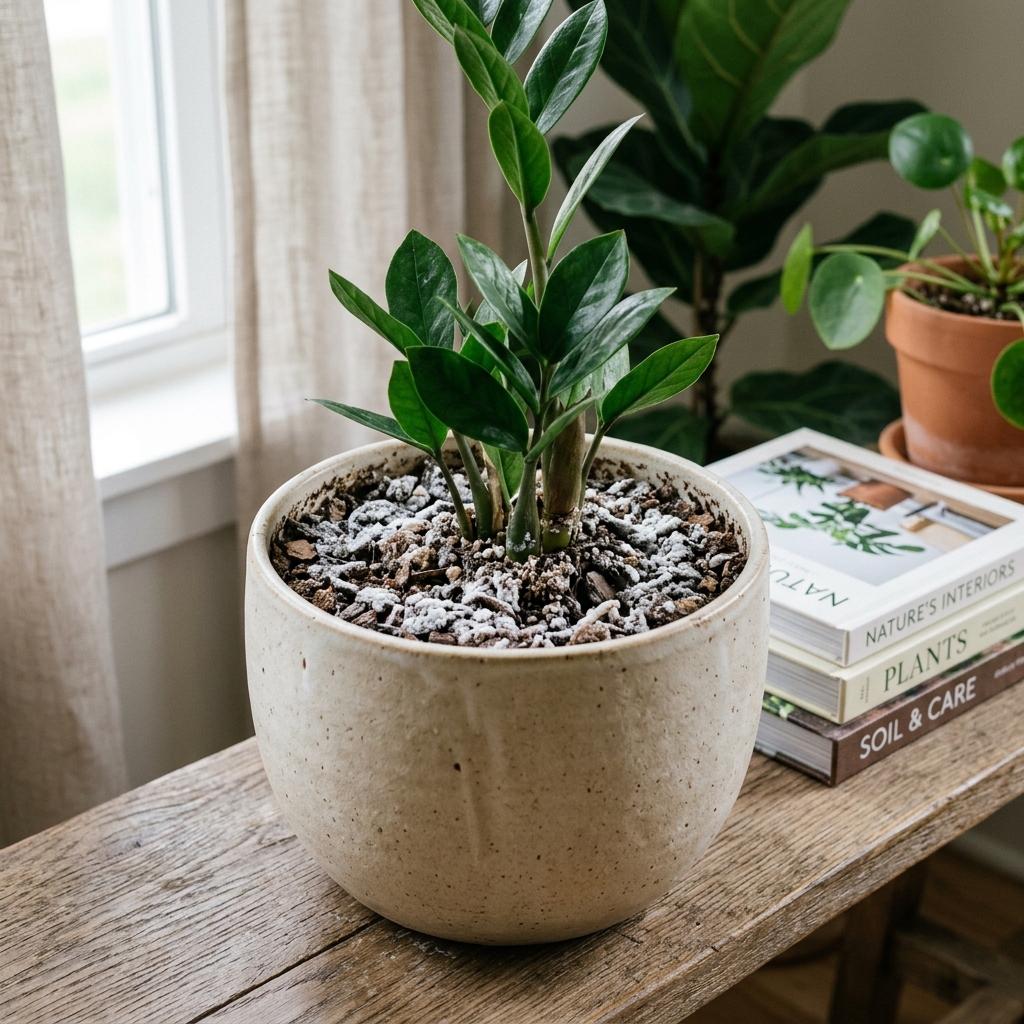
    White crust on soil surface

    Visible crystalline deposits of fertiliser salts on the soil surface or rim of the pot. This is definitive evidence of salt accumulation and indicates severe buildup.

  • !
    Stunted growth

    Reduced cell expansion and division due to osmotic stress and impaired nutrient uptake. New growth is smaller, internodes shorten, and overall vigour declines.

  • !
    Wilting despite moist soil

    Roots cannot absorb water from a hypertonic soil solution even when moisture is present. Leaves wilt while soil feels damp—a classic sign of physiological drought from salt stress.

  • !
    Root browning and death

    Salt-damaged roots turn brown, become brittle, and lose fine root hairs. Root tips die back first. When severe, the root system cannot support the plant even after salts are removed.

  • !
    Reduced flowering and fruiting

    Reproductive processes are energy-intensive and the first to be abandoned under stress. Bud drop, poor fruit set, and smaller flowers result from chronic salt buildup.

  • !
    Dark green or bluish foliage

    Some plants develop unusually dark green or slightly bluish leaves due to phosphorus accumulation and impaired nitrogen metabolism under high salt conditions.

Underlying Causes(8)

  • ▸
    Over-fertilisation

    Applying fertiliser more frequently or at higher concentrations than plants can absorb is the leading cause of salt buildup. Excess nutrients remain in the soil and accumulate with each application.

  • ▸
    Insufficient leaching

    Watering only enough to moisten soil without allowing drainage leaves salts behind. In container growing, every watering should produce 10-20% runoff to flush accumulated salts.

  • ▸
    Hard water

    Water high in calcium, magnesium, and bicarbonates contributes dissolved minerals to the soil with every irrigation. Over time, these accumulate alongside fertiliser salts.

  • ▸
    High-frequency fertilisation

    Daily or every-other-day feeding with liquid fertilisers—common in hydroponics and intensive container growing—rapidly elevates EC if leaching is inadequate.

  • ▸
    Poor drainage

    Containers without drainage holes, compacted soil, or waterlogged conditions prevent the flushing action that removes excess salts. Salts concentrate in the root zone.

  • ▸
    Low humidity and high temperature

    Hot, dry conditions increase transpiration, which draws more water (and salts) to leaf margins, accelerating tip burn. Evaporation from soil surfaces also concentrates surface salts.

  • ▸
    Small container size

    Plants in small pots have limited soil volume to buffer salt accumulation. The same fertiliser dose in a 4-inch pot creates much higher EC than in a 12-inch pot.

  • ▸
    Use of high-salt fertilisers

    Some fertilisers, particularly those high in sodium or chloride (e.g., muriate of potash), contribute directly to toxic ion accumulation. Cheap, unbalanced fertilisers often contain filler salts.

🔬 DIAGNOSIS PROTOCOL4 Steps

Diagnosis Protocol

1
White crust visible on soil surface or pot rim
Definitive salt buildup. Flush immediately with 2-3 volumes of plain water. Reduce future fertiliser rates and increase leaching frequency.
2
Leaf tip burn on older leaves with moist soil
Classic salt toxicity symptom. Test runoff EC. If above recommended levels, flush soil and reduce fertiliser concentration by 25-50%.
3
Wilting despite moist soil
Physiological drought from high osmotic pressure. Roots cannot absorb water. Flush soil immediately. Check for root damage—brown, brittle roots indicate advanced toxicity.
4
Multiple symptoms or unclear cause
Measure runoff EC and pH. EC > 2.0 mS/cm for houseplants confirms salt buildup. If EC is normal, investigate root rot, nutrient deficiency, or pest damage as alternative causes.
✓ BEST PRACTICES & COMMON MISTAKES(5)
  • ✓
    Establish a monthly flushing routine

    Schedule a plain-water flush on the same day each month. This is the single most effective prevention strategy for container-grown plants.

  • ✓
    Calibrate fertiliser to plant needs

    Match fertiliser strength to growth stage, light levels, and plant species. Fast-growing plants in high light need more; slow-growing plants in low light need far less.

  • ✓
    Use the 'quarter-strength, twice as often' rule cautiously

    While dilute frequent feeding reduces individual salt spikes, it only works if leaching occurs. Without runoff, even dilute solutions accumulate over time.

  • ✓
    Test water source EC

    Measure your tap water's baseline EC. If it is above 0.5 mS/cm, your water is contributing significantly to salt load. Consider alternative water sources.

  • ✓
    Never let pots sit in drainage water

    Saucers full of runoff allow salts to be reabsorbed into the soil. Empty saucers within 30 minutes of watering.

⚠ Common Grower Mistakes(6)
  • ✕
    Fertilizing on a fixed schedule regardless of plant needs
    ↳ Recommended Fix:Fertilize based on growth rate, season, and observed vigour rather than calendar dates. Dormant or slow-growing plants need little to no fertiliser.
  • ✕
    Watering without runoff
    ↳ Recommended Fix:Always water until 10-20% drains from the bottom. This is the only way to leach salts. Small, frequent sips concentrate salts in the root zone.
  • ✕
    Ignoring visible salt crust
    ↳ Recommended Fix:White crust is not cosmetic—it signals severe buildup. Flush immediately and reassess your fertilisation and watering practices.
  • ✕
    Using the same fertiliser rate year-round
    ↳ Recommended Fix:Reduce fertiliser by 50-75% in winter when growth slows. Resume full rates only when active growth returns in spring.
  • ✕
    Reusing old potting mix without amendment
    ↳ Recommended Fix:Old mix contains accumulated salts. Replace with fresh, high-quality potting mix annually, or leach thoroughly before reuse.
  • ✕
    Mistaking salt burn for nutrient deficiency
    ↳ Recommended Fix:Both cause leaf discolouration, but salt burn affects margins and tips of older leaves first, while deficiencies often show interveinal patterns or affect new growth. Test EC to confirm.
🛡 Proactive Prevention Guidelines8 Guidelines
  • ▸
    Flush soil with plain water monthly

    Water thoroughly until 20-30% of the applied volume drains from the bottom of the container. This leaches accumulated salts before they reach toxic levels. Use room-temperature water.

  • ▸
    Monitor EC with a meter

    Measure runoff EC weekly for container plants or monthly for garden beds. Maintain EC below 2.0 mS/cm for most houseplants, below 3.0 for vegetables, and below 4.0 for established trees.

  • ▸
    Water until runoff occurs

    Every watering should produce 10-20% drainage. This prevents the salt concentration that occurs when water is applied in small, frequent doses without leaching.

  • ▸
    Use balanced, quality fertilisers

    Choose complete fertilisers with micronutrients and avoid products high in sodium or chloride. Slow-release and organic fertilisers release nutrients more gradually, reducing salt spikes.

  • ▸
    Avoid fertilizing dry soil

    Dry roots are more susceptible to salt shock. Water lightly before applying fertiliser solution to ensure roots are hydrated and salts dissolve evenly.

  • ▸
    Repot annually in fresh mix

    For container plants, replace potting mix yearly to remove accumulated salts. Choose a high-quality, well-draining mix. Do not reuse old soil without amendment and leaching.

  • ▸
    Use rainwater or filtered water

    If your tap water is hard (EC > 0.5 mS/cm), use rainwater, reverse osmosis water, or distilled water for irrigation to reduce mineral input from the water source itself.

  • ▸
    Increase container size as plants grow

    Larger soil volumes dilute salts and provide more buffering capacity. Repot into appropriately sized containers to prevent the rapid EC spikes common in small pots.

What is Salt Buildup?

Salt buildup occurs when soluble salts from fertilisers and hard water accumulate in the potting soil over time. Because indoor plants are grown in closed containers, the salts have nowhere to escape unless properly flushed. Over time, these salts reach toxic levels, reversing the osmotic pressure in the root zone and dehydrating the plant even when the soil is wet.

How to Prevent and Fix It

Prevention is straightforward: always water your plants until about 10-20% of the water drains out of the bottom of the pot. This is called leaching, and it washes away excess salts before they can accumulate. If you already have a severe salt crust on the soil surface, the best remedy is to place the pot in a sink or shower and flush it thoroughly with room-temperature water, running 3 to 4 times the pot's volume of water through the soil to dissolve and carry away the accumulated salts. If the buildup is extreme and roots are damaged, repotting into fresh soil is the safest option.

RECOMMENDED WORKFLOWS

Next Best Actions & Diagnostic Tools

All Plant Calculators →
⚡
EC Meter Guide for Plants
An EC (Electrical Conductivity) meter is a handheld device that measures how well a liquid conducts electricity, which correlates directly with the concentration of dissolved fertilizer salts present. Because fertilizer salts break into charged ions in water, higher EC readings mean a stronger, more concentrated nutrient solution. For home growers, EC testing removes the guesswork from feeding schedules by providing an objective number to track over time. It complements pH testing, since both salt concentration and pH availability affect whether a plant can actually absorb the nutrients present in its soil.
⚡
PPM Explained for Plant Feeding
PPM, or Parts Per Million, is a concentration unit indicating how many milligrams of dissolved solids, primarily fertilizer salts and minerals, are present in each liter of water. It gives growers an objective, numerical way to describe nutrient solution strength rather than relying on imprecise terms like half-strength or quarter-strength. PPM is closely related to EC and TDS measurements, though each is derived slightly differently: EC measures electrical conductivity directly, while TDS and PPM are typically estimated from that EC reading using a conversion factor. Understanding these relationships helps growers interpret meter readings consistently across different devices and brands.
⚡
TDS Meter Guide: PPM, EC Conversion & Safe Ranges for Plants
A TDS (Total Dissolved Solids) meter estimates the concentration of dissolved minerals, salts, and fertilizers in water by converting electrical conductivity (EC) into parts per million (ppm). It is an essential tool for hydroponic growers and container gardeners to mix nutrient solutions accurately, monitor feeding strength, and prevent fertilizer burn before it damages sensitive roots. This approach helps maintain optimal conditions and prevents common issues that can affect your plant's overall health and longevity over time.
⚡
Osmotic Pressure in Plant Roots
Osmotic pressure is the physical force governing water movement across the semipermeable membranes of plant root cells, moving from areas of lower solute concentration toward areas of higher concentration. Under normal conditions, roots maintain a solute concentration slightly higher than the surrounding soil, creating a gradient that continuously pulls water inward. When fertilizer salts accumulate in the soil beyond what the plant can tolerate, this gradient reverses: soil solute concentration exceeds that inside the root cells, and water is instead pulled out of the roots. This reversal is the core mechanism behind fertilizer burn, even in soil that still feels moist.
Hydration & Irrigation Tool

Plant Watering Calculator: Estimate the Ideal Watering Schedule

Calculate the correct watering frequency for your plant based on species, pot size, soil type, season, and climate.

Enter plant type, pot size, and conditions for a custom watering schedule.Free Evidence-Based Botanical Tool

Keep exploring

Related Guides and Articles

EC Meter Guide for PlantsAn EC (Electrical Conductivity) meter is a handheld device that measures how well a liquid conducts electricity, which correlates directly with the concentration of dissolved fertilizer salts present. Because fertilizer salts break into charged ions in water, higher EC readings mean a stronger, more concentrated nutrient solution. For home growers, EC testing removes the guesswork from feeding schedules by providing an objective number to track over time. It complements pH testing, since both salt concentration and pH availability affect whether a plant can actually absorb the nutrients present in its soil.
Read guide →
PPM Explained for Plant FeedingPPM, or Parts Per Million, is a concentration unit indicating how many milligrams of dissolved solids, primarily fertilizer salts and minerals, are present in each liter of water. It gives growers an objective, numerical way to describe nutrient solution strength rather than relying on imprecise terms like half-strength or quarter-strength. PPM is closely related to EC and TDS measurements, though each is derived slightly differently: EC measures electrical conductivity directly, while TDS and PPM are typically estimated from that EC reading using a conversion factor. Understanding these relationships helps growers interpret meter readings consistently across different devices and brands.
Read guide →
TDS Meter Guide: PPM, EC Conversion & Safe Ranges for PlantsA TDS (Total Dissolved Solids) meter estimates the concentration of dissolved minerals, salts, and fertilizers in water by converting electrical conductivity (EC) into parts per million (ppm). It is an essential tool for hydroponic growers and container gardeners to mix nutrient solutions accurately, monitor feeding strength, and prevent fertilizer burn before it damages sensitive roots. This approach helps maintain optimal conditions and prevents common issues that can affect your plant's overall health and longevity over time.
Read guide →
Osmotic Pressure in Plant RootsOsmotic pressure is the physical force governing water movement across the semipermeable membranes of plant root cells, moving from areas of lower solute concentration toward areas of higher concentration. Under normal conditions, roots maintain a solute concentration slightly higher than the surrounding soil, creating a gradient that continuously pulls water inward. When fertilizer salts accumulate in the soil beyond what the plant can tolerate, this gradient reverses: soil solute concentration exceeds that inside the root cells, and water is instead pulled out of the roots. This reversal is the core mechanism behind fertilizer burn, even in soil that still feels moist.
Read guide →