🧮
Calculators
🌿
Plants
💧
Watering
☀️
Sunlight
🧪
Fertilizers
🪴
Potting Mix
🎯
Quizzes
Botanical Topic

Fertiliser Burn: Symptoms and Treatment

Written by PlantSolve Editorial Team21 min readReviewed by Botanical Specialists
Fertiliser Burn: Symptoms, Causes, Treatment & How to Save Overfertilized Plants - Plant Care Guide
⚠ DIAGNOSTIC TRIAGE // SYMPTOMS & ROOT CAUSESTriage Telemetry

Observed Symptoms(9)

  • !
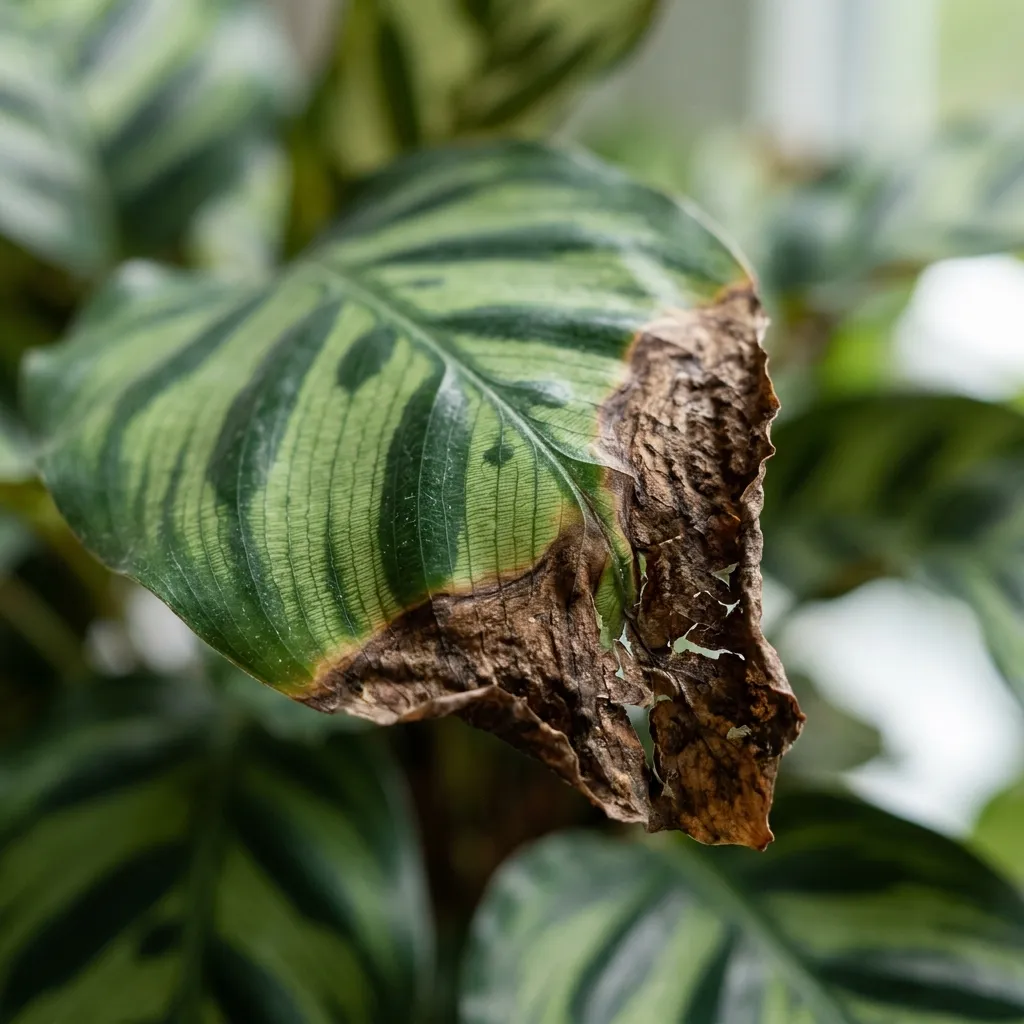
    Brown, crispy tips on leaves

    The earliest sign; salt accumulation at leaf margins dehydrates tissue, causing necrosis that starts at the tip and spreads inward.

  • !
    Yellowing margins with brown edges

    Chlorosis followed by necrosis along leaf edges as salt toxicity disrupts chlorophyll production and cell hydration.

  • !
    White or grayish crust on soil surface

    Crystallized fertiliser salts accumulating on top of the soil as water evaporates, leaving minerals behind.

  • !
    Wilting or drooping despite moist soil

    Roots lose turgor pressure because salts have pulled water out of root cells; the plant cannot rehydrate even when water is present.

  • !
    Leaf curl or cupping

    Leaves curl downward or cup as a stress response to reduce surface area and minimize further water loss.

  • !
    Sudden leaf drop

    Severe osmotic shock causes the plant to abort leaves as a survival mechanism, conserving resources for the roots.

  • !
    Stunted or arrested growth

    Root damage reduces nutrient and water uptake, halting cell division and expansion even in optimal light and temperature.

  • !
    Blackened or mushy roots

    Advanced salt burn kills root tissue, which then rots due to secondary bacterial or fungal infection.

  • !
    Slow decline over weeks after fertilizing

    Unlike mechanical damage, fertiliser burn often manifests gradually as salts accumulate and osmotic pressure builds.

Underlying Causes(11)

  • ▸
    Applying too much fertiliser at once

    Exceeding the recommended dose creates an immediate salt spike that overwhelms the root zone's dilution capacity.

  • ▸
    Feeding too frequently

    Even moderate doses applied too often cause cumulative salt buildup faster than the plant can absorb or leaching can remove.

  • ▸
    Fertilizing dormant or slow-growing plants

    Plants in dormancy take up minimal water; salts remain concentrated around roots instead of being diluted by active transpiration.

  • ▸
    Poor drainage or lack of drainage holes

    Water and salts cannot escape the pot; evaporation concentrates salts further while roots sit in a saline bath.

  • ▸
    High baseline EC or PPM in source water

    Hard tap water already contains 200–400 PPM of salts; adding fertiliser on top pushes total concentration into the burn zone.

  • ▸
    Never flushing accumulated salts

    Without periodic leaching, every feeding adds a new layer of salt on top of the previous one, compounding over months.

  • ▸
    Incorrect dilution or measurement errors

    Misreading tablespoons for teaspoons, using weight instead of volume, or failing to account for concentrate strength.

  • ▸
    Stacking multiple fertiliser products

    Combining base nutrients, bloom boosters, cal-mag, and supplements without calculating total combined PPM.

  • ▸
    Using full-strength synthetic fertiliser on houseplants

    Manufacturer recommendations are often calibrated for outdoor garden beds or greenhouse production, not small containers.

  • ▸
    Fertilizing dry soil

    Without moisture to dilute and distribute salts, fertiliser contacts roots at full concentration, causing instant chemical shock.

  • ▸
    Using hot or fresh manure or uncomposted organic matter

    Decomposing organic materials release ammonium and salts rapidly, creating localized zones of extreme concentration.

🔬 DIAGNOSIS PROTOCOL7 Steps

Step-by-Step Fertiliser Burn Diagnosis

1
Inspect leaf tips and margins for browning, crispiness, or yellowing.
↳ Expected Outcome / Observation:Brown tips starting at the leaf apex and moving inward are the hallmark early sign of salt burn.
2
Check the soil surface for white crystalline crust or salt deposits.
↳ Expected Outcome / Observation:A visible salt crust is definitive evidence of accumulated fertiliser minerals.
3
Measure the EC or PPM of your last nutrient solution and compare to the plant's safe range.
↳ Expected Outcome / Observation:If solution EC exceeds the plant's tolerance (e.g., >1.5 mS/cm for most houseplants), over-fertilisation is confirmed.
4
Collect runoff water after watering and measure its EC.
↳ Expected Outcome / Observation:Runoff EC significantly higher than input EC indicates dangerous salt accumulation in the root zone.
5
Review your recent feeding history: dose, frequency, products used, and whether soil was dry.
↳ Expected Outcome / Observation:Recent full-strength application, feeding dry soil, or stacking products points directly to fertiliser burn.
6
Gently unpot the plant and inspect root colour and texture if symptoms are severe.
↳ Expected Outcome / Observation:Healthy roots are white and firm. Brown, black, or mushy roots indicate advanced salt damage and secondary rot.
7
Differentiate from other causes: check for pests, pH issues, and underwatering.
↳ Expected Outcome / Observation:Uniform tip burn + salt crust + recent fertilizing = fertiliser burn. Patterned damage or webbing suggests pests.
📋 QUICK REFERENCE MATRIXTelemetry Reference

Safe EC Ranges by Plant Type (Prevents Burn)

Plant CategorySafe EC (mS/cm)Safe PPM (500 scale)Burn Risk EC
Seedlings & Cuttings0.4–0.8200–400>1.0
Sensitive Houseplants (ferns, orchids)0.6–1.0300–500>1.2
General Houseplants1.0–1.5500–750>2.0
Heavy Feeders (tomatoes, peppers)1.5–2.5750–1250>3.0
Hydroponic Lettuce1.0–1.4500–700>1.8
Hydroponic Tomatoes (fruiting)2.0–3.51000–1750>4.0
📋 QUICK REFERENCE MATRIXTelemetry Reference

Fertiliser Burn Flush Protocol by Severity

SeverityWater VolumeFrequencyAdditional ActionFertiliser Hold
Mild2–3× pot volumeOnceNone2 weeks
Moderate3–4× pot volumeTwice over 48 hoursTrim damaged leaves3–4 weeks
Severe4–5× pot volume + repotFlush, then repot in fresh mixTrim dead roots, disinfect tools4–6 weeks
✓ BEST PRACTICES & COMMON MISTAKES(7)
  • ✓
    Feed only during active growth periods; withhold fertiliser entirely during dormancy.
  • ✓
    Always use pots with drainage holes; closed containers trap salts and prevent flushing.
  • ✓
    Water thoroughly until 10–20% runoff before every fertilisation to pre-moisten roots and soil.
  • ✓
    Monitor runoff EC monthly as an early warning system for salt accumulation.
  • ✓
    Measure EC of every mixed nutrient solution before it touches plant roots.
  • ✓
    Reduce fertiliser concentration by 50% in winter or whenever growth visibly slows.
  • ✓
    Increase nutrient concentration gradually (100–200 PPM at a time) and observe plant response.
⚠ Common Grower Mistakes(7)
  • ✕
    Using full-strength manufacturer recommendations on container houseplants without dilution.
  • ✕
    Fertilizing dry soil, which causes instant root shock and concentrated salt contact.
  • ✕
    Ignoring runoff EC and PPM, missing the early warning signs of cumulative salt buildup.
  • ✕
    Mixing multiple fertiliser brands or products without calculating the combined total PPM.
  • ✕
    Fertilizing sick, stressed, or recently transplanted plants that cannot process nutrients.
  • ✕
    Continuing to feed on the same schedule through dormancy when uptake has dropped by 80%.
  • ✕
    Assuming more fertiliser equals faster growth; excess salts actually halt growth and damage tissue.
🛡 Proactive Prevention Guidelines9 Guidelines
  • ▸
    Measure EC or PPM of your nutrient solution with a TDS meter before every feeding.
  • ▸
    Use a fertiliser calculator to determine precise doses based on container size, plant type, and growth stage.
  • ▸
    Reduce or eliminate fertilizing during dormancy (fall and winter for most temperate houseplants).
  • ▸
    Water thoroughly until runoff before applying fertiliser; never feed dry soil.
  • ▸
    Flush container soil with plain water every 4–6 weeks to leach accumulated salts.
  • ▸
    Measure runoff EC monthly; if runoff EC exceeds input EC by more than 20%, flush immediately.
  • ▸
    Start new fertilisers at half the manufacturer's recommended strength and increase gradually.
  • ▸
    Follow a plant-specific feeding schedule rather than a generic calendar.
  • ▸
    Use reverse osmosis or distilled water when source water EC exceeds 0.4 mS/cm (200 PPM).

What Is Fertiliser Burn?

Fertiliser burn is a form of chemical damage caused by excessive concentrations of fertiliser salts in the soil. It is not caused by heat or acidity—it is caused by osmotic stress. When the salt concentration in the soil solution becomes higher than the concentration of dissolved salts inside the plant's root cells, water is pulled out of the roots through reverse osmosis. The plant dehydrates from the inside out, even when the surrounding soil is soaking wet.

This is why fertiliser burn is so deceptive: the soil feels moist, but the plant is dying of thirst at the cellular level. The salts also directly damage root cell membranes and leaf tissue, causing the characteristic brown, crispy margins and tips that growers recognize as burn.

The Science: Osmosis and Root Damage

Plant roots absorb water through osmosis—water moves from areas of low solute concentration (dilute soil solution) to areas of high solute concentration (inside root cells). This requires the soil to be less salty than the root interior.

When you over-fertilize, you reverse this gradient:

High soil salinity → Water exits root cells → Root cells dehydrate → Root death → Plant cannot absorb water or nutrients

Even before roots die, the high salt concentration disrupts enzyme function, damages cell membranes, and interferes with nutrient uptake. Nitrogen and potassium—highly mobile nutrients—accumulate to toxic levels fastest, which is why leaf tip burn (where these nutrients are transported and deposited) appears first.

Early Warning Signs vs. Advanced Symptoms

← Scroll horizontally to inspect full matrix →
StageSymptomsWhat to Do
Early (Days 1–3)Brown tips on newest leaves; slight leaf curlFlush immediately; stop all fertilizing
Moderate (Days 3–10)Brown margins spreading inward; white salt crust; wiltingFlush 3–4 times; trim damaged tissue; hold fertiliser 3–4 weeks
Advanced (Week 2+)Massive leaf drop; black roots; foul smell; plant collapseRepot after trimming dead roots; treat as transplant shock

How to Treat Fertiliser Burn: The Flush Method

Flushing is the immediate, first-line treatment for all severity levels. The goal is to dissolve accumulated salts and wash them out of the root zone:

  1. Stop fertilizing immediately. Do not apply any more nutrients until recovery is confirmed.
  2. Use plain water at room temperature. Tap water is fine unless your tap is extremely hard (>400 PPM); in that case, use distilled or rainwater.
  3. Calculate volume: Use 3–5 times the volume of the pot. A 1-gallon pot needs 3–5 gallons of water.
  4. Pour slowly and evenly over the soil surface, allowing water to saturate and drain completely between each pour.
  5. Collect and measure runoff with a TDS meter. Continue flushing until runoff PPM is within 100–200 PPM of your source water.
  6. Let drain thoroughly. Never let the pot sit in a saucer of flush water, which would reabsorb the salts you just removed.

For severe burn: If flushing 3–5 times fails to reduce runoff EC, or if roots are visibly rotting, proceed to repotting into entirely fresh mix.

Recovery Timeline: What to Expect

← Scroll horizontally to inspect full matrix →
TimeframeActionExpected Outcome
Day 1Flush soil thoroughly; stop all fertiliserSalt levels begin dropping; no visible change yet
Days 2–7Maintain light moisture; stable environmentRoot osmotic balance begins restoring; wilting may stabilize
Week 2Trim dead leaves; inspect for new growthNew buds or leaves should appear green and healthy
Week 3–4If new growth is healthy, apply ¼-strength feed oncePlant tests nutrient processing ability
Week 6–8Gradually return to ½-strength normal scheduleFull recovery confirmed by consistent healthy new growth

EC Meters: Detecting Burn Before It Happens

The most powerful tool for preventing fertiliser burn is an EC or TDS meter. Visible symptoms appear only after significant damage has occurred. An EC meter reveals dangerous salt levels while roots are still healthy:

  • Input EC: Measure your nutrient solution before feeding. Most houseplants tolerate 1.0–1.5 mS/cm.
  • Runoff EC: Measure drainage water monthly. If runoff EC is >20% above input EC, salts are accumulating—flush immediately.
  • Source water EC: Hard tap water at 0.5 mS/cm (250 PPM) adds hidden salts. Subtract this baseline from your target.

Think of EC measurement as a smoke detector for fertiliser burn: it alerts you to danger before you can see the fire.

The Fertiliser Calculator Journey: Preventing Burn Before It Starts

The complete workflow for safe, precise fertilisation that eliminates burn risk:

  1. Identify your plant and growth stage — Seedlings, vegetative, flowering, or dormant?
  2. Use a fertiliser calculator — Enter your fertiliser's NPK, container size, and target PPM.
  3. Mix precisely — Weigh or measure exactly what the calculator specifies.
  4. Measure EC/PPM — Verify the mixed solution with a TDS meter before feeding.
  5. Water first, then feed — Pre-moisten soil to dilute and distribute salts evenly.
  6. Feed and observe — Apply solution and monitor plant response over 48–72 hours.
  7. Log and adjust — Record dose, EC, and plant reaction. Adjust next feeding if needed.

This闭环 (closed loop) removes guesswork. Burn happens when growers skip the measurement and verification steps.

Why Dormant Plants Burn So Easily

One of the most common scenarios for fertiliser burn is a well-meaning grower who continues their summer feeding schedule into winter. During dormancy:

  • Transpiration rates drop by 60–90%
  • Root metabolic activity slows dramatically
  • Nutrient demand falls to near-zero
  • Water uptake is minimal, so salts concentrate around roots

A dose that was perfectly safe in July becomes lethal in December. The rule is simple: when growth stops, feeding should stop (or drop to ¼ strength at most).

Fertiliser Burn vs. Other Problems

← Scroll horizontally to inspect full matrix →
ProblemKey DifferentiatorHow to Confirm
Fertiliser BurnBrown tips + salt crust + recent feedingHigh runoff EC; white soil crust
UnderwateringDry soil + wilting + uniform browningSoil is dry; plant perks up after watering
Nutrient DeficiencyPatterned chlorosis (interveinal, old leaves first)Low EC; specific nutrient patterns
Root RotMushy roots + foul smell + wet soilBlack roots; often follows overwatering, not overfeeding
Pest DamageSpotting, webbing, or visible insectsInspect undersides of leaves with magnification
pH LockoutYellowing with green veins (iron) or purple stems (phosphorus)pH test; EC may be normal
RECOMMENDED WORKFLOWS

Next Best Actions & Diagnostic Tools

All Plant Calculators →
⚡
Salt Buildup in Plants: Causes, Symptoms & How to Fix It
Salt buildup occurs when soluble salts from fertilizers, hard water, and soil amendments accumulate in the growing medium faster than they can be leached away. It raises soil EC, creates osmotic stress, and causes specific ion toxicities that damage roots and foliage. Common in container plants, indoor gardens, and arid climates, salt buildup is preventable through proper watering, periodic flushing, and regular EC monitoring. This approach helps maintain optimal conditions and prevents common issues that can affect your plant's overall health and longevity over time.
⚡
Osmotic Pressure in Plant Roots
Osmotic pressure is the physical force governing water movement across the semipermeable membranes of plant root cells, moving from areas of lower solute concentration toward areas of higher concentration. Under normal conditions, roots maintain a solute concentration slightly higher than the surrounding soil, creating a gradient that continuously pulls water inward. When fertilizer salts accumulate in the soil beyond what the plant can tolerate, this gradient reverses: soil solute concentration exceeds that inside the root cells, and water is instead pulled out of the roots. This reversal is the core mechanism behind fertilizer burn, even in soil that still feels moist.
⚡
EC Meter Guide for Plants
An EC (Electrical Conductivity) meter is a handheld device that measures how well a liquid conducts electricity, which correlates directly with the concentration of dissolved fertilizer salts present. Because fertilizer salts break into charged ions in water, higher EC readings mean a stronger, more concentrated nutrient solution. For home growers, EC testing removes the guesswork from feeding schedules by providing an objective number to track over time. It complements pH testing, since both salt concentration and pH availability affect whether a plant can actually absorb the nutrients present in its soil.
⚡
PPM Explained for Plant Feeding
PPM, or Parts Per Million, is a concentration unit indicating how many milligrams of dissolved solids, primarily fertilizer salts and minerals, are present in each liter of water. It gives growers an objective, numerical way to describe nutrient solution strength rather than relying on imprecise terms like half-strength or quarter-strength. PPM is closely related to EC and TDS measurements, though each is derived slightly differently: EC measures electrical conductivity directly, while TDS and PPM are typically estimated from that EC reading using a conversion factor. Understanding these relationships helps growers interpret meter readings consistently across different devices and brands.
Hydration & Irrigation Tool

Plant Watering Calculator: Estimate the Ideal Watering Schedule

Calculate the correct watering frequency for your plant based on species, pot size, soil type, season, and climate.

Enter plant type, pot size, and conditions for a custom watering schedule.Free Evidence-Based Botanical Tool

Frequently Asked Questions

Can fertiliser burn be reversed?

The damage to existing leaves is permanent—they will not turn green again. However, the condition itself is reversible if caught early. Flush the soil thoroughly to leach salts, then wait for new growth. Healthy new leaves emerging within 2–4 weeks confirm recovery.

Will damaged leaves recover or grow back?

No. Burned leaf tissue is dead and cannot regenerate. Trim severely damaged leaves with sterile scissors to redirect the plant's energy toward new growth. The plant will replace them with fresh, healthy foliage once the root zone is restored.

How long does recovery from fertiliser burn take?

Mild burn: 1–2 weeks for new growth to appear healthy. Moderate burn: 2–4 weeks. Severe burn with root damage: 4–8 weeks or longer. Recovery speed depends on the plant species, growing conditions, and how quickly salts were removed.

Can organic fertiliser burn plants?

Yes, though it is less common. Fresh manure, uncomposted organic matter, and concentrated liquid organics like fish emulsion at full strength can all cause salt burn or ammonia toxicity. Organic fertilisers generally release nutrients more slowly, but over-application still raises soil salinity.

How much water should I use to flush fertiliser burn?

Use 3–5 times the volume of the pot. For a 1-gallon (4-litre) pot, pour 3–5 gallons (12–20 litres) of plain, room-temperature water through the soil over 15–20 minutes. Allow full drainage between each pour. Repeat until runoff EC drops close to source water levels.

Is fertiliser burn permanent?

It can be if root damage is severe enough to kill the plant. But in most cases, plants recover fully once salts are leached and roots heal. The key is acting quickly—within days of noticing symptoms—and stopping all fertilizing until recovery is confirmed.

Should I repot a plant with fertiliser burn?

For mild to moderate burn, flushing is usually sufficient. Repot only if: (1) the soil is severely degraded, (2) roots are rotting, (3) the pot has no drainage, or (4) flushing 3–5 times fails to reduce runoff EC. Use fresh, well-draining mix when repotting.

How can I tell fertiliser burn apart from underwatering?

Both cause browning, but fertiliser burn typically affects leaf tips and margins uniformly across the plant, often with a white salt crust on soil. Underwatering usually causes wilting, dry soil, and more generalized browning. A TDS meter confirming high EC definitively identifies burn.

Why do my plants burn more easily in winter?

During dormancy or low-light winter conditions, plants transpire less and take up water slowly. Fertiliser salts remain concentrated around roots instead of being diluted by active water flow. Always reduce or stop fertilizing in fall and winter.

Can I prevent fertiliser burn by using slow-release fertiliser?

Slow-release fertilisers reduce but do not eliminate burn risk. They release nutrients gradually, but if applied too heavily, placed too close to roots, or used in small containers, they can still concentrate salts. Always follow application rates and keep granules away from the stem.

Keep exploring

Related Guides and Articles

Salt Buildup in Plants: Causes, Symptoms & How to Fix ItSalt buildup occurs when soluble salts from fertilizers, hard water, and soil amendments accumulate in the growing medium faster than they can be leached away. It raises soil EC, creates osmotic stress, and causes specific ion toxicities that damage roots and foliage. Common in container plants, indoor gardens, and arid climates, salt buildup is preventable through proper watering, periodic flushing, and regular EC monitoring. This approach helps maintain optimal conditions and prevents common issues that can affect your plant's overall health and longevity over time.
Read guide →
Osmotic Pressure in Plant RootsOsmotic pressure is the physical force governing water movement across the semipermeable membranes of plant root cells, moving from areas of lower solute concentration toward areas of higher concentration. Under normal conditions, roots maintain a solute concentration slightly higher than the surrounding soil, creating a gradient that continuously pulls water inward. When fertilizer salts accumulate in the soil beyond what the plant can tolerate, this gradient reverses: soil solute concentration exceeds that inside the root cells, and water is instead pulled out of the roots. This reversal is the core mechanism behind fertilizer burn, even in soil that still feels moist.
Read guide →
EC Meter Guide for PlantsAn EC (Electrical Conductivity) meter is a handheld device that measures how well a liquid conducts electricity, which correlates directly with the concentration of dissolved fertilizer salts present. Because fertilizer salts break into charged ions in water, higher EC readings mean a stronger, more concentrated nutrient solution. For home growers, EC testing removes the guesswork from feeding schedules by providing an objective number to track over time. It complements pH testing, since both salt concentration and pH availability affect whether a plant can actually absorb the nutrients present in its soil.
Read guide →
PPM Explained for Plant FeedingPPM, or Parts Per Million, is a concentration unit indicating how many milligrams of dissolved solids, primarily fertilizer salts and minerals, are present in each liter of water. It gives growers an objective, numerical way to describe nutrient solution strength rather than relying on imprecise terms like half-strength or quarter-strength. PPM is closely related to EC and TDS measurements, though each is derived slightly differently: EC measures electrical conductivity directly, while TDS and PPM are typically estimated from that EC reading using a conversion factor. Understanding these relationships helps growers interpret meter readings consistently across different devices and brands.
Read guide →