Why Volumetric Accuracy Matters in Semi-Hydroponics
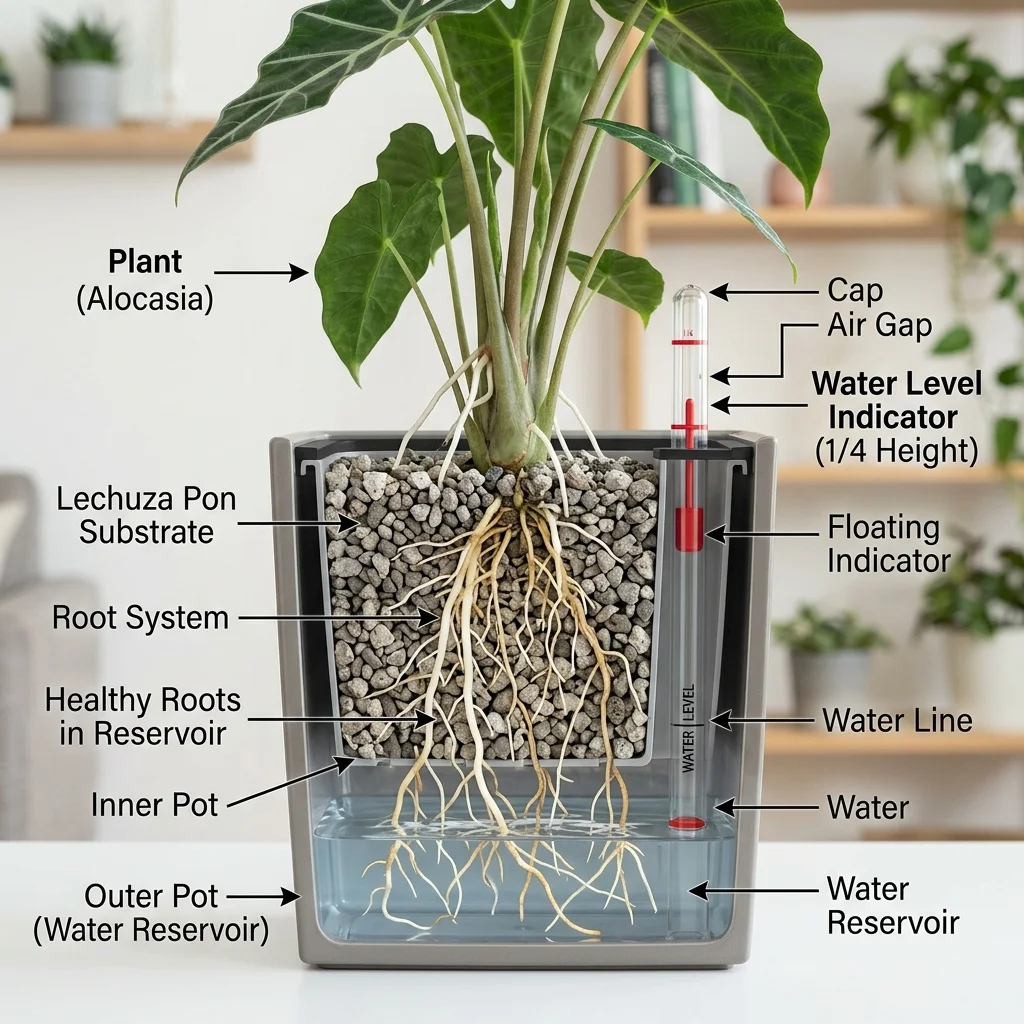
Inorganic mineral substrates do not compress or settle the way soil does. If you underestimate the volume, roots and crowns sit too low in the pot. If you overestimate, you waste expensive mineral media. Before planting, read our semi-hydroponics with Pon guide to understand how capillary wicking works, then use this calculator to size your purchase.
Why Cylinder Formulas Fail for Tapered Pots
Most nursery pots and planters narrow toward the base so they drain well and release from molds. The standard cylinder formula assumes the base is as wide as the rim, so it overestimates the volume of any tapered pot. For the 15 cm preset below, a cylinder at the top diameter would give about 2.47 L, against a true 1.87 L, an overestimate of roughly a third. The error is smaller for gently tapered pots and larger for steep ones.
The Geometry: Conical Frustum Volume
The calculator models the pot as a conical frustum, a cone with its tip cut off:
$$V = \frac{\pi \cdot h}{12} \left(D_{\text{top}}^2 + D_{\text{top}} \cdot D_{\text{bottom}} + D_{\text{bottom}}^2\right)$$
Measure the inside diameters at the rim and at the floor, and the internal height from floor to rim. For a heavily rooted plant such as Monstera deliciosa, raise the root displacement percentage so you do not overfill the pot. Enter the same top and bottom diameter for a straight-sided pot, and the formula becomes a cylinder.
The 3:2:1 Mineral Split
Commercial premixes are convenient, but mixing your own with our DIY Pon recipe is cheaper when you repot many plants. The classic blend uses three mineral components screened to 3–6 mm:
- Pumice (50%, 3 parts): a light, porous structural base that keeps the mix airy and wicks water without compacting.
- Zeolite (33.3%, 2 parts): a mineral with high cation exchange capacity that holds nutrient ions such as ammonium, potassium and magnesium, which helps buffer fertiliser swings.
- Lava rock (16.7%, 1 part): adds weight to anchor top-heavy plants and contributes fine pores.
The equal-parts and 2:1:1 options trade zeolite and lava for more or less pumice. If you are choosing between clay pebbles and mineral stone, compare them in our LECA vs Pon guide.
Reservoir Depth: Preventing Collar Rot
Passive semi-hydroponics relies on capillary rise: water climbs through the fine pores of the granules while air moves through the gaps between them. The water table must never reach the plant's crown or stem base.
- Standard aroids and established plants: keep the water line at about 25% (1/4) of pot height.
- Thirsty plants and warm conditions: raise it to about 33% (1/3) during peak growth.
- Newly converted plants, winter and low light: drop to about 20% (1/5), or follow the dry-start approach in our guide to converting houseplants to semi-hydro.
These are starting points. Adjust to how fast your plant uses water and how humid your room is.
Nutrients, Mass and Shelf Loading
Mineral substrates do not release organic nutrients, so plants in Pon need a regular dilute hydroponic fertiliser. Follow the concentration guidance in our semi-hydro fertiliser dosing guide and flush periodically to prevent salt buildup.
Minerals are heavy. At about 0.90 kg per litre, the 25 cm specimen tub in the reference table holds around 7 L of Pon, which is roughly 6.3 kg (14 lb) dry. Saturated, with about 0.35 kg of water per litre, it reaches roughly 8.8 kg (19 lb), before counting the plant, pot and reservoir water. Check that shelves and stands are rated for the total.
How to Use the Calculator
- Measure the internal top diameter, bottom diameter and height of your pot.
- Estimate root displacement: about 10% for small or sparse roots, 15% for average, up to 25% for root-bound plants.
- Pick a recipe, or choose Commercial Premix if you only need total volume.
- Pick a reservoir depth that suits the plant and season.
- Read the net volume, component volumes, dry weight and water line.