🧮
Calculators
🌿
Plants
💧
Watering
☀️
Sunlight
🧪
Fertilizers
🪴
Potting Mix
🎯
Quizzes
Interactive Botanical Engine

Paludarium Water Volume Calculator: Gallons & Liters

Calculate the gross aquatic zone volume and estimate net usable water volume of a paludarium in gallons and litres. Deduct foundation and hardscape displacement.

Botanical Console Engine // SYS.2.5
ONLINE
Calibration Controls
7 Parameters
Measurement units
1100
Length in cm
1100
Width in cm
1100
Depth in cm
0100
Volume in Liters
0100
Volume in Liters
0100
Volume in Liters
Diagnostic Telemetry
Console Standby

Awaiting Parameter Calibration

Adjust parameters in the left console to initiate real-time telemetry and biological safety verification.

Botanical Reference Framework

Target Cultivation Range & Stress Boundaries

General horticultural guideline thresholds for balanced moisture, transpiration, and nutrient uptake under typical growing conditions.

Target RangeStandard Growth Zone

Balanced conditions supporting steady vegetative development and normal transpiration.

Caution BoundarySub-Optimal / Watch Zone

Early indicators of environmental drift; monitor substrate moisture, airflow, or light exposure.

Critical ThresholdElevated Stress Risk

Conditions outside recommended parameters; increased risk of root rot, dehydration, or scorched foliage.

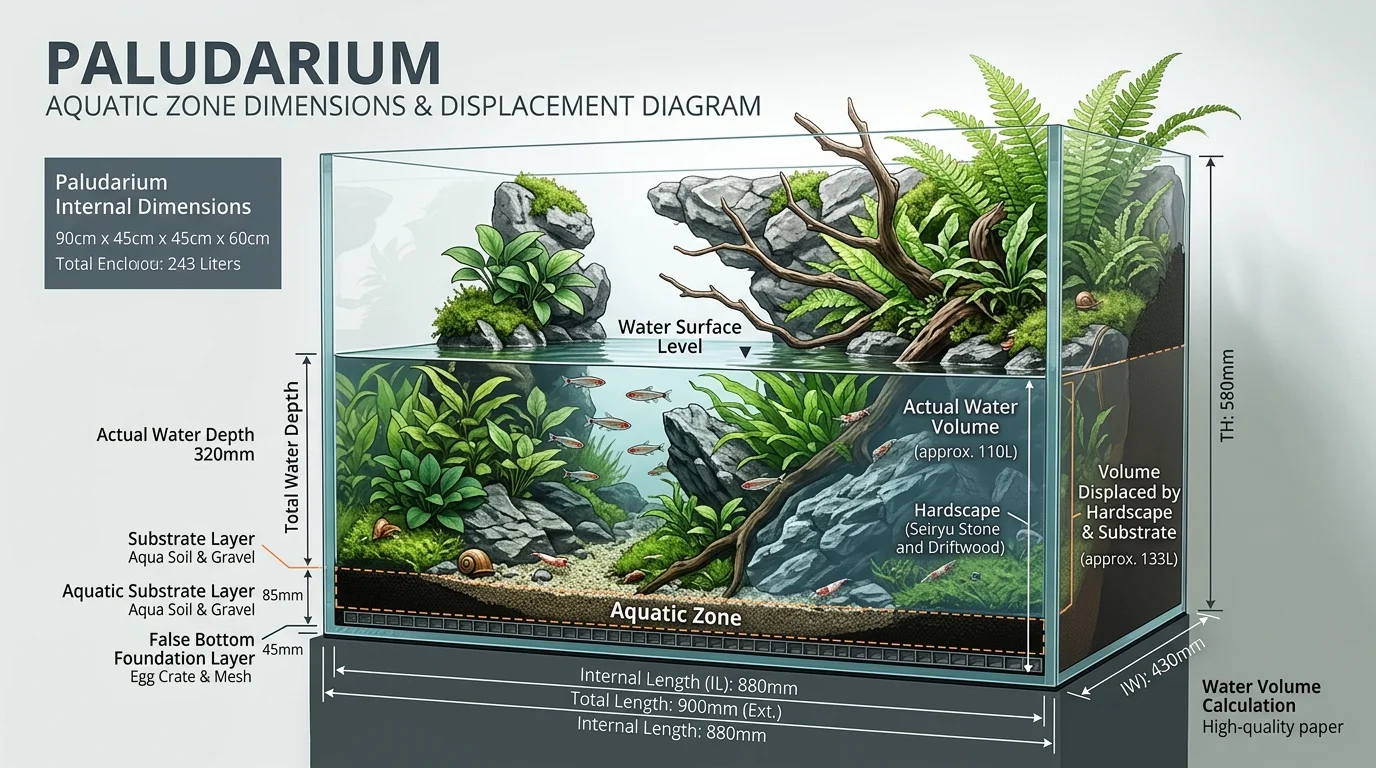
Paludarium Aquatic Zone Dimension and Displacement Diagram
Diagram illustrating internal aquatic zone dimensions (Length, Width, Water Depth) and displacement components (Foundation, Substrate, Hardscape) in a paludarium.

What this calculator measures

A paludarium is a hybrid ecosystem combining terrestrial land sections with an aquatic zone. Because water fills only a fraction of the enclosure and because land foundations, substrate layers, and hardscapes occupy significant space inside the water column, the actual usable water volume is far lower than outer tank dimensions suggest.

This calculator determines the gross geometric aquatic volume of your water column and estimates your net usable water volume by explicitly deducting displacement from foundations, substrates, and hardscape features.

Understanding the inputs & dimensions

To get an accurate result, enter the following key dimensions into the calculator above:

  • Internal Length (in / cm): The inside length of the water-holding section (excluding glass thickness and dry land side barriers).
  • Internal Width (in / cm): The inside width from front to back glass within the aquatic zone.
  • Actual Water Depth (in / cm): The vertical distance from the top surface of the main substrate bed up to the water line. Do not measure total tank height.
  • Foundation Displacement (gal / L): Optional volume consumed by false bottoms, egg crate grids, PVC risers, or drainage bricking submerged in the water column.
  • Substrate Displacement (gal / L): Optional volume of extra gravel or aqua soil banked up inside the measured free-water column.
  • Hardscape Displacement (gal / L): Optional volume of submerged Seiryu stone, dragon stone, lava rock, or driftwood occupying water space.

Common paludarium setups & reference values

If you are planning a build or estimating volume before filling your enclosure, use these standard reference values as baseline benchmarks for common paludarium tank sizes:

← Scroll horizontally to inspect full matrix →
Tank Type / EnclosureDimensions (L × W × Depth)Gross Water VolumeEst. DisplacementNet Usable Water Volume
10 Gallon Nano Paludarium19.5 in × 9.5 in × 5.0 in4.01 US gal (15.18 L)0.80 US gal (3.03 L)~3.21 US gal (12.15 L)
20 Gallon Long Paludarium29.5 in × 11.5 in × 6.0 in8.81 US gal (33.35 L)1.80 US gal (6.81 L)~7.01 US gal (26.54 L)
40 Gallon Breeder Paludarium35.5 in × 17.5 in × 7.0 in18.83 US gal (71.28 L)3.80 US gal (14.38 L)~15.03 US gal (56.90 L)
55 Gallon Standard Paludarium47.5 in × 12.5 in × 8.0 in20.56 US gal (77.83 L)4.50 US gal (17.03 L)~16.06 US gal (60.80 L)

How to measure irregular hardscape displacement

Rocks, driftwood, and custom foam backgrounds have complex, irregular shapes. The easiest way to measure their true displacement volume is the bucket displacement method:

  • Fill a bucket with a known baseline volume of water.
  • Completely submerge the rock or wood piece.
  • Note the new water level. The difference in volume is the exact displacement of that piece.

Frequently Asked Questions

How do I calculate paludarium water volume?

Measure the internal length, internal width, and actual free-water depth from the top of the substrate. Multiply these three dimensions together to find the gross geometric volume, then subtract the volume displaced by any hardscape, additional substrate, or foundations extending into that free water.

Should I measure the full tank height?

No. You should only measure the actual depth of the free water, not total enclosure height.

How do I calculate paludarium volume in gallons and litres?

First find the volume in cubic inches by multiplying length (in) × width (in) × water depth (in). Divide cubic inches by 231 to get US gallons. Multiply US gallons by 3.78541 to get litres. This calculator does these conversions automatically.

What is the difference between gross and net water volume?

Gross geometric aquatic volume is the rectangular water volume represented by the entered internal length, width, and actual water depth. Net usable water volume is the estimated actual liquid remaining after subtracting the space taken up by solid objects within that water column.

How should I account for rocks and hardscape?

Use a bucket of water with known volume markers to measure the exact amount of water displaced when you submerge the irregular rock or driftwood piece, then enter that displacement volume into the calculator. Only account for the portion that sits in the free-water column.

Should aquatic substrate count as displacement?

Since you measure the free-water depth from the top of the main substrate layer, that base substrate is already excluded from the gross volume. You should only enter substrate displacement if you have additional substrate banked up into the measured free-water column.

What if the aquatic zone has an irregular shape?

This calculator uses a rectangular geometric model. For curved or multi-tiered shorelines, the best approach is to divide the aquatic area into multiple simpler rectangular sections, calculate the volume of each separately, and add them together, taking care not to double-count substrate.

Companion Ecosystem

Related Plant Calculators

3 Tools